
Fluorine-Lined Butterfly Valve Selection Guide
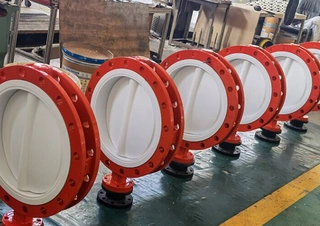
A fluorine-lined butterfly valve is a specialized valve designed for conveying corrosive media. Its core feature is a fluoroplastic lining that covers the surfaces of cast steel or stainless steel components, such as the valve body and disc, that come into contact with the fluid. This design completely isolates the metal parts from corrosive liquids, fundamentally solving corrosion challenges faced by industries such as chemical processing, petroleum, and pharmaceuticals.
Compared with standard butterfly valves, the opening and closing element of a fluorine-lined butterfly valve is a disc structure. All wetted flow components, including the inner wall of the valve body, the disc surface, and the seat sealing surface, are lined with a relatively thick fluoroplastic layer. This structure not only delivers exceptional corrosion resistance but also provides good wear resistance, making it one of the most widely used valve types in anti-corrosion equipment today.
Core Advantages of Fluorine-Lined Butterfly Valves
The widespread use of fluorine-lined butterfly valves in highly corrosive environments stems from their unique technical characteristics:
- Complete Corrosion Isolation: The fluoroplastic lining fully separates the metal substrate from the medium, preventing both electrochemical and chemical corrosion.
- Zero-Leakage Sealing: The valve seat and disc are manufactured entirely from PTFE. Combined with precision machining, they can achieve a zero-leakage sealing grade that meets environmental and safety requirements.
- Long Service Life: High-quality fluoroplastics offer excellent aging resistance. Under proper selection and operating conditions, their service life is significantly longer than that of metal valves.
- Broad Media Compatibility: These valves can withstand concentrated sulfuric acid, hydrochloric acid, nitric acid, hydrofluoric acid, aqua regia, various organic acids, strong acids, oxidizing media, high-temperature concentrated sulfuric acid, high-temperature acetic acid, alternating acid–alkali media, and many organic solvents.
Performance Comparison and Selection of Fluoroplastic Linings
The performance of a fluorine-lined butterfly valve largely depends on the fluoroplastic material used. Differences in temperature resistance, corrosion resistance, and mechanical properties among fluoroplastics are significant, making correct lining selection a critical step.
1. Fluorinated Ethylene Propylene (FEP, F46)
F46 is currently the most commonly used material in fluorine-lined valves.
- Applicable media: Any organic solvent or reagent; dilute or concentrated inorganic acids; alkalis; ketones; aromatic hydrocarbons; chlorinated hydrocarbons, etc.
- Temperature range: -85°C to 150°C (up to 150°C for short periods; recommended below 120°C for long-term use)
- Performance: Mechanical, electrical, and chemical stability comparable to PTFE, but with higher impact toughness and excellent weather and radiation resistance
- Cost advantage: Moderately priced with strong cost performance
- Important limitation: When the medium temperature exceeds 120°C for extended periods or briefly surpasses 150°C, F46 can soften and deform, leading to poor sealing and increased leakage. In such cases, a higher-grade material must be selected.
2. Perfluoroalkoxy (PFA)
When operating temperatures exceed the range suitable for F46, PFA is an ideal alternative.
- Temperature range: -85°C to 180°C (up to 180°C short-term; up to 150°C for continuous use)
- Performance: Retains the excellent properties of PTFE while offering the processing advantages of thermoplastics
- Cost consideration: More expensive than F46-lined valves but often the only economically viable solution for high-temperature conditions
3. Polytetrafluoroethylene (PTFE, F4)
PTFE offers the best overall performance among fluoroplastics.
- Applicable media: Nearly all corrosive media, including strong acids, strong alkalis, and strong oxidizers
- Temperature range: -200°C to 180°C
- Core advantages: Outstanding chemical stability, excellent heat and cold resistance, extremely low friction coefficient, and superior self-lubrication
- Limitations: Lower mechanical strength, poor flowability, high thermal expansion coefficient, and relatively difficult processing
4. Polychlorotrifluoroethylene (PCTFE, F3)
F3 provides unique advantages under certain operating conditions.
- Applicable media: Various organic solvents and inorganic corrosive liquids (oxidizing acids)
- Temperature range: -195°C to 120°C
- Performance: Thermal resistance, electrical properties, and chemical stability second only to F4, while mechanical strength, creep resistance, and hardness exceed those of F4
5. Other Optional Materials
- Polyvinylidene Fluoride (PVDF, F2): Resistant to most chemicals and solvents; operating temperature -70°C to 100°C. Offers better tensile and compressive strength than F4. Its greatest advantage is toughness and ease of forming.
- Polypropylene (RPP): Suitable for aqueous solutions of inorganic salts, inorganic acids, and alkalis; operating temperature -14°C to 80°C. One of the lightest plastics, featuring excellent rigidity, good heat resistance, and low cost, though with a narrower temperature range.
- Polyolefin (PO): Suitable for acids, alkalis, salts of various concentrations, and certain organic solvents; operating temperature -58°C to 80°C. Considered one of the most ideal anti-corrosion materials worldwide and widely used for lining large equipment and piping components.
Key Selection Parameters and Considerations
After understanding the differences among fluoroplastics, users often face a critical question: how to precisely match material properties with actual operating conditions? Many valve failures are not caused by material defects but by mismatched selection parameters. Therefore, beyond choosing the lining material, the following factors must be systematically evaluated.
1. Temperature Control
Temperature is the primary limiting factor in valve selection. Users must clearly distinguish between:
- Instantaneous temperature: The highest temperature the valve may encounter briefly
- Continuous temperature: The normal operating temperature during long-term service
For F46-lined valves, even if instantaneous temperature does not exceed 150°C, continuous operation above 120°C can still cause softening and deformation, eventually leading to improper sealing. In such cases, switching to PFA, despite higher cost, can prevent total valve failure.
2. Media Cleanliness
Fluoroplastics have relatively low hardness, an inherent limitation of lined valves. Selection must evaluate whether the medium contains:
- Hard solid particles
- Crystalline substances
- Mechanical impurities
If present, standard fluorine-lined butterfly valves are unsuitable. During operation, particles may wear through the lining on the valve core, seat, or PTFE bellows, causing failure.
Solution: Choose valves with corrosion-resistant alloy cores and seats, such as INCONEL, MONEL, or Hastelloy. Although more expensive, these alloys provide both corrosion and wear resistance and are the only reliable choice for particle-containing media.
3. Pressure and Differential Pressure Control
Pressure and differential pressure must remain within allowable limits. Excessive values can over-compress sealing components during operation, damaging sealing surfaces and severely affecting performance.
General principle: When pressure and temperature exceed certain thresholds, metal-seated butterfly valves are recommended instead of forcing the use of a lined structure.
4. Flow Rate and Diameter Calculation
The flow coefficient (Cv) of fluorine-lined butterfly valves is slightly lower than that of standard wafer and flanged butterfly valves, making precise calculation essential.
Calculation steps:
- Determine the required flow (Cv) based on process requirements
- Calculate the appropriate diameter using technical parameters
- Evaluate the valve's opening range
Common mistake: Selecting an oversized valve that operates at a small opening for extended periods. Combined with media pressure, this can cause severe impact and vibration on the valve core and stem, potentially leading to stem fracture.
Best practice: Ensure a reasonable opening during normal operation (generally 30%–70%) and avoid continuous operation below 20%.
5. Restrictions Under Vacuum Conditions
Fluorine-lined valves must not be used in pipeline vacuum conditions. Negative pressure can pull the lining outward (bulging) or cause delamination, resulting in operational failure or complete valve malfunction.
If vacuum conditions are possible, consult the manufacturer for special structural designs or consider alternative valve types.
Connection Methods and Actuator Selection
The choice of connection method and actuator affects not only installation convenience but also sealing reliability and long-term stability. After determining materials, diameter, and operating compatibility, the connection form and automation scheme must be evaluated.
1. Connection Types
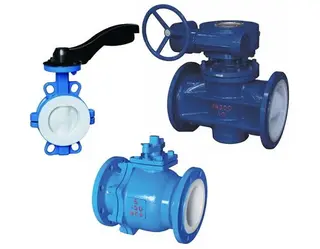
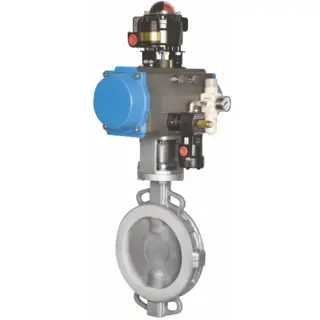
Wafer-Type Fluorine-Lined Butterfly Valve: Compact structure, lightweight, minimal installation space, suitable for pipelines with flanges on both ends, and relatively cost-effective.
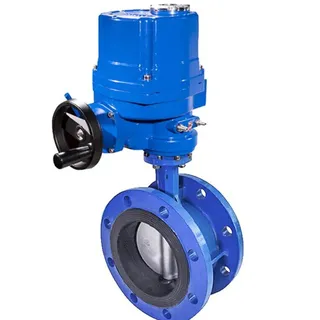
Flanged Fluorine-Lined Butterfly Valve: Equipped with flanges on both ends for easier installation and higher sealing reliability, making it suitable for critical or high-pressure applications.
2. Actuator Types
Depending on control requirements, options include:
- On-off actuators: Enable rapid shutoff for two-position control (fully open/fully closed).
- Modulating actuators: Provide proportional flow regulation for processes requiring precise control.
Actuator selection should consider power type (electric, pneumatic, hydraulic), explosion-proof requirements, control signal type, and other technical parameters.
Comprehensive Evaluation of Complex Media
Industrial corrosive media are often mixtures rather than single acids, bases, or salts. This complexity makes lining selection more challenging and requires consideration of:
- Liquid composition ratios
- Concentration levels
- Operating temperature
- Particle size and content
- Flow velocity
Users are advised to provide detailed media information before selection and communicate thoroughly with the manufacturer's technical department. When necessary, material corrosion testing should be conducted to ensure correct selection.
Conclusion: Selection Decision Process
Proper fluorine-lined butterfly valve selection should follow these steps:
- Clarify media characteristics: composition, concentration, temperature, solids content, toxicity, flammability, and viscosity
- Determine process parameters: operating pressure, differential pressure, flow requirements, and pipeline size
- Select lining material: choose F46, PFA, or other materials based on temperature and corrosiveness
- Evaluate structural form: fully lined or partially lined; wafer or flanged
- Determine actuation method: on-off or modulating; power type
- Verify critical limits: presence of hard particles, vacuum conditions, temperature compliance
- Calculate valve diameter: determine specifications using Cv values to avoid oversizing or undersizing
When operating conditions exceed standard technical limits, users must communicate with the manufacturer to develop a joint solution. Blind selection under uncertain conditions should be avoided, as it may lead to premature valve failure and compromise production safety.
Through scientific and rational selection, fluorine-lined butterfly valves can achieve long-term stable operation in highly corrosive environments, providing reliable protection for safe production in industries such as petroleum, chemical processing, and pharmaceuticals. By mastering these selection principles, users can identify the most suitable valve for complex operating conditions and achieve the optimal balance between economic efficiency and operational reliability.
Send your message to this supplier
Related Articles from the Supplier
Fluorine-Lined Butterfly Valve Selection Guide
- Feb 12, 2026
Related Articles from China Manufacturers

Related Products Mentioned in the Article

Supplier Website
Source: https://www.bossealvalves.com/news/fluorine-lined-butterfly-valve-selection-guide.html