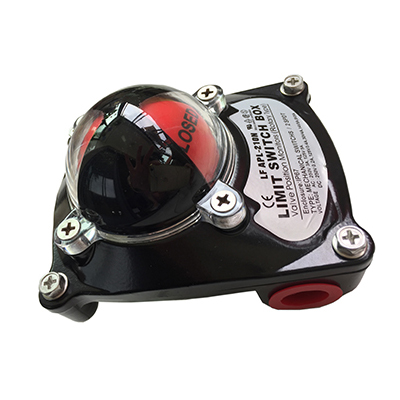
Valve Limited Switch
Model Number: YV-VLS-01
Key Specifications / Features
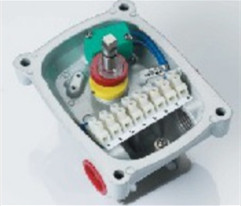
China Valve Limited Switch Manufacturer offers Mechanical Valve Limited Switch SS5GL/SS10GL, Proximity Sensor NJ2-V3-N, Switch dimension, Namur bracket.
Detail Information
Valve Limited Switch Features: 
-Solid and compact design.
Aluminium die-casting housing and powder coating.
-Bolts on visual position indicator.
-Quick-set” cam
Spring loaded splined cam.
No need to adjust again after initial setting.
Easy setting without tool.
-Dual cable entries.
2 x 1/2 NPT(Standard ) M20,PG13.5,PF1/2”,PT1/2".(Option).
-Captive cover bolts.
worry to loose bolts while cover open.
-Easy mounting bracket.
NAMUR standard stainless steel shaft and bracket.

-Solid and compact design.
Aluminium die-casting housing and powder coating.
-Bolts on visual position indicator.
-Quick-set” cam
Spring loaded splined cam.
No need to adjust again after initial setting.
Easy setting without tool.
-Dual cable entries.
2 x 1/2 NPT(Standard ) M20,PG13.5,PF1/2”,PT1/2".(Option).
-Captive cover bolts.
worry to loose bolts while cover open.
-Easy mounting bracket.
NAMUR standard stainless steel shaft and bracket.
| SPECIFICATION | STANDARD | OPTION | MATERIAL | |
| Enclosure | Weatherproof IP67/NEo MA4&4X | IP 68 | Housing cover&body | Aluminium die casting |
| Ambient temperature | -20 ℃ ~ 80 ℃ | |
Shaft | Stainless steel |
| Indicator cover | Polycarbonate | |||
| Conduit entries | Two NPT1/2” | Two PF1/2”,PT1/2” M20,PG13.5 | Indicator | ABS/Polycarbonate |
| Terminal Strips | 8 points (0.08-2.5mm²) | Cam | Polycarbonate | |
| Position indicator | 0° ~ 90° (90° turn free join) close:red open:yellow |
0 ~ 90° close:red open:green |
Spring | Stainless steel |
| Housing cover bolt | Stainless steel | |||
| Switches | Mechanical switch x2 proximity sensor x2 |
O -ring | NBR | |
| Bushing | Bronze | |||
| External coating |
Polyester podwer coating(black) |
Nylon others on request red,green,blue, yellow,silver, |
E-ring(shaft) | Stainless steel |
| Earth lug | Stainless steel | |||
| Shaft | Standard shaft(83mm/16mm) | Option shaft(FREE) | Bracket | Stainless steel |
Position indicator 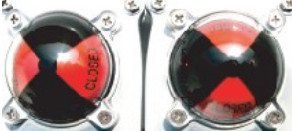 Re-adjustment available upon required direction |
Conduit entries 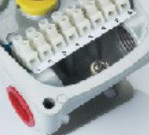 Cable entry due to length and thickness |
||
 |
90° Closed or Open for rotary application 90°Open or Closed for rotary application 45° Open or Closed for linear application |
Captive cover bolts 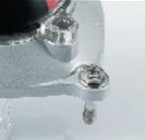 cover bolts are specially designed to prevent loosing it during maintenance or installation. |
|
| Switch Specifition | |
| Mechanical switch (2SPDT) APL-210N | Proximity sensor APL-220N |
-APL-210N.jpg) |
 |
| Standard switch : SS5GL(Omron) 2SPDT switches (option: spst-nc, spst-no) Contact arrangement: 250V AC/3A, 125V AC/5A 250VDC/0.2A , 125VDC/0.4A, 30VDC/4A, Optional switch: SS10GL(Omron) 2SPDT switches (option: spst-nc, spst-no) Contact arrangement: 250V AC/10.1A, 125V AC/10.1A 250VDC/0.2A , 125VDC/0.4A, 30VDC/4A, Approved standards:UL,CSA,SEMKO,SEV EN61058-1 |
Standard sensor : NJ2-V3-N (P&F) Inductive proximity sensor (intrinsically safe) Voltage range: 8V DC ( IP67 to IEC 60529) Operating distance: 2mm Optional sensor EMC to EN60947-5-2 NBB2-V3-E2/E3(PNP): 10 - 30V DC Operating distance: 2mm NBB2-V3-E0 (NPN): 10 - 30V DC Operating distance: 2mm NBB3-V3-Z4/Z5: 5 - 60V DC Operating distance: 3mm |
| Bracket ( NAMUR Standard ) | Model No | Material | Application |
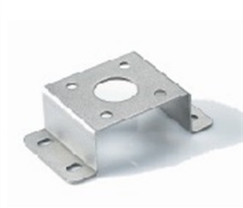 |
MBP-100 | Stainless steel | 30x80 h20 |
| MBP-200 | Stainless steel | 30x80 h30 | |
| MBP-300 | Stainless steel | 30x130 h30 | |
| MBP-400 | Stainless steel | 30x130 h50 |
Supplier Information
Shanghai YAAO valve CO., LTD.
Verified Supplier
NO. 111, Caoli Road, Fengjing Town, Jinshan District, Shanghai, China.
Est. 1991
Certifications:
ISO 9001

ya**********01
540 article(s)
Comments
Leave a Comment