How to Choose a Rising Stem Ball Valve Supplier in China

In modern industrial piping systems, valve selection directly affects operational safety, efficiency, and long-term maintenance costs. Among the many advanced valve types used in critical applications, the Rising Stem Ball Valve (RSBV) has gained increasing attention due to its unique structure, superior sealing performance, and excellent durability under extreme operating conditions.
China has become one of the world's leading manufacturing hubs for industrial valves, offering a wide range of suppliers with different technical strengths, production capacities, and market focuses. However, selecting a reliable Rising Stem Ball Valve supplier in China requires a deep understanding of product design, manufacturing standards, material capabilities, and supplier credibility.
This article provides a comprehensive industry guide on Rising Stem Ball Valves and explains how to choose the right Chinese supplier for long-term industrial cooperation.
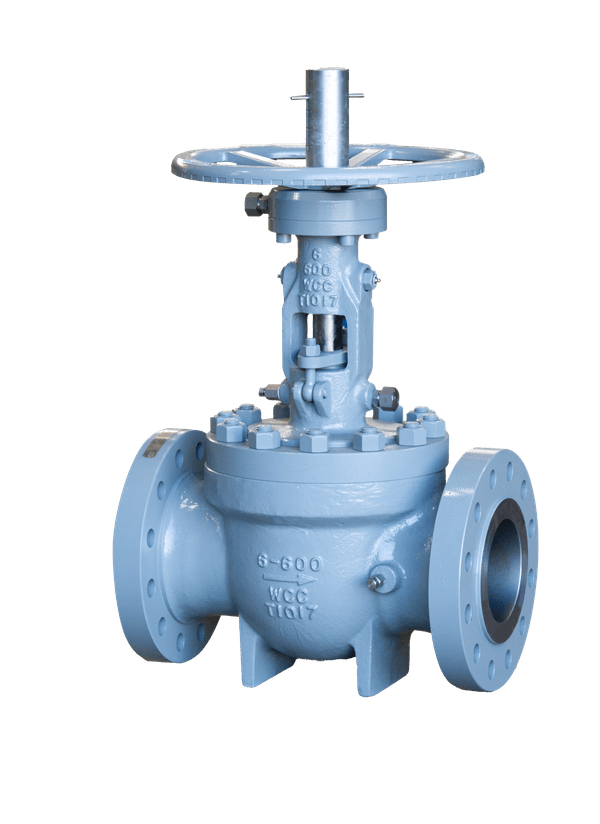
A Rising Stem Ball Valve (RSBV) is an advanced evolution of the traditional ball valve. Its most distinctive feature is the rising stem mechanism, which combines linear and rotary motion to lift the ball away from the seat before rotation.
Unlike conventional ball valves where the ball rotates directly against the seat, the rising stem design minimizes friction between sealing surfaces. This structural improvement significantly reduces wear, enhances sealing reliability, and extends service life.
Rising stem ball valves are widely recognized for:
- Visual position indication (stem rises when valve opens)
- Low friction operation
- Extended sealing lifespan
- High-performance sealing under extreme pressure and temperature
- Reduced torque requirement
- Suitable for automation systems
Advanced designs often feature all-metal sealing structures and fire-safe configurations, making them suitable for critical industries such as oil & gas, petrochemical processing, power generation, and cryogenic engineering.
High-quality rising stem ball valves can operate under extreme conditions such as:
- Temperature range: -196°C to 600°C
- Media compatibility: water, steam, hydrocarbons, acids, solvents
- Special media handling: oxygen, hydrogen peroxide, methane, ethylene, and other reactive gases
This versatility makes them an essential component in high-risk and high-precision industrial systems.
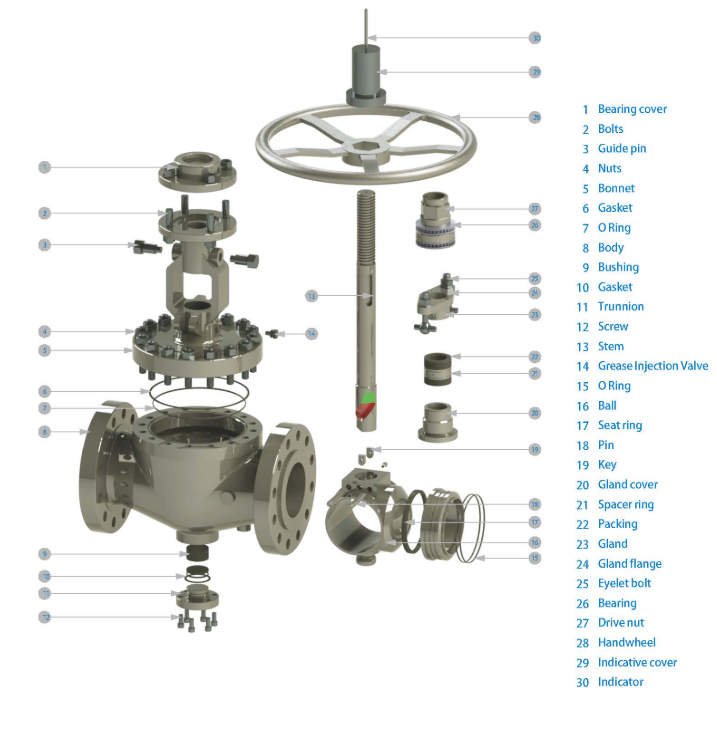
To fully understand how rising stem ball valves function, it is essential to analyze their core components and structural design.
The ball is the central shut-off component with a precision-machined bore through its center. Its function is to control flow by rotating 90 degrees:
- Open position: bore aligns with pipeline → fluid flows freely
- Closed position: solid side blocks flow → tight shut-off
The ball is usually made of stainless steel or coated alloy materials to resist corrosion and wear.
The stem connects the actuator or handle to the ball. In rising stem designs:
- The stem moves linearly upward and downward
- It also provides rotational force transmission
- The rising motion visually indicates valve status
This dual-motion system eliminates direct friction between ball and seat during operation.
Seats are positioned on both sides of the ball and ensure tight sealing when the valve is closed.
Common seat materials include:
- PTFE (polytetrafluoroethylene)
- Reinforced PTFE (RPTFE)
- Metal-to-metal sealing for high temperature applications
Seat selection determines chemical resistance, temperature tolerance, and sealing performance.
The valve body contains all internal components and connects the valve to pipeline systems. It is typically manufactured from:
- Carbon steel
- Stainless steel
- Alloy steel
- Special corrosion-resistant alloys
The choice depends on pressure class, temperature conditions, and fluid characteristics.
The working principle of a rising stem ball valve combines rotational motion and axial lifting, creating a low-friction sealing mechanism.
When the valve begins to open, the stem first lifts the ball slightly away from the seat
- Once lifted, the stem rotates the ball 90 degrees
- This movement aligns the bore with the pipeline
- Fluid passes through with minimal resistance
During closing:
- The stem rotates the ball back to its original position
- The ball gradually lowers into sealing contact with the seats
- A tight shut-off is achieved without scraping friction
This mechanism provides several engineering advantages:
- Zero seat abrasion during operation
- Self-cleaning effect reduces particle buildup
- Low torque operation reduces actuator load
- Longer service life compared to conventional ball valves
- Better performance under high-cycle operation systems
These advantages make rising stem ball valves highly suitable for automation and precision flow control systems.
China plays a dominant role in the global industrial valve supply chain due to:
- Large-scale manufacturing capabilities
- Advanced machining and CNC technology
- Competitive production costs
- Strong export infrastructure
- Mature industrial clusters (especially Zhejiang and Jiangsu)
Chinese valve manufacturers supply products to North America, Europe, the Middle East, Southeast Asia, and South America, covering nearly all industrial sectors.
However, supplier capability varies significantly, making selection strategy extremely important.
Below are some representative suppliers in the Chinese industrial valve market.
ZHEJIANG VERVO VALVE CO., LTD is one of the established Chinese industrial valve manufacturers specializing in a wide range of high-performance valve products.
Product Portfolio
The company manufactures:
- Floating ball valves
- Trunnion-mounted ball valves
- Cast steel gate valves
- Forged steel gate valves
- Pressure seal gate valves
- Globe valves (cast and forged)
- Cryogenic valves
- Check valves
- Butterfly valves (API 609)
- Plug valves
- Y-strainers
Market Coverage
The company serves global markets including:
- North America
- South America
- Europe (Western & Eastern)
- Middle East
- Southeast Asia
- Africa and Oceania
Strengths
- Broad product range for industrial applications
- Strong export experience
- Capability in high-pressure and special valves
- Compliance with international standards
KOSEN Valve Co., Ltd is a professional valve manufacturer integrating R&D, production, testing, sales, and after-sales service.
Manufacturing Base
Located in Oubei, Zhejiang—one of China's most important valve production hubs—the company operates advanced machining facilities covering approximately 6,000 m².
Product Range
- Ball valves
- Gate valves
- Globe valves
- Check valves
- Plug valves
- Butterfly valves
- Strainers
Material Capability
The company specializes in advanced materials such as:
- Carbon steel
- Stainless steel
- Cr-Mo steel
- Duplex stainless steel
- Hastelloy C
- Monel
- Inconel alloys (INL625, INL825)
- Cryogenic-grade steels
Strengths
- Strong material engineering capability
- High-performance alloy processing
- Comprehensive product testing system
- Suitable for demanding chemical and energy industries
Baltic Valve Co., Ltd is a well-established valve supplier with over 15 years of experience in the global valve market.
Business Focus
The company is known for:
- Stable product quality
- Strong technical support
- Responsive customer service
- International trade expertise
Product Line
- Ball valves
- Plug valves
- Gate valves
- Globe valves
- Check valves
- Strainers
Key Products
- Double Block and Bleed (DBB) ball valves
- Monoflange valves
- Custom valve solutions
Export Markets
- South America
- Europe
- South Africa
- Middle East
Strengths
- Strong customization capability
- Experienced export team
- Reliable quality control system
- Competitive pricing for international buyers
Selecting the right supplier requires evaluating multiple technical and commercial factors.
A reliable supplier should have:
- CNC machining centers
- Precision assembly lines
- Heat treatment facilities
- Pressure testing systems
Strong manufacturing capability ensures product consistency and reliability.
Rising stem ball valves are often used in extreme environments, so material selection is critical.
Look for suppliers capable of handling:
- Cryogenic materials (-196°C service)
- High-temperature alloys (up to 600°C)
- Corrosion-resistant stainless steels
- Duplex and super duplex steels
- Nickel-based alloys
High-quality suppliers should comply with:
- API standards
- ASME standards
- ISO quality management systems
- Fire-safe certification requirements
Standard compliance ensures global compatibility and safety.
A strong QC system should include:
- Raw material inspection
- Dimensional testing
- Pressure testing (shell & seat tests)
- Leakage testing
- Non-destructive testing (NDT)
Without strict QC, valve reliability cannot be guaranteed.
Industrial applications often require customized valve solutions.
A strong supplier should offer:
- OEM/ODM services
- Engineering customization
- Special material selection
- Design optimization for specific applications
Suppliers with global experience better understand:
- Documentation requirements
- International shipping logistics
- Compliance with regional regulations
- After-sales technical support
While price is important, buyers should avoid selecting suppliers based only on cost.
A reliable evaluation includes:
- Product durability
- Maintenance cost
- Service life
- Warranty and support
Rising stem ball valves are widely used in:
- Oil and gas pipelines
- Petrochemical refineries
- Power generation systems
- Cryogenic storage systems
- Pharmaceutical production
- Hydrogen energy systems
- Chemical processing plants
Their ability to handle extreme pressure and temperature makes them ideal for critical infrastructure.
The industry is evolving toward:
- Smart valve automation systems
- IoT-enabled condition monitoring
- Low-emission sealing technologies
- Advanced corrosion-resistant materials
- Higher efficiency actuator integration
Chinese manufacturers are increasingly investing in digital manufacturing and intelligent valve systems.
Choosing the right Rising Stem Ball Valve supplier in China requires a comprehensive evaluation of manufacturing capability, material expertise, quality control systems, and international experience.
Companies such as ZHEJIANG VERVO VALVE CO., LTD, KOSEN Valve Co., Ltd, and Baltic Valve Co., Ltd represent different strengths within the Chinese valve manufacturing ecosystem—from large-scale production to advanced material engineering and export-focused customization.
Ultimately, the best supplier is not only the one that offers competitive pricing, but the one that ensures long-term reliability, technical support, and consistent product performance under demanding industrial conditions.