Winter Operation Guide for Compressors
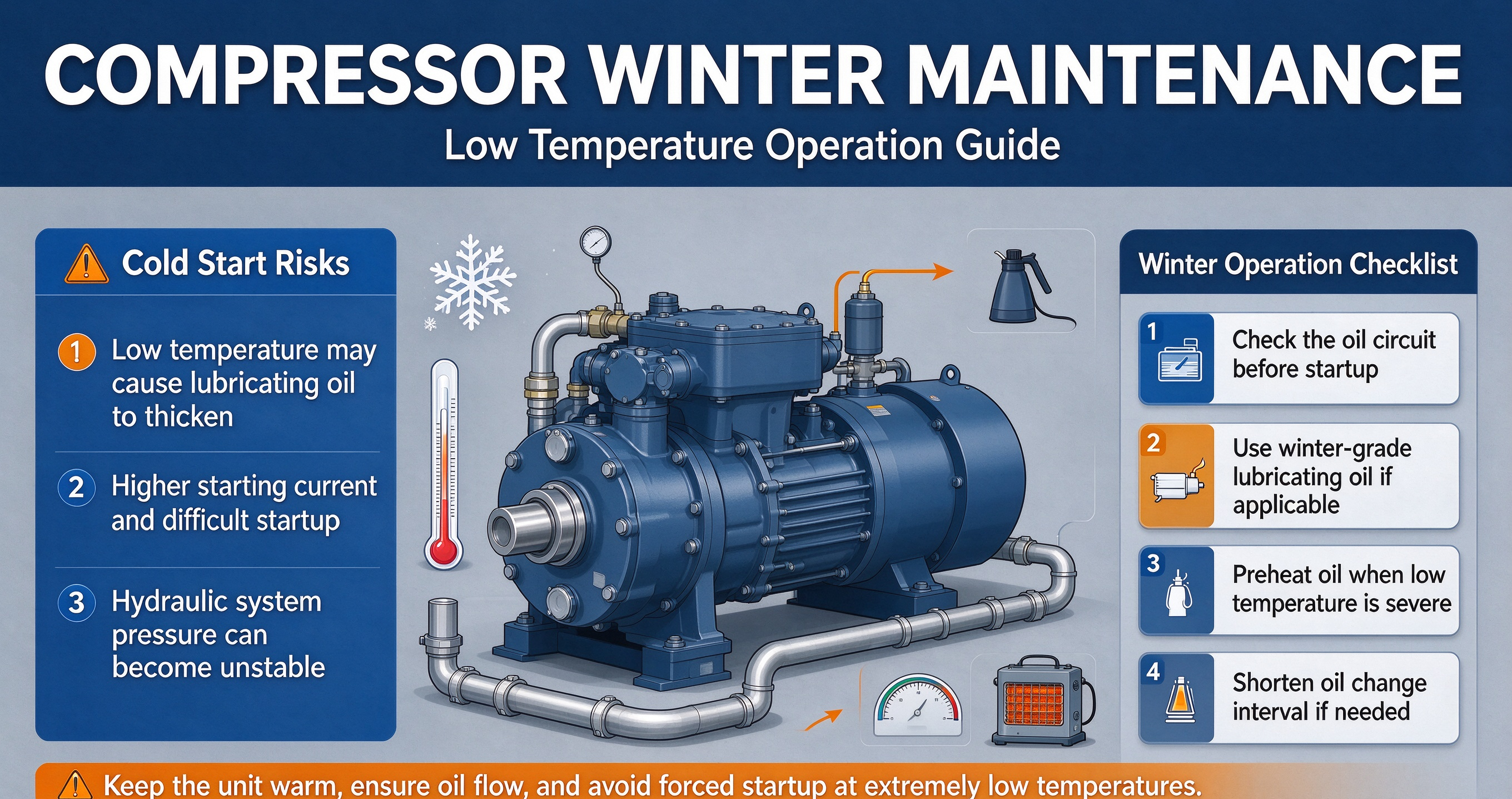
Winter can create demanding operating conditions for industrial compressors, particularly in regions where ambient temperatures remain below 0°C for extended periods. Low temperatures affect lubricating oil viscosity, battery and motor performance, condensate behavior, seals, piping, valves, and control systems. If these factors are not considered before the cold season begins, a compressor may experience difficult starting, increased energy consumption, inadequate lubrication, freezing damage, or unexpected shutdowns.
The basic mechanical principle is straightforward: most lubricants become more viscous as temperature decreases. A lubricant that flows normally at room temperature may become significantly thicker during a cold start. The compressor motor must then overcome greater mechanical resistance, while the lubrication system may require more time to establish stable oil circulation. In severe cases, insufficient lubrication during the first moments of operation can accelerate bearing, rotor, piston, or other moving-component wear.
Winter preparation should therefore begin before the first severe cold weather arrives. Operators should review the compressor manufacturer's minimum operating temperature, recommended lubricant grade, starting procedure, heater requirements, condensate management system, and protection strategy. The goal is not simply to keep the compressor warm, but to ensure that every subsystem remains within its designed operating range.
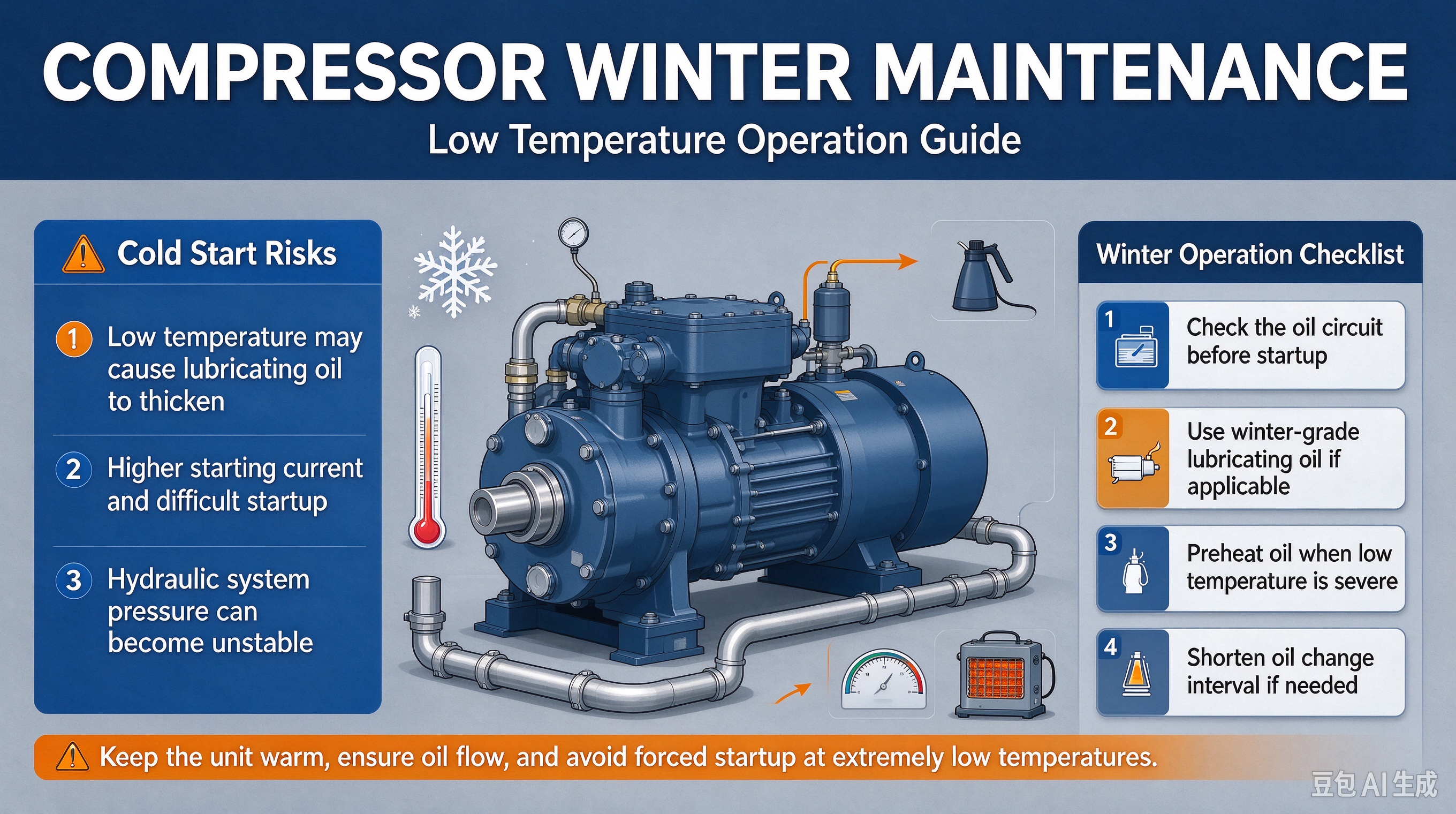
Lubricating oil is essential for reducing friction, controlling wear, removing heat, and protecting internal components from corrosion. However, viscosity is strongly influenced by temperature. As ambient temperature falls, many oils become thicker and flow less readily.
During normal operation, the compressor may generate enough internal heat to bring the lubricant to its intended operating temperature. The more difficult period is often the initial start-up after the machine has been exposed to cold conditions for several hours.
A cold compressor may therefore experience:
- Higher starting resistance
- Slower oil circulation
- Increased motor current
- Delayed lubrication of bearings and moving components
- Higher mechanical friction
- Greater wear during the initial operating period
- Longer warm-up time
The severity depends on compressor design, lubricant type, ambient temperature, oil temperature, and the condition of the lubrication system.
Winter lubricant selection should not be based simply on choosing the "thinnest" available oil. Compressor lubricants are engineered for specific applications, temperatures, loads, oxidation conditions, and material combinations.
Using an oil with an inappropriate viscosity can be just as problematic as using oil that is too viscous. Excessively low viscosity may reduce the strength of the lubricating film under operating load, while excessive viscosity can restrict circulation and increase starting torque.
Operators should therefore follow the compressor manufacturer's specified lubricant grade and temperature range. If seasonal oil changes are permitted, the selected lubricant should have suitable low-temperature flow characteristics while still providing adequate viscosity at normal operating temperature.
A compressor that has been shut down overnight in sub-zero weather should not necessarily be started immediately after power is applied. A pre-start inspection should first confirm that the lubrication, electrical, mechanical, and condensate systems are in acceptable condition.
A practical winter pre-start inspection can include:
- Check ambient and equipment temperature.
- Inspect oil level and oil condition.
- Verify that the lubricant is appropriate for the current temperature.
- Check oil heaters if installed.
- Inspect for abnormal leakage.
- Verify that air or gas discharge lines are not blocked by ice.
- Check condensate drains and separators.
- Confirm electrical supply and motor protection.
- Inspect belts, couplings, and rotating components where applicable.
- Confirm that control alarms and interlocks are functioning.
This procedure is particularly important for compressors installed outdoors or in partially enclosed buildings.
Many industrial compressors are equipped with crankcase heaters, oil heaters, separator heaters, or other temperature-control devices. Their purpose is to maintain the lubricant within an acceptable temperature range before startup.
Preheating reduces lubricant viscosity and allows the oil to circulate more readily when the compressor starts. It can also reduce the mechanical resistance imposed on the motor.
However, the heater should not be treated as a universal solution. Operators should verify that the heating system is functioning correctly and that the lubricant reaches the manufacturer's recommended pre-start temperature.
Where an external oil-heating system is used, temperature control should prevent excessive heating that could degrade the lubricant or create a safety hazard.
Cold conditions can affect the electrical side of compressor operation as well as the mechanical system. When oil becomes more viscous and mechanical resistance increases, the motor may require greater torque to accelerate the compressor.
Depending on motor type and starting method, this can result in increased starting current or a longer acceleration period.
Operators should pay particular attention to:
- Motor starting current
- Voltage stability
- Motor protection settings
- Starter or variable-frequency drive condition
- Electrical connection quality
- Control-panel heaters
- Battery condition where applicable
- Insulation condition
If a motor repeatedly struggles to start in cold conditions, simply attempting to restart it several times may create additional thermal stress. The underlying cause should be identified before repeated starting attempts are made.
Where practical, compressors should be installed in an enclosed, weather-protected environment. A properly designed compressor room provides protection from snow, freezing rain, wind, and extremely low ambient temperatures.
However, enclosure design must balance temperature protection with ventilation. Compressors generate substantial heat during operation. If ventilation is inadequate, the room can become excessively hot even during winter.
A well-designed winter compressor room should therefore provide:
- Protection against direct exposure to weather
- Adequate ventilation
- Controlled air circulation
- Drainage for condensate and melted ice
- Protection against freezing
- Adequate maintenance access
- Appropriate electrical protection
Simply closing all ventilation openings is not recommended because insufficient ventilation can cause overheating during operation.
Insulating exposed piping and components can help prevent freezing, but insulation must be applied appropriately. Oil lines, condensate drains, water lines, and compressed-air piping may require different approaches depending on their temperature and moisture conditions.
Particular attention should be given to low points and dead legs, where water can accumulate and freeze.
Compressed air contains water vapor. When compressed air cools downstream of the compressor, some of this vapor condenses into liquid water. In winter, the risk becomes more serious because collected water can freeze.
A frozen condensate drain can prevent accumulated water from leaving the compressed-air system. This can lead to higher moisture levels, corrosion, pressure losses, and even mechanical damage.
Automatic drains should therefore be inspected before winter and checked regularly during cold weather.
Common condensate drain technologies include timer-controlled drains, float-operated drains, and electronic zero-loss drains. Regardless of the design, the drain must remain functional under the expected temperature conditions.
Operators should check:
- Drain outlet condition
- Electrical power
- Heater operation where installed
- Drain valve movement
- Blockage
- Ice accumulation
- Discharge frequency
- Water accumulation upstream
If the drain outlet is exposed to freezing temperatures, additional insulation or trace heating may be necessary depending on the installation.
Condensate remaining inside compressed-air piping can freeze when pipe temperature falls below the freezing point. Ice formation may partially or completely restrict airflow.
This can produce pressure drops and interfere with pneumatic equipment. In severe cases, expanding ice can damage components or piping.
A properly designed compressed-air system should therefore minimize water accumulation through:
- Correct pipe slope
- Proper drainage points
- Adequate air treatment
- Effective moisture separation
- Insulation where appropriate
- Heat tracing in critical locations
- Elimination of unnecessary low points
The objective is to prevent liquid water from remaining in vulnerable sections of the distribution system.
Even when a pipe does not freeze completely, ice formation or partially blocked drains can increase pressure drop. Pneumatic cylinders, valves, instruments, and production equipment may then receive insufficient pressure.
The resulting symptoms may appear to be equipment failure even though the underlying problem is frozen condensate in the compressed-air network.
Air receivers collect compressed air and provide storage capacity that helps stabilize system pressure. They also provide an important location for condensate accumulation.
During winter, the receiver's drain system should be inspected carefully because water collected at the bottom can freeze.
A winter inspection should include:
- Checking receiver drain operation.
- Verifying automatic drain heating if installed.
- Inspecting drain piping.
- Checking for external corrosion.
- Confirming pressure-gauge operation.
- Inspecting safety-valve condition.
- Following the required statutory inspection schedule.
The receiver itself must always remain within its certified operating pressure and temperature limits. Heating or insulation modifications should not interfere with safety devices or inspection requirements.
Air-cooled and water-cooled compressors face different winter risks. In a water-cooled compressor, cooling water may freeze if the machine is stopped for an extended period while ambient temperatures remain below freezing.
Frozen water expands and can damage heat exchangers, cooling passages, valves, seals, and piping.
Therefore, if a water-cooled compressor will be shut down in freezing conditions, the manufacturer's shutdown and freeze-protection procedure should be followed. Depending on the system, this may involve draining the cooling circuit, maintaining circulation, using an approved antifreeze solution, or maintaining controlled room temperature.
The correct method depends on the equipment design and cooling-fluid specification. Operators should never introduce an unapproved antifreeze simply because freezing is expected.
Some compressor applications, particularly refrigeration and certain oil-injected systems, have additional winter considerations. Refrigeration compressors can experience refrigerant migration and oil dilution during extended shutdown periods. When the compressor starts, the resulting mixture may create lubrication and mechanical problems.
Crankcase heaters are commonly used in refrigeration systems to reduce the risk associated with refrigerant migration into the oil during shutdown.
The correct heater operation, pre-start procedure, and minimum operating temperature should be established according to the compressor and refrigeration-system manufacturer.
This illustrates a broader engineering principle: "compressor" is a general category rather than a single machine type. Reciprocating, screw, scroll, centrifugal, refrigeration, process-gas, and other compressor designs have different winter requirements.
Oil-injected screw compressors are particularly sensitive to lubricant condition because oil performs multiple functions. Depending on the design, it may lubricate bearings, seal internal clearances, remove heat, and participate in compression.
During cold startup, high oil viscosity can influence separator pressure, oil circulation, motor loading, and internal temperature rise.
Operators should therefore pay attention to:
- Correct compressor oil
- Oil temperature
- Oil filter condition
- Oil separator condition
- Oil heater operation
- Minimum starting temperature
- Start-up loading sequence
If the compressor control system provides a no-load or warm-up period, operators should allow the machine to complete the intended sequence rather than immediately forcing it to full load.
Reciprocating compressors contain pistons, cylinders, valves, crank mechanisms, bearings, and lubrication systems. Cold oil can increase the resistance of these components during startup.
In addition, temperature changes can influence clearances and sealing behavior.
Before winter operation, operators should inspect:
- Crankcase oil
- Cylinder lubrication
- Suction and discharge valves
- Piston rings where applicable
- Couplings
- Belts
- Bearings
- Cooling system
- Pressure relief devices
Particular attention should be given to unusual knocking, vibration, or pressure behavior during startup. These symptoms should not be ignored simply because they disappear after the compressor warms up.
Modern compressors often depend on electronic controllers, pressure sensors, temperature sensors, motor drives, and communication systems. These components may have minimum and maximum ambient temperature limits.
Condensation inside an electrical enclosure can also become a problem when temperature changes rapidly. Moisture can cause corrosion, insulation degradation, signal instability, and short circuits.
Electrical cabinets installed in cold environments may therefore require:
- Anti-condensation heaters
- Thermostatic control
- Proper enclosure sealing
- Appropriate ventilation or pressure equalization
- Inspection of cable glands
- Moisture protection
The objective is to prevent condensation without creating excessive cabinet temperature.
Cold weather does not automatically mean that compressor oil must always be changed more frequently. However, severe winter conditions can alter lubricant behavior and operating patterns.
If a compressor repeatedly starts under low-temperature conditions, experiences extended warm-up periods, or operates with excessive moisture contamination, the lubricant may require closer monitoring.
Instead of changing oil purely according to a calendar, operators can combine the manufacturer's maintenance interval with condition monitoring.
Useful indicators include:
- Oil color and appearance
- Viscosity
- Acid number where applicable
- Water contamination
- Particle contamination
- Oxidation
- Wear metals
- Filter differential pressure
Oil analysis can help determine whether the lubricant remains suitable for continued service.
Frequent stopping and restarting can be particularly demanding during winter. Every cold start may expose the compressor to high lubricant viscosity and elevated mechanical resistance.
Where the production process permits, stable operating schedules can reduce unnecessary thermal cycling.
For compressors equipped with automatic control systems, operators should verify that pressure setpoints and load/unload cycles are appropriate. Excessively frequent cycling can increase mechanical and electrical stress.
In variable-speed systems, control strategies should also be reviewed to ensure that the compressor does not repeatedly operate in inefficient or unstable regions.
A structured winter maintenance program can reduce unexpected downtime.
The following tasks should ideally be completed before severe cold arrives:
| Inspection Area | Recommended Action |
|---|---|
| Lubricant | Verify grade, level, and condition |
| Oil heater | Test operation |
| Motor | Check electrical condition |
| Control cabinet | Inspect heater and sealing |
| Condensate drains | Clean and test |
| Air piping | Check insulation and low points |
| Air receiver | Inspect drains and safety devices |
| Cooling system | Check freeze protection |
| Valves | Inspect operation and leakage |
| Filters | Replace or clean as required |
| Sensors | Verify readings |
| Safety devices | Confirm functionality |
This preventive approach is generally more effective than waiting for the first freezing-related failure.
During periods of severe cold, operators should add several simple checks to the normal inspection routine.
After a cold overnight shutdown, inspect the compressor before starting. Check for ice, leaks, unusual oil appearance, blocked drains, and abnormal temperature conditions.
Observe the motor starting behavior, current, vibration, pressure development, and oil pressure. An abnormal start should be investigated rather than ignored.
Check whether drains are functioning and whether water is accumulating at low points.
Confirm that the compressor reaches its normal operating temperature within the expected period. An unusually long warm-up may indicate lubricant, thermostat, heater, cooling, or load-related problems.
Several failures occur repeatedly in cold-weather compressor installations.
Possible causes:
- Excessively viscous oil
- Insufficient preheating
- Low supply voltage
- Increased mechanical resistance
- Incorrect lubricant
- Motor or starter problems
Possible causes:
- Low ambient temperature
- Failed drain heater
- Poor insulation
- Blocked drain
- Excessive water accumulation
Possible causes:
- Poor drainage
- Inadequate dryer operation
- Low air temperature
- Separator problems
- Frozen or malfunctioning automatic drain
Possible causes:
- Condensation in electrical cabinet
- Low-temperature sensor limitations
- Heater failure
- Damaged cable insulation
- Loose electrical connections
Possible causes:
- Incorrect oil grade
- Excessive oil viscosity
- Low oil level
- Blocked oil filter
- Heater malfunction
- Oil contamination
One of the most important principles of winter compressor operation is to follow the manufacturer's specified minimum ambient and operating temperatures.
Different compressor designs use different materials, lubricants, control systems, seals, motors, and cooling arrangements. A procedure that is appropriate for one compressor may be unsuitable for another.
Operators should consult the equipment documentation for:
- Minimum starting temperature
- Minimum oil temperature
- Recommended lubricant
- Heater requirements
- Warm-up procedure
- Cooling-system requirements
- Condensate management
- Shutdown procedure
- Low-temperature alarms
Where manufacturer requirements differ from generic industry practices, the equipment-specific requirements should govern the operation.
Winter operation is not only a reliability issue. It can also affect energy consumption.
A compressor that operates with excessive mechanical resistance, frequent cold starts, blocked filters, poor condensate drainage, or inappropriate control settings may consume more electricity per unit of compressed air.
Energy-saving measures include:
- Maintaining the compressor at an appropriate operating temperature.
- Using the manufacturer's recommended lubricant.
- Preventing unnecessary cold starts.
- Maintaining clean filters and separators.
- Repairing compressed-air leaks.
- Maintaining appropriate discharge pressure.
- Optimizing load/unload or variable-speed control.
- Recovering compressor waste heat where practical.
- Maintaining dryers and condensate drains.
- Monitoring compressor specific energy consumption.
Winter maintenance and energy efficiency are therefore closely connected.
A general winter start-up sequence can be structured as follows, subject to the compressor manufacturer's instructions:
Step 1 — Inspect the machine
Check for ice, leaks, abnormal mechanical conditions, and visible damage.
Step 2 — Check lubricant
Verify oil level, oil condition, and temperature. Confirm that the lubricant matches the specified grade.
Step 3 — Activate preheating
Where the compressor is equipped with an oil or crankcase heater, allow sufficient time for the lubricant to reach the specified pre-start condition.
Step 4 — Check electrical supply
Confirm voltage, control power, motor protection, and control-panel condition.
Step 5 — Inspect condensate management
Confirm that automatic drains, separators, and discharge lines are not blocked or frozen.
Step 6 — Start under the prescribed condition
Use the manufacturer's recommended unloaded or reduced-load starting sequence where applicable.
Step 7 — Monitor the first operating period
Observe current, pressure, temperature, vibration, oil circulation, and abnormal noise.
Step 8 — Apply load gradually
Do not immediately force a cold compressor to full load unless the manufacturer specifically permits this operating mode.
This controlled sequence reduces the risk associated with sudden mechanical and thermal loading.
Proper shutdown can be just as important as startup. If a compressor is expected to remain idle during freezing conditions, the shutdown procedure should account for oil temperature, water accumulation, cooling-fluid freezing risk, and electrical condensation.
For water-cooled systems, the cooling circuit may require special treatment. For refrigeration compressors, crankcase-heater operation may be important. For outdoor compressed-air systems, condensate drains and exposed piping may require freeze protection.
A shutdown plan should therefore distinguish between:
- Short-term shutdown
- Overnight shutdown
- Weekend shutdown
- Seasonal shutdown
- Emergency shutdown
Each situation can require a different freeze-protection strategy.
Winter operation places additional demands on compressors because low temperatures influence lubricant viscosity, starting torque, electrical performance, condensate behavior, seals, piping, cooling systems, and control equipment. The most important preparation is to understand how the specific compressor design responds to cold conditions and to ensure that the machine is operated within its specified temperature and lubrication limits.
Lubricant management is particularly important. Cold oil can become more viscous, increasing starting resistance and delaying circulation. Appropriate oil selection, preheating, oil-level inspection, and condition monitoring can significantly reduce cold-start risks. However, operators should always follow the compressor manufacturer's specified lubricant and temperature requirements rather than selecting oil solely according to seasonal temperature.
Condensate management is another critical winter issue. Water that remains in drains, separators, receivers, or compressed-air piping can freeze and cause blockages, pressure losses, corrosion, or equipment damage. Automatic drains, insulation, heat tracing where appropriate, and proper piping design should therefore form part of the winter protection strategy.
Electrical and control systems also require attention. Low temperatures, condensation, and heater failures can affect motors, sensors, drives, and control cabinets. Regular inspection can identify these problems before they cause unexpected shutdowns.
Ultimately, reliable winter compressor operation depends on preparation rather than emergency response. By combining pre-winter inspection, appropriate lubrication, controlled startup, condensate protection, electrical checks, regular monitoring, and correct shutdown procedures, industrial operators can reduce cold-weather failures while maintaining stable production and energy-efficient compressed-air operation.