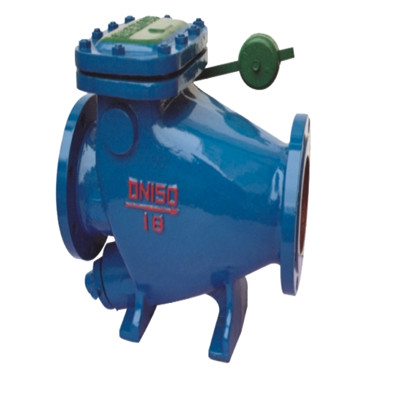
Low Resistant Slow Closing Check Valve

Low Resistant Slow Closing Check Valve

Key Specifications / Features

Request a quote

Detail Information

Low resistant slow closing check valve is utilized for drainage system. The check valve is installed at the exit of pump to avoid refluence of medium and eliminate destructive water hammer. It can also decrease the pressure of water hammer effectively to ensure safety when check valve closed.
 
Characteristics
1. Utilizing hydraulic slow closing installation
2. Light weight, large aperture, energy conservation
3. Reliable seal, wearing resistance, long service life, no vibration, no noise, etc.
 
Standards 
Design: GB/T 12233
Face to Face : GB/T 12221
Flange: JB/T 79,HG20592,GB9113,ANSI
Test & Inspection: JB/T 9092,GB/T13927
Pressure & Temperature: GB/T 9131
Marking: GB/T 12220
 
Model No.
Materials Model No.
HT200 HH44H/X-10,HH44H/X-16
WCB HH44H/X-16C,HH44H/X-25

Components Materials
Components Body & Bonnet Disc Stem
Materials Gray cast iron rubber Stainless steel

Main Dimensions
Nominal Diameter 40 50 65 80 100 125 150 200 250 300 350 400 450 500 600 700 800
L 200 230 290 310 350 400 480 500 600 700 800 900 1000 1100 1300 1400 1500
H 300 300 320 354 350 380 500 580 670 730 820 920 950 1100 1200 1550 1700
B 220 270 290 300 320 340 410 450 550 580 630 700 800 900 990 1120 1300

Send your message to this supplier

FAQs

Low-emission packing systems are specifically engineered to minimize microscopic leakage along the valve stem, which is a common source of fugitive emissions in industrial plants.

Compared with conventional packing, low-emission designs achieve better performance through:

Higher material density control to reduce permeation paths

Pre-compressed or die-formed graphite rings for stable sealing stress

Optimized load distribution using live-loading spring systems

Improved surface finish compatibility with stem materials

These design improvements allow the packing to maintain consistent sealing force even under thermal cycling and vibration. As a result, leakage levels can be reduced to extremely low thresholds (often measured in parts per million), supporting compliance with environmental regulations and reducing operational losses.

Basic Concept

Low Emission Valves refer to valves that, through special design and manufacturing processes of the stem packing and mid-seat gasket, control the leakage of media (gases, liquids) to extremely low levels. They are primarily used in industrial scenarios with high safety and environmental protection requirements. The core objective is to reduce or prevent the leakage of harmful media (such as volatile organic compounds (VOCs), toxic gases, flammable and explosive substances, etc.) into the external environment. Therefore, low emission valves offer multiple advantages in terms of energy conservation, emission reduction, reduced safety risks, and environmental pollution.

Key Technical Standards and Leakage Grades

The performance of Low Emission Valves is quantified by their leakage rate, and different industries follow different standards. Common standards include:

1. International Standards

ISO 15848-1: This standard classifies valve leakage grades into four levels: A (the highest requirement), B, C, and D. Grade A requires a leakage rate of ≤100 ppm (by volume).

API 624 (American Petroleum Institute): This standard, applicable to the refining and chemical industries, specifies a leakage rate of ≤100 ppm (for gases) under specific pressures.

EPA Standard (U.S. Environmental Protection Agency): This standard, targeting VOC emissions, requires a leakage rate of ≤500 ppm.

2. Chinese Standards

GB/T 42223-2022: This standard, which references international standards, regulates the design, manufacturing, and testing of Low Emission Valves.

At first, manufacturing low emission valves was pretty much the same for us as it was for other regular valve manufacturers in China. If we ran into problems like valves not passing tests or having leak rates that kept changing, we'd just try to get better packing materials from a different supplier. We didn't really stop to think about the bigger picture, like how the whole manufacturing process or the properties of the materials we were using might be causing the issues.

Over time, we figured out that the metal parts of the valves were pretty reliable, but we hadn't been paying enough attention to the non-metal parts that actually do the sealing. And those parts are super important for making sure the valves don't leak. So, back in 2008, we decided to focus on manufacturing low emission valves from start to finish.

First, we created a special team just for figuring out better ways to seal valves. They dug deep into how to make the seals work really well and how to build them. At the same time, we started working closely between the people who design the seals and the people who manufacture the valves. By tweaking the design of the seals and how we put the valves together, we made a system where everything works together perfectly. After that, we tested a bunch of different valves to see how well they sealed in all kinds of situations: different sizes, pressures, and temperatures. All the data we collected from these tests helped us keep improving our valves.

Now, when we manufacture a bunch of valves and check them randomly, they all meet the tough standards of API 624 and ISO 15848-1. We've gone from just following a process to really understanding and controlling the technology ourselves.

Similar Products

Related Searches

Products you might also like