How Does The Pneumatic Actuator of Control Valve Work
Key Specifications / Features
Detail Information
How Does the Pneumatic Actuator of a Control Valve Work?
Overview: What Is a Pneumatic Control Valve Actuator?
Pneumatic actuators are commonly used to actuate control valves and are available in two main forms:
- Piston actuators
- Diaphragm actuators
The Two Main Types of Pneumatic Actuators
Piston Actuators
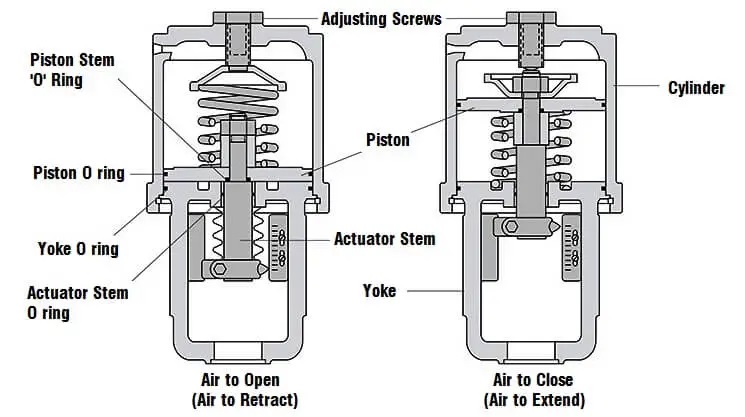
Piston actuators are generally used where the stroke of a diaphragm actuator would be too short or the thrust is too small. The compressed air is applied to a solid piston contained within a solid cylinder.
Piston actuators can be single acting or double acting, can withstand higher input pressures and can offer smaller cylinder volumes, which can act at high speed.
Diaphragm Actuators
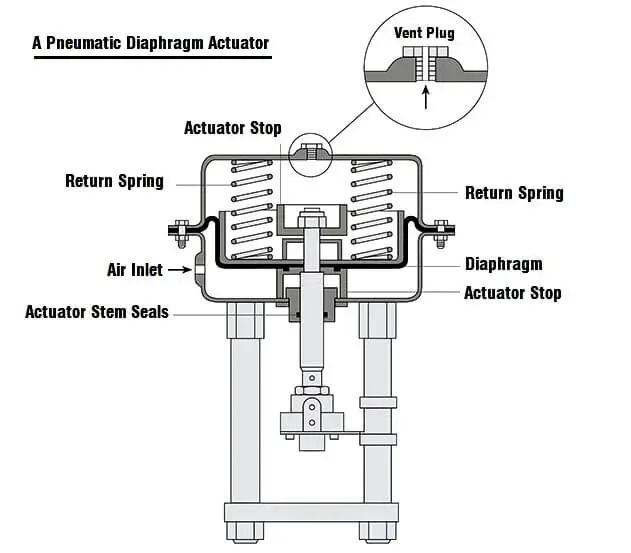
Diaphragm actuators have compressed air applied to a flexible membrane called the diaphragm. The figure below shows a rolling diaphragm where the effective diaphragm area is virtually constant throughout the actuator stroke.
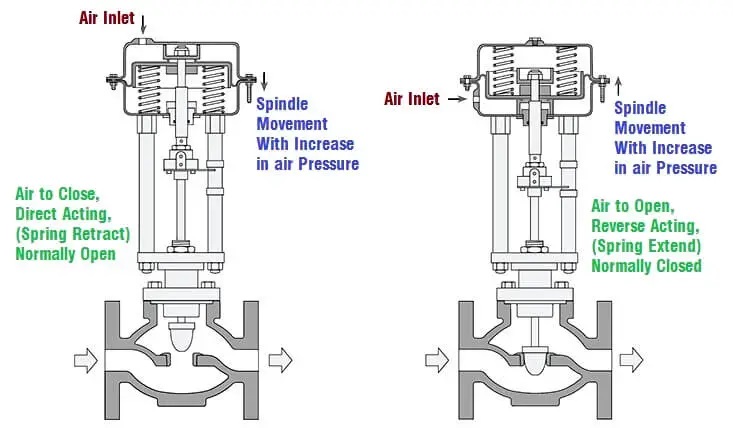
These types of actuators are single acting, in that air is only supplied to one side of the diaphragm, and they can be either direct acting (spring-to-retract) or reverse acting (spring-to-extend), which we also call air to open and air to close.
How Diaphragm Actuators Work
Reverse Acting (Spring-to-Extend / Air to Open)
The operating force is given from compressed air pressure, which is applied to a flexible diaphragm. The actuator is designed so that the force resulting from the air pressure, multiplied by the area of the diaphragm, overcomes the force exerted (in the opposite direction) by the spring(s).
The diaphragm is pushed upwards, pulling the stem up, and if the stem is connected to a direct acting valve, the plug is opened. The actuator is designed so that with a specific change of air pressure, the stem will move sufficiently to move the valve through its complete stroke from fully-closed to fully-open.
As the air pressure decreases, the spring(s) moves the stem in the opposite direction. The range of air pressure is equal to the stated actuator spring rating, for example 0.2 – 1 bar.
With a larger valve and/or a higher differential pressure to work against, more force is needed to reach full valve movement. To generate more power, a larger diaphragm area or higher spring range is needed. This is why control manufacturers offer a range of pneumatic actuators to match a range of valves – comprising increasing diaphragm areas, and a choice of spring ranges to create different power forces.
Direct Acting (Spring-to-Retract / Air to Close)
The direct acting actuator is designed with the spring below the diaphragm, having air supplied to the space above the diaphragm. The result, with increasing air pressure, is stem movement in the opposite direction to the reverse acting actuator.
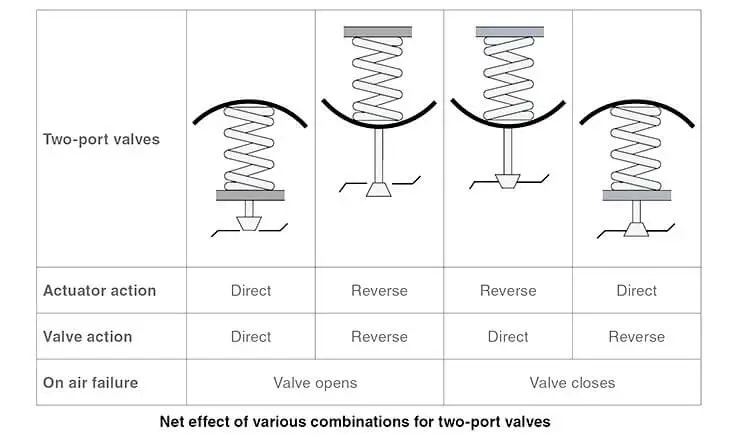
The effect of this movement on the valve opening depends on the design and type of valve used, and is illustrated in the figure above.
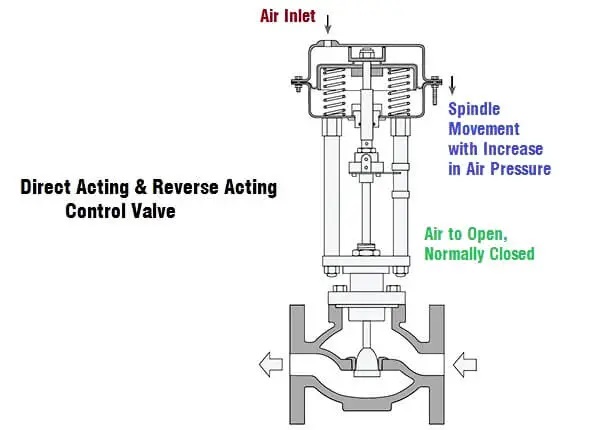
There is, however, an alternative, which is shown below. A direct acting pneumatic actuator is coupled to a control valve with a reverse acting plug (sometimes called a 'hanging plug').
Fail-Safe Action: What Happens When Air Supply Fails?
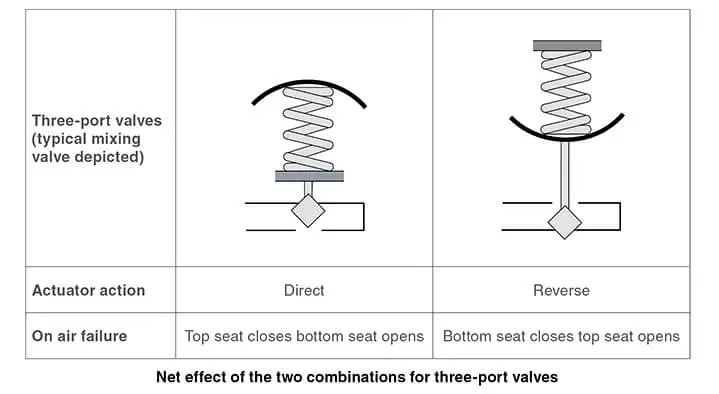
The choice between direct acting and reverse acting pneumatic controls depends on what position the valve should revert to in the event of failure of the compressed air supply. Should the valve close or be wide-open?
This choice depends upon the nature of the application and safety requirements. It makes sense for steam valves to close on air failure, and cooling valves to open on air failure.
How to Choose Between Direct Acting and Reverse Acting
The combination of actuator and valve type must be considered. The figures above show the net effect of the various combinations.
Summary: Key Takeaways on Pneumatic Actuator Selection
- Pneumatic control valve actuators mainly come in piston and diaphragm types; piston actuators suit short-stroke or high-thrust duties and can be single or double acting.
- Diaphragm actuators are single acting and work as reverse acting (air to open / spring-to-extend) or direct acting (air to close / spring-to-retract).
- Fail-safe position is decided by the application: steam valves typically close on air failure, cooling valves typically open.
- Always evaluate the actuator + valve combination together to get the correct net action on air supply failure.
Supplier Information
Shanghai Shinjo Valve Co., Ltd.
Verified Supplier
Certifications:
