Shanghai YAAO valve CO., LTD.
The Classification and Characteristics of Valve Actuator

On this page
1. The classification of valve drive mode
According to the movement way of driving mechanism, the valve actuator can be classified into linear and rotary actuator.
In terms of the driving structure, the valve actuator is divided into:
2. The characteristics of all kinds of valve actuator:
3. How to choose valve drive mode
The choice of valve drive mode is based on:
1. Form, specifications and structure of valve.
2. Opening and closing torque of valve (pipe line pressure, maximum differential pressure across the valve), thrust.
3. The highest temperature and fluid medium.
4. Operation method and usage count.
5. Speed and time of opening and closing.
6. Stem diameter, pitch, direction of rotation.
7. Connection mode.
8. Parameters of power supply: electric power supply voltage, phase number, frequency; the pressure of pneumatic air source; the pressure of hydraulic source.
9. Special consideration: low temperature, anti-corrosion, explosion-proof, waterproof, fire prevention, radiation protection, etc.
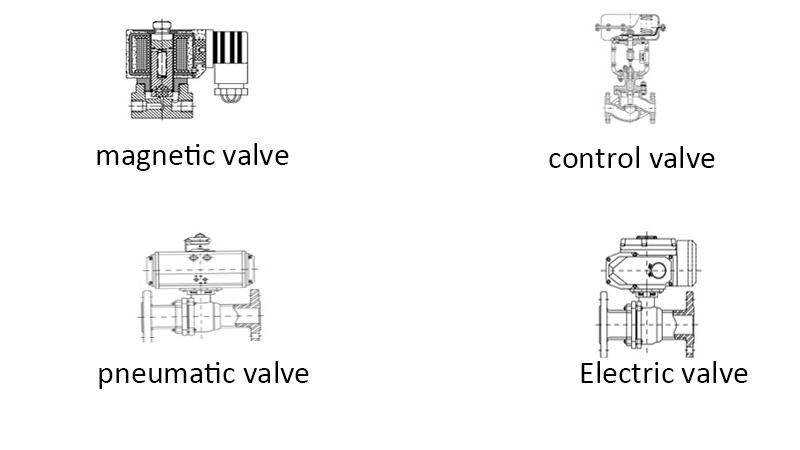
According to the movement way of driving mechanism, the valve actuator can be classified into linear and rotary actuator.
In terms of the driving structure, the valve actuator is divided into:
| Manual drive | Handle or hand wheel (including deceleration through intermediate gear) |
| Spring lever | |
| Dynamic drive | Electromagnetic type |
| Motor type | |
| Pneumatic drive | 1.Diaphragm type |
| 2. Cylinder type (1)Piston cylinder type (2)Piston rack type (3)Piston rod type (4)Piston fork type (5)Piston screw type |
|
| 3. Vane type | |
| 4. Air injection engine type | |
| 5. Film and ratchet combined type | |
| Hydraulic drive | Hydraulic cylinder type |
| Hydraulic motor type | |
| Linkage drive | Electrohydraulic type |
2. The characteristics of all kinds of valve actuator:
| Electric actuator | |
| Advantages | 1. Stronger applicability. It is not affected by environmental temperature. 2. A wider range of output torque. 3. Easy to control. It can freely adopt DC, AC, short-wave and pulse signals, is suitable for amplification, memory, logic judgment and calculation, etc. 4. It can realize micro-miniaturization. 5. It possesses mechanical self-locking performance. 6. Easy installation. 7. Convenient maintenance. |
| Disadvantage | 1. Complicated structure. 2. Low mechanical efficiency. (usually only 25% ~ 60%) 3. The output speed cannot be too low or too high. 4. It is vulnerable to be influenced by power voltage fluctuation. |
| Hydraulic actuator | |
| Advantage | 1. Simple & compact structure, small volume. 2. Big output. 3. Easy to obtain low speed or high speed, infinitely variable speeds. 4. Remote automatic control. 5. As a result of the viscosity of hydraulic oil, it has advantages of high efficiency,, self-lubricating performance and anti-rust performance. |
| Disadvantage | 1. The changed oil temperature will cause the changes of oil viscosity. 2. Leakage is prone to be seen in hydraulic components and pipe. 3. With tube, maintenance is not convenient. 4. It is not suitable for all kinds of operation for signal. |
| Pneumatic actuator | |
| Advantages | 1. Simple structure. 2. Easy to get air source. 3. Higher switching speed. 4. Governor can be installed to adjust switching speed according to different needs. 5. Larger gas compressibility, bigger elasticity when shutting off. |
| Disadvantages | 1. Compared with the hydraulic actuator, the structure is larger and it is not suitable for large diameter high pressure valve. 2. Because of gas compressibility, the speed is not even. |
3. How to choose valve drive mode
The choice of valve drive mode is based on:
1. Form, specifications and structure of valve.
2. Opening and closing torque of valve (pipe line pressure, maximum differential pressure across the valve), thrust.
3. The highest temperature and fluid medium.
4. Operation method and usage count.
5. Speed and time of opening and closing.
6. Stem diameter, pitch, direction of rotation.
7. Connection mode.
8. Parameters of power supply: electric power supply voltage, phase number, frequency; the pressure of pneumatic air source; the pressure of hydraulic source.
9. Special consideration: low temperature, anti-corrosion, explosion-proof, waterproof, fire prevention, radiation protection, etc.