
Ball Valve vs. Gate Valve: Which is Best for Your Application?
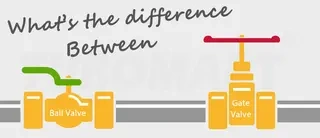
There are many industrial valves available in the market. The function of industrial valve types vary from each other. Some regulate the flow of media while others isolate media or control the direction of the media. These valves also vary in design and sizes.
Two of the most common valves used in industrial applications are ball valves and gate valves. Both are known to provide tight shut-off mechanisms. This article will compare the two valves in various factors such as working mechanisms, designs, ports, and the likes.
What is a Ball Valve?
The ball valve is part of the quarter-turn valve family. It only takes a 90-degree turn for it to open or close. The ball valve design has a hollowed-out ball that acts as the disc which allows the flow of media. They are mostly for non-slurry applications. Ball valves are also suited for applications that require tight shut-off.
The quick opening and closing of the ball make the ball valve important in some applications that need media isolation. They are commonly used in low-pressure applications. In a nutshell, ball valves are best for control and management of media with minimal pressure drop.
What is a Gate Valve?
On the other hand, gate valves belong to the linear motion valve family. Otherwise known as the knife valve or the slide valve, the gate valve has a flat or wedge disc that acts as a gate. That gate or disc controls the flow of fluid inside the valve. The gate valve is best used when the linear flow of media is with less pressure drop.
It is a shut-off valve with throttling capacity. It is intended more for material flow as to flow regulation. More suitable for thicker flow media, the flat disc of gate valves makes it easier to cut through such kind of media.
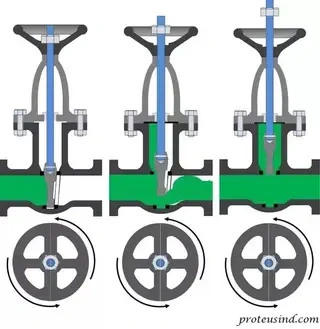
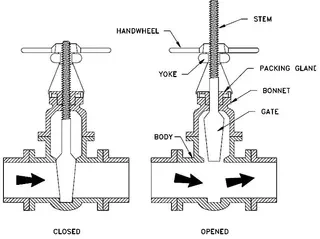
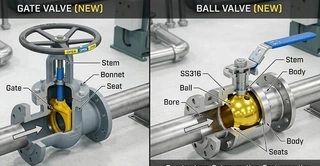
The gate valve is also part of the rotary family as the wheel or actuator needs to be rotated for the wedge or disc to open. For its closing position, the gate moves downwards and between two seats located on the upper portion of the disc as well as at its bottom as shown in the image above.
Gate Valve vs. Ball Valve: Working Mechanism
How Does a Ball Valve Work?
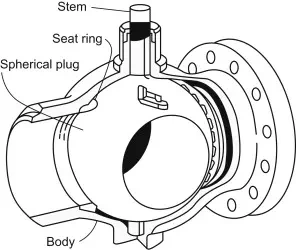
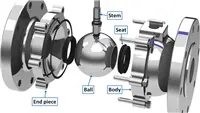
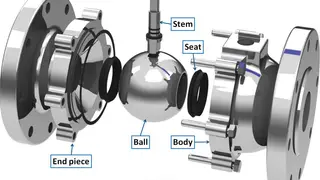
Ball valves have a hollow sphere that allows the passage of media. If you look at the cross-section of the ball valve below, you'll know the operation is through the rotation of the shaft or stem by a quarter of a turn. The stem is perpendicular to the ball part of the valve.
Fluid is allowed to pass when the stem is at the right angle with the ball disc. The lateral movement of the media plays an important role in the shut-off mechanism. Ball valves use fluid pressure to act upon the valve or seat to provide a tight seal, depending on the ball valve configuration.
Ball valves can be full port or reduced port. A full port ball valve means its diameter is the same as the pipe. This allows for low operating torque and pressure drop. However, there are also reduced ports where the size of the valve is one size smaller than that of the pipe size.
Gate Valve vs. Ball Valve: Working Mechanism
How Does a Ball Valve Work?
Ball valves have a hollow sphere that allows the passage of media. If you look at the cross-section of the ball valve below, you'll know the operation is through the rotation of the shaft or stem by a quarter of a turn. The stem is perpendicular to the ball part of the valve.
Fluid is allowed to pass when the stem is at the right angle with the ball disc. The lateral movement of the media plays an important role in the shut-off mechanism. Ball valves use fluid pressure to act upon the valve or seat to provide a tight seal, depending on the ball valve configuration.
Ball valves can be full port or reduced port. A full port ball valve means its diameter is the same as the pipe. This allows for low operating torque and pressure drop. However, there are also reduced ports where the size of the valve is one size smaller than that of the pipe size.
How Does a Gate Valve Work?
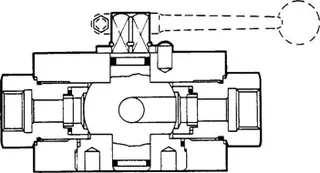
Gate valves work by lifting the gate or disc to allow the media to pass through the valve. These types of valves only allow unidirectional flow with little pressure drop. You would often see gate valves with handwheels. The handwheel is attached to the packing.
There are two kinds of gate valve stem designs. When this hand wheel rotates, the stem rises to the outside environment and, at the same time, lifts the gate. The other kind of gate valve is the non-rising gate valve. This is characterized by the stem threaded into the wedge, thereby exposing it to the media.
When the gate valve opens, the path becomes larger. The flow path is not linear in the sense that the media can occupy the void as seen in the illustration below. If the gate valve is used as a throttle, it would have an uneven flow rate, which will cause vibration. Such can cause damage to the disk.
Valve Flow Direction
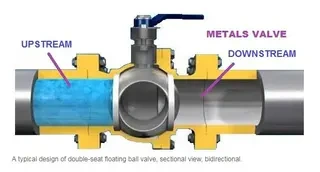
Ball valves and gate valves, by convention, is bi-directional. This means that ball valves have the capacity to block the media from both the upstream end and the downstream end. Check the illustration below.
Valve Seal Capacity
For the ball valves, the seals can be fixed for the floating ball valve design and it can be floating for the trunnion-mounted ball valve. Ball valves are often used in low-pressure applications. Considering the nature of its working mechanism, the primary seals are often made of PTFE and other related materials.
While the quick closing and opening of the ball valve can be advantageous, this can also cause some problems. Ball valves are prone to water hammer or the sudden surge of pressure upon closing of the valve. This condition damages the seats of the ball valve.
Furthermore, water hammer can increase the pressure inside the ball valve. In applications where such conditions can occur, i.e. the appliction of combustible material. There is an emergency seat seal, often made of metal. This is the second barrier in conditions where the elastomeric seal becomes damaged in high-pressure services. To relieve pressure, ball valves can have a pressure vent installed.
Gate valves minimize pressure drops when fully opened. That is through the use of full bore port design, meaning that the size of the valve is equal to the size of the pipe. It is because of this characteristic of gate valves that give them an advantage over ball valves. Water hammering does not occur in gate valves.
The downside of the gate valve is that high-pressure differential often happens in the shutoff. The friction can cause seat and disk wear.
Valve Design and Construction Differences
The main difference between ball valves and gate valves is their structure even if they function similarly.
For ball valves, movement of media is free-flowing. Aside from that, the ball valve design allows it to last longer even after heavy use. Of course, one should also take into consideration the type of material being used to manufacture it.
While ball valves do not provide fine control, their tight shut capability is one of the best for low-pressure applications. In this aspect, ball valves are reliable. Low-pressure loss is another quality problem of ball valves and it takes up more space because of its quarter-turn capability.
Gate valve, on the other hand, uses a handwheel to open or close the disc. The valve body is also much more slender and thus only a narrow space is needed. In contrast to ball valves, gate valves offer a more refined control as it has throttling abilities. It may not have a quick on-off capability, but it can control not only the media flow but also its pressure.
Valve Material
Ball Valves:
– Stainless steel
– Brass
– Bronze
– Chrome
– Titanium
– PVC (Polyvinyl chloride)
– CPVC (Chlorinated polyvinyl chloride)
Gate Valves:
– Cast Iron
– Cast Carbon Steel
– Ductile Iron
– Gunmetal Stainless Steel
– Alloy Steel
– Forged Steel
Application
Ball valves are often used in applications that require a smaller diameter, which can be up to DN 300 or a 12-inch diameter pipe. On the other hand, gate valves are often used in applications that require noncritical services and where leakages are not a top priority.
Gate Valve
– Oil and Gas Industry
– Pharmaceutical Industry
– Manufacturing Industry
– Automotive Industry
– Marine Industry
Ball Valve:
– On/Off Shore Gas Industry
– On/Off Shore Petrochemical Industry
In Summary
Ball valves have its advantages and disadvantages and so are gate valves. Understanding how each function and knowing whether such valve suits the application should be the priority. Contact UNIQUE and we will give you a free valve estimate.
Send your message to this supplier
Related Articles from the Supplier
What is Ball Valve?
- Jul 29, 2015
-200x99.webp)
Best 10 Ball Valve Manufacturers in the US
- Mar 18, 2017
Difference Between Ball Valve and Butterfly Valve
- Dec 15, 2017
How does a Ball Valve Work?
- Jun 23, 2019
Top 10 Ball Valve Manufacturers in India
- Jul 23, 2020

Related Articles from China Manufacturers
V-Port Ball Valve vs. Knife Gate Valve
- Mar 13, 2026
Ball Valve vs Control Valve
- Aug 06, 2024
-320x320.webp)
Butterfly Valve VS Ball Valve
- Mar 09, 2019
Related Products Mentioned in the Article

Supplier Website
Source: https://www.uvalve.cn/news/ball-valve-vs-gate-valve-which-is-best-for-your-application.html