Stainless Steel Gate Valve: Grades, Standards and Limits

A stainless steel gate valve is specified from the service, not from the word stainless. The 304 and 316 types (cast CF8 and CF8M) can crack in warm chloride service above about 60 °C (140 °F), where duplex or higher-nickel alloys resist better. API 603 or MSS SP-42 governs the design, ASME B16.34 sets the rating, and a CoCr-hardfaced seat keeps stainless faces from galling. Write every choice on the datasheet.
A stainless steel gate valve is chosen for its service, not for the word stainless. The cast grades CF8 and CF8M, the cast counterparts of wrought 304 and 316, resist many corrosive fluids. In warm chloride service, though, they can crack above about 60 °C (140 °F). A stainless wedge closing on a stainless seat can also gall, unless one seating face is hardfaced. Both risks belong to the buyer. The datasheet is where they are controlled: grade, class, trim, packing, inspection.
This guide is written for procurement and project engineers specifying a cast, corrosion-resistant gate valve of NPS 2 (DN 50) and larger. Stainless fits some services and misses others. CF8, CF3, CF8M and CF3M pair with forged counterparts; duplex and higher alloys extend the range, ranked by PREN. API 603, API 600 and MSS SP-42 apply; ASME B16.34 rates the stainless grades against WCB. Wedge, seat, trim, bonnet, stem and packing are specified, with API 624 or ISO 15848-1 emission tests. Cryogenic service, EN 10204 certificates, PMI and ASTM A262 belong on the datasheet, along with a specification checklist.
- Stainless is a service decision. 304 and 316 can crack in warm chlorides above about 60 °C (140 °F).
- Pair each cast grade with its forged twin. CF8M with F316, CF3M with F316L.
- Use PREN to rank, not to approve. PREN = Cr + 3.3Mo + 16N compares pitting resistance only.
- Read ratings from ASME B16.34. Stainless rates below WCB at ambient; above 425 °C (797 °F), WCB falls faster.
- Hardface at least one seating face. Stainless on stainless can gall; name the trim number and materials.
- Name the emission test and class. API 624, or ISO 15848-1 with its full class.
- Demand the documents. EN 10204 3.1 certificates with heat numbers, PMI, and any ASTM A262 practice ordered.
- TL;DR
- Abstract
- Key Takeaways
- Stainless Steel Gate Valve: When Stainless Fits, and When It Does Not
- By the Numbers
- Stainless Gate Valve Grades: CF8, CF8M, CF3M, Duplex and Higher Alloys
- Standards and Ratings: API 603, API 600, MSS SP-42 and ASME B16.34
- ASME B16.34 Ratings: Stainless Versus WCB
- Wedge, Seat and Trim: Designing Out Galling
- Bonnet, Stem and Packing: Rising Stems, Bellows Seals and Emission Tests
- Cryogenic and Low-Temperature Service
- Inspection and Documents: PMI, EN 10204 3.1 and Intergranular Corrosion Tests
- Stainless Steel Gate Valve Datasheet Checklist
- Frequently Asked Questions
- Conclusion
- References
A stainless steel gate valve is the right choice when the fluid would corrode carbon steel, but its 304 and 316 grades have two limits: warm chlorides, where they can crack, and heavy welds without the low-carbon grade (CF3 or CF3M).
A gate valve is a linear on-off valve: a gate or wedge moves across the flow path and seats against two seat faces. The gate valve vs ball valve comparison covers construction and valve-type choice.
Per Atlas Steels' datasheets, Grade 316 is generally more resistant than 304 in atmospheric and many corrosive environments (Atlas Steels, 2013). Austenitic grades also keep excellent toughness at low temperature. Shinjo supplies gate valves; Shinjo's gate valve range shows the current catalog, and grade and rating still belong on the datasheet.
Both grades are subject to pitting and crevice corrosion in warm chlorides, and to stress corrosion cracking above about 60 °C (140 °F) (Atlas Steels, 2013). In potable water, Grade 304 resists pitting to about 200 mg/L chlorides at ambient, and 150 mg/L at 60 °C (140 °F) (Atlas Steels, 2013). Grade 316 raises that to about 1000 mg/L at ambient, and 300 mg/L at 60 °C (140 °F) (Atlas Steels, 2013). These are pitting limits in potable water, not SCC limits and not a valve limit. Per the Specialty Steel Industry of North America (SSINA), fully immersed stainless steels rarely see chloride SCC below 60 °C (140 °F) (SSINA, n.d.). SSINA lists 304/304L and 316/316L (8 to 10 wt% nickel) as very susceptible; no stainless grade is totally immune (SSINA, n.d.). US Federal Highway Administration U-bend tests cracked 304L and 316LN under concentrated high-pH chloride droplets at 50 °C (122 °F), while duplex 2304 and 2205 resisted; the bridge-reinforcement study shows evaporation-concentrated chlorides can crack austenitic grades below the 60 °C (140 °F) rule of thumb (Liu et al., 2024). Continuous use of 304 or 316 in 425 to 860 °C (797 to 1580 °F) sensitizes the grade against aqueous corrosion; 304L and 316L resist it (Atlas Steels, 2013). Heavy welded 316 sections need post-weld annealing for maximum corrosion resistance; 316L does not (Atlas Steels, 2013). Specify the low-carbon cast grade (CF3 or CF3M) where the body will be welded without annealing.
Atlas Steels' 304 and 316 datasheets place chloride stress corrosion cracking above about 60 °C (140 °F) (Atlas Steels, 2013). That threshold drops where chlorides concentrate: US Federal Highway Administration U-bend tests cracked 304L and 316LN in high-pH chloride droplets at 50 °C (122 °F), near the salt's deliquescence humidity (Liu et al., 2024).
Alloy 20, 904L and the 6% molybdenum superaustenitic grades resist chloride SCC substantially better, and duplex sits between the austenitic and ferritic families (Atlas Steels, 2013). Where the service is not corrosive, carbon steel WCB is the usual choice; at ambient temperature ASME B16.34 rates WCB slightly above the stainless grades (Emerson, 2017).
- 60 °C (140 °F) SCC rule of thumb for 304 and 316 (Atlas Steels, 2013)
- 50 °C (122 °F) cracking under concentrated chloride droplets (Liu et al., 2024)
- 1000 mg/L 316 pitting limit, potable water, ambient (Atlas Steels, 2013)
- 300 mg/L same 316 limit at 60 °C (140 °F) (Atlas Steels, 2013)
In a stainless steel gate valve, the common cast grades are CF8M and CF3M (316 types) and CF8 and CF3 (304 types); duplex and higher-nickel alloys are the step up for chloride service. Name the cast grade and the forged grade of every forged part on the datasheet.
| Cast grade | Wrought or forged counterpart | What changes | PREN of the wrought counterpart (BSSA) | Limit to watch |
|---|---|---|---|---|
| CF8 | 304, A182 F304 (Atlas Steels, 2013) | standard 18Cr-8Ni grade | 17.5-20.8 (BSSA, n.d.) | chloride SCC above about 60 °C (140 °F) (Atlas Steels, 2013) |
| CF3 | 304L, A182 F304L (Atlas Steels, 2013) | low carbon | not listed by BSSA; corrosion resistance usually as 304 (Atlas Steels, 2013) | resists sensitization after welding (Atlas Steels, 2013) |
| CF8M | 316, A182 F316 (Atlas Steels, 2013) | adds molybdenum (Atlas Steels, 2013) | 23.1-28.5 (BSSA, n.d.) | chloride SCC above about 60 °C (140 °F) (Atlas Steels, 2013) |
| CF3M | 316L, A182 F316L (Atlas Steels, 2013) | low carbon, adds molybdenum | 23.1-28.5 (BSSA, n.d.) | resists sensitization after welding (Atlas Steels, 2013) |
| A995 4A (CD3MN) | 2205 (Atlas Steels, 2013) | duplex | 30.8-38.1 (BSSA, n.d.) | not above 300 °C (572 °F) or below -50 °C (-58 °F) (Atlas Steels, 2013) |
| A995 5A (CD3MWCuN) | 2507 (Atlas Steels, 2013) | super duplex | 40 or more (BSSA, n.d.) | not above 300 °C (572 °F) (Atlas Steels, 2013) |
| CN7M | Alloy 20 (Atlas Steels, 2013) | high nickel | not listed by BSSA | did not crack in boiling 26% NaCl (Atlas Steels, 2013) |
In ASTM A351, "M" means molybdenum is added (Atlas Steels, 2013). The "3" grades are the low-carbon versions (Atlas Steels, 2013). Between each pair, corrosion resistance is usually the same (Atlas Steels, 2013). When a body will be welded and not annealed afterwards, order the low-carbon grade: 316L (CF3M) resists sensitization (grain-boundary carbide precipitation) and is used in heavy welded components (Atlas Steels, 2013). ASTM, DIN, JIS and UNS equivalents are collected in a stainless steel grade comparison chart.
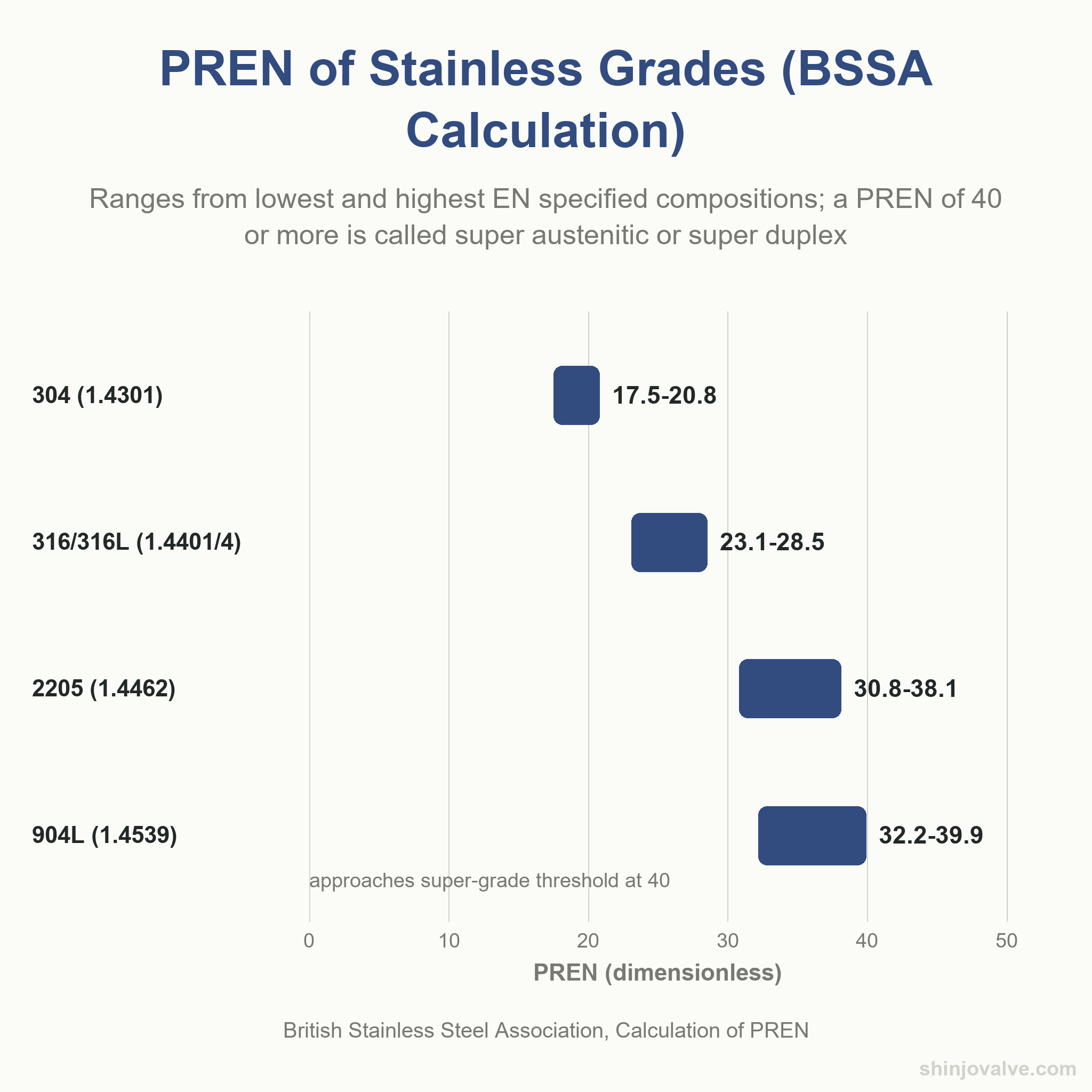
Duplex grades have roughly equal austenite and ferrite, high strength, good toughness and good resistance to stress corrosion cracking (SCC) (Atlas Steels, 2013). ASTM A995 pairs cast 4A (CD3MN) with 2205, and 5A (CD3MWCuN) with 2507 (Atlas Steels, 2013). Wrought 904L has a BSSA PREN range of 32.2-39.9 (BSSA, n.d.) and much better SCC resistance than the standard austenitic grades (Atlas Steels, 2013). In boiling 26% NaCl, 304L and 316L cracked while 904L, Alloy 20, 2205 and 2507 did not; in boiling 42% MgCl2, all six of those grades cracked (Atlas Steels, 2013). Duplex is not a high-temperature or cryogenic grade: 2205 is not generally suitable above 300 °C (572 °F) or below -50 °C (-58 °F) (Atlas Steels, 2013), and 2507 embrittles above 300 °C (572 °F) even for short times (Atlas Steels, 2013). See duplex stainless steel valves for a wider introduction.
The commonly used formula is PREN = Cr + 3.3Mo + 16N (BSSA, n.d.). Calculated from the lowest and highest EN compositions, wrought grades rank: 304 (1.4301) 17.5-20.8; 316/316L (1.4401/4) 23.1-28.5; 2205 (1.4462) 30.8-38.1; 904L (1.4539) 32.2-39.9 (BSSA, n.d.). Grades at PREN 40 or more are called 'super' austenitic or 'super' duplex; oil and gas specifications such as NORSOK or NACE typically require a minimum PREN of 40 for super duplex (BSSA, n.d.).
Per the British Stainless Steel Association, PREN numbers "are useful for ranking and comparing the different grades, but cannot be used to predict whether a particular grade will be suitable for a given application, where pitting corrosion may be a hazard" (BSSA, n.d.).
PREN combines chromium, molybdenum (weighted 3.3) and nitrogen (weighted 16) into a single ranking number, sorting austenitic and duplex grades from least to most resistant to pitting (BSSA, n.d.). It ranks; it does not approve (BSSA, n.d.). The buyer still verifies each grade against the fluid, temperature and chloride level.
American Petroleum Institute (API) 603 and Manufacturers Standardization Society (MSS) SP-42 are the corrosion-resistant gate valve standards for a stainless steel gate valve, API 600 is the heavier-wall alternative, and American Society of Mechanical Engineers (ASME) B16.34 supplies the pressure-temperature rating behind them. Every stainless steel gate valve datasheet names one design standard and one rating standard together, so the buyer picks both.
| Standard | What it covers | What it settles on the datasheet |
|---|---|---|
| API 603 | Corrosion-resistant, bolted-bonnet gate valves with flanged and butt-welding ends (Velan, n.d.) | Wall thickness equal to ASME B16.34 for bolted-bonnet valves (Powell, n.d.) and pressure-temperature ratings from ASME B16.34 (Powell, n.d.) |
| API 600 | The heavier-wall steel gate valve design | Ordered when the specification asks for a thicker wall in a stainless body (Powell, n.d.) |
| MSS SP-42-2026 | Corrosion-resistant gate, globe, angle and check valves with flanged and butt-weld ends in Classes 150, 300 and 600 (MSS, n.d.) | The MSS design choice for corrosion-resistant valves |
| ASME B16.34 | Flanged, threaded and welding-end valves: minimum shell wall thickness, pressure-temperature ratings and pressure testing requirements (Emerson, 2017) | The rating for the class and material group |
| API 598 | Valve inspection and testing, referenced by API 603 (Powell, n.d.) | The shell and seat test records |
Name one design standard on the datasheet with its edition, either API 603, API 600 or MSS SP-42-2026, and pair it with ASME B16.34 for the class rating. Where the specification needs API 600 wall thickness in a stainless body, write that combination explicitly, so the supplier does not default to the lighter API 603 wall. Velan's API 603 range, for example, runs NPS 1/2 to 24 (DN 15 to 600) (Velan, n.d.).
API 603 relies on ASME B16.34. Its wall thicknesses equal ASME B16.34 for bolted-bonnet valves (Powell, n.d.), and it refers to ASME B16.34 for pressure-temperature ratings (Powell, n.d.). A stainless steel gate valve datasheet therefore names both documents: the design standard for the shell, and the rating standard for the class and material group.
Small-bore stainless gate valves are often forgings rather than castings, and compact forged steel gate valves have their own standard, API 602. The forged low-carbon grades rate lower than the cast grades: at -29 to 38 °C (-20 to 100 °F), Class 150, forged F304L and F316L are rated 15.9 bar (230 psi) against 19.0 bar (275 psi) for the cast grades CF8, CF3, CF8M and CF3M (Emerson, 2017). Larger cast valves with bolted bonnets follow API 603, API 600 or MSS SP-42.
A knife gate valve closes with a thin, sharp-edged gate that cuts through the medium, which suits slurry and pulp stock (MSS, n.d.). MSS SP-81-2021 covers stainless-steel or stainless-steel-lined, bonnetless, knife gate valves with flanged ends (MSS, n.d.). It is not a substitute for a Class-rated wedge gate valve. Shinjo's manual knife gate valve page lists CF8, CF8M, CF3, CF3M and 2205 among its materials, and Shinjo's electric actuated stainless knife gate valve page is the actuated equivalent.
Numbers on a datasheet still need a supplier to check them against. Once the cast grade, design standard, pressure class and trim material are fixed, Shinjo quotes gate valves against those exact conditions instead of browsing a generic listing.
ASME B16.34 rates a valve by class and material group, so a stainless valve and a WCB valve of the same class do not carry the same rating. In Class 300, CF8M is 49.6 bar against WCB's 51.1 bar at ambient, and 35.7 bar against 43.8 bar at 200 °C (392 °F) (Emerson, 2017).
At -29 to 38 °C (-20 to 100 °F), Class 150 rates WCB at 19.6 bar (285 psi), CF8/CF3 and CF8M/CF3M at 19.0 bar (275 psi), and forged F304L/F316L at 15.9 bar (230 psi) (Emerson, 2017).
The printed ASME B16.34 Class 300 table gives working pressures in bar (psi) at five temperatures (Emerson, 2017).
| Material (ASME B16.34 group) | -29 to 38 °C (-20 to 100 °F) | 100 °C (212 °F) | 200 °C (392 °F) | 425 °C (797 °F) | 450 °C (842 °F) |
|---|---|---|---|---|---|
| WCB (Group 1.1) | 51.1 (740) | 46.6 (676) | 43.8 (635) | 28.8 (418) | 23.0 (334) |
| CF8/CF3 (Group 2.1) | 49.6 (720) | 40.9 (593) | 35.4 (513) | 28.0 (406) | 27.4 (397) |
| CF8M/CF3M (Group 2.2) | 49.6 (720) | 42.2 (612) | 35.7 (518) | 29.1 (422) | 28.8 (418) |
| F304L/F316L (Group 2.3) | 41.4 (600) | 34.8 (505) | 29.2 (424) | 23.9 (347) | 23.4 (339) |
WCB is Group 1.1; CF8, CF3 and F304 are Group 2.1; CF8M, CF3M and F316 are Group 2.2; F304L and F316L are Group 2.3 (Emerson, 2017).
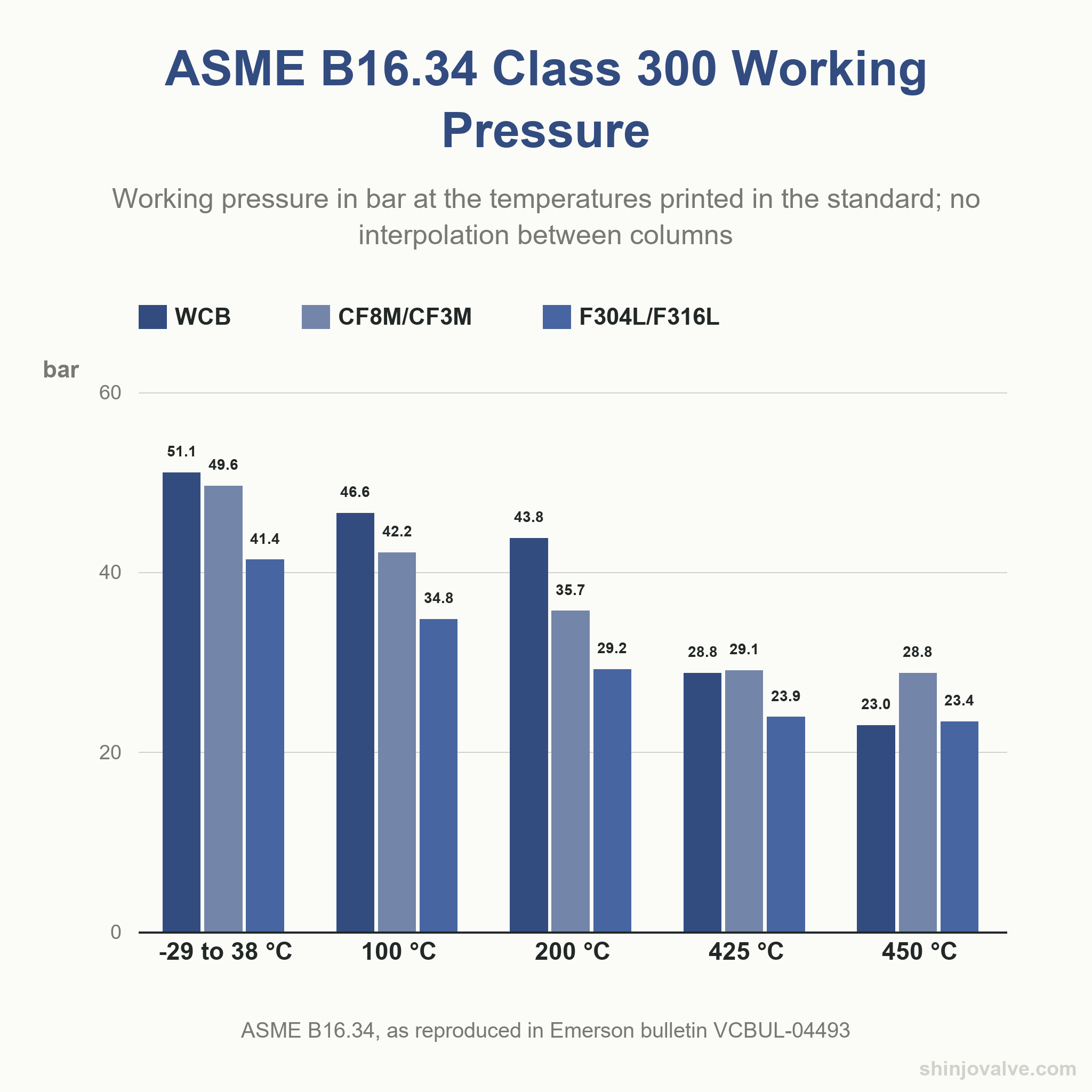
Above 425 °C (797 °F) the order reverses: from 425 to 450 °C (797 to 842 °F), WCB drops from 28.8 to 23.0 bar while CF8M moves from 29.1 to 28.8 bar (Emerson, 2017).
The bulletin prints CF3 and CF3M in the CF8 and CF8M columns, but ASME B16.34 material notes can lower an individual grade's maximum temperature, so the 425 °C (797 °F) and 450 °C (842 °F) cells apply here to CF8 and CF8M only (Emerson, 2017).
Never compute a value between printed temperatures. Name the class, material group and maximum design temperature on the datasheet, then read the row at or below that temperature. Flanged-end ratings end at 538 °C (1000 °F) (Emerson, 2017). The tables must be used in accordance with ASME B16.34, and a valve used under the ASME Boiler and Pressure Vessel Code, the ASME code for pressure piping or government regulation is subject to that code's limits, including maximum temperature limits and rules for using a material at low temperature (Emerson, 2017).
When the service does not need stainless, the carbon steel option is Shinjo's ASME B16.34 cast steel gate valve page.
Hot service flips the ASME B16.34 Class 300 ranking between stainless CF8M and carbon steel WCB. At ambient WCB leads, 51.1 bar to CF8M's 49.6 bar, but at 450 °C (842 °F) CF8M rates 28.8 bar while WCB is down to 23.0 bar (Emerson, 2017).
Stainless sliding on stainless can gall under load, so a stainless gate valve is usually ordered with at least one seating face hardfaced with a cobalt-chromium alloy. Write the trim number together with the actual face materials on the datasheet: for example, Trim 12 with a 316 wedge and a 316 seat overlaid with CoCr.
- Solid wedge: a one-piece wedge.
- Flexible wedge: a one-piece wedge cut around its edge so each face can follow small seat distortion from temperature change or pipe load.
- Split wedge: two halves that align to each seat.
- Parallel slide: two parallel discs.
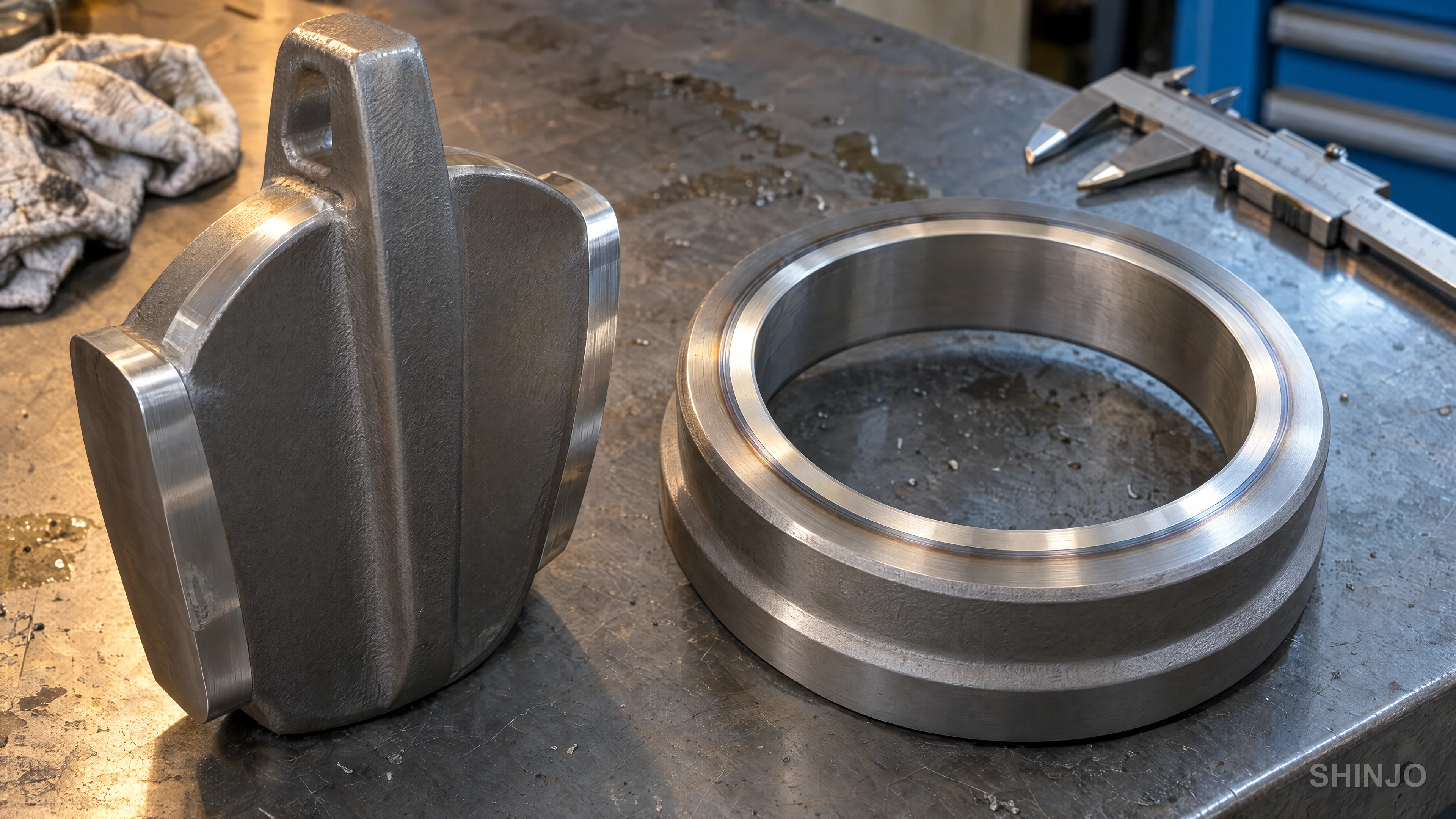
Galling is adhesive wear in which metal surfaces sliding under load bond and tear, and austenitic stainless steel sliding on austenitic stainless steel is prone to it. Cobalt-base hardfacing alloys are the established benchmark for galling resistance. Stellites are cobalt-based alloys, and parts are usually made by depositing them onto steel substrates rather than from solid Stellite. For API 600, to which API 603 refers, the hardness differential between the body and disc seat surfaces is the manufacturer's standard (API, 2021). The practical rule: make at least one sliding face hardfaced or of a different hardness, and write it on the datasheet.
The trim number pins the materials of the stem, the wedge face and the seat face.
| Trim | Stem | Wedge face | Seat face | Seating-surface hardness |
|---|---|---|---|---|
| 2 | 304 | 304 (CF8/304) | 304 (API, 2021) | not specified |
| 10 | 316 | 316 (CF8M/T316) | 316 (API, 2021) | not specified |
| 12 | 316 | 316 | 316 with CoCr overlay (API, 2021) | 350 HB min. (API, 2021) |
| 15 | 304 | 304 with CoCr overlay | 304 with CoCr overlay (API, 2021) | 350 HB min. (API, 2021) |
| 16 | 316 | 316 with CoCr overlay | 316 with CoCr overlay (API, 2021) | 350 HB min. (API, 2021) |
| 2S | 304 | 304 | 304 with CoCr overlay (API, 2021) | 350 HB min. (API, 2021) |
The CoCr-A class, AWS A5.13 ECoCr-A or AWS A5.21 ERCoCr-A, includes trademark materials such as Stellite 6, Stoody 6 and Wallex 6 (API, 2021). Trim 2S is not referenced by API but is often used for API 603 valves (API, 2021). The chart's note also records that API 603-2018 contains no trim chart, and that its clause 6.2.2 makes trim materials the same as the body plus overlays (API, 2021).
Write the trim number together with the face materials on every datasheet line: "Trim 12: 316 wedge, 316 seat with CoCr overlay" rather than "Trim 12" alone, because Trim 2S is not an API trim and a bare number can be misread. Operator sizing follows a metal-seated gate valve torque chart for the class and size ordered.
A stainless seat sliding against a stainless wedge is the classic galling geometry, because austenitic stainless steel sliding on austenitic stainless steel is prone to adhesive wear. Cobalt-base hardfacing alloys are the established benchmark against it. The trim chart therefore specifies CoCr-faced seating surfaces at 350 HB minimum on Trims 12, 15, 16 and 2S (API, 2021).
Most corrosion-service gate valves are rising-stem OS&Y valves with a bolted bonnet. The stem seal is the usual leak path to atmosphere, so the datasheet must name the packing material and the emission test the valve design was qualified against.
An OS&Y (outside screw and yoke) rising stem places the stem thread outside the pressure boundary, away from the fluid, and its visible position shows whether the valve is open. A non-rising stem places the thread inside the body, in the fluid; the valve needs less headroom above the bonnet.
The bolted bonnet is the construction API 603 is written for. Pressure-seal bonnets, common at higher classes, have their own MSS practice, MSS SP-144-2020 (MSS, n.d.). A bellows seal adds a welded metal bellows around the stem, and it has its own MSS practice, MSS SP-117-2023 (MSS, n.d.). Flexible graphite packing for rising stems has a dedicated MSS practice, MSS SP-120-2024 (MSS, n.d.). Powell's API 603 catalog states that for API 603 compliance its optional graphitic packing and gasket are required, since its standard packing is PTFE (Powell, n.d.).
Shinjo's pressure-seal gate valve page lists CF8, CF8M and F316L among its materials.
| Item | API 624 | ISO 15848-1 |
|---|---|---|
| Valves covered | rising and rising/rotating stem valves, such as gate and globe valves (Allen & Mertes, 2018) | isolation and control valves (Allen & Mertes, 2018) |
| Test fluid | methane only (Valve World Americas, 2021) | helium or methane (Allen & Mertes, 2018) |
| Packing qualification | packing first qualified to API 622 (Valve World Americas, 2021) | not required by the test |
| Mechanical cycles | a defined number; confirm the count in the edition in force | 205, 1,500 or 2,500 for isolation valves, by endurance class (Allen & Mertes, 2018) |
| Thermal cycles or temperature | three cycles from room temperature to 260 °C (500 °F) (Allen & Mertes, 2018) | temperature classes from -196 °C (-321 °F) to 400 °C (752 °F), plus room temperature (Allen & Mertes, 2018) |
| Test pressure | 41.4 bar (600 psi), or the class's maximum operating pressure if lower (Valve World Americas, 2021) | the class's maximum allowable operating pressure for the selected temperature class (Valve World Americas, 2021) |
| Acceptance | flat 100 ppmv per measurement (Valve World Americas, 2021) | tightness class: AH, BH, CH (helium) or AM, BM, CM (methane) (Allen & Mertes, 2018) |
The API 624 scope also includes leakage from the body-bonnet connection (Allen & Mertes, 2018). Both are type tests: they qualify a valve design, not each valve shipped (Allen & Mertes, 2018; Valve World Americas, 2021). On the datasheet, write the standard, and for ISO 15848-1 write the full class: tightness, endurance and temperature.
API 624 qualifies rising-stem valves fitted with graphite packing using methane at a flat 100 ppmv limit (Allen & Mertes, 2018; Valve World Americas, 2021). ISO 15848-1 allows helium or methane and grades the result by tightness class (AH, BH, CH with helium; AM, BM, CM with methane), endurance class and temperature class (Allen & Mertes, 2018). Both qualify a design, not each valve shipped (Allen & Mertes, 2018; Valve World Americas, 2021).
A cryogenic gate valve needs both a tough material and an extended bonnet; either one alone is not enough. The material must stay tough at the service temperature, and the stem seal must stay warm enough to work. Missing one condition leaves either a body that cracks or a stem that seizes.
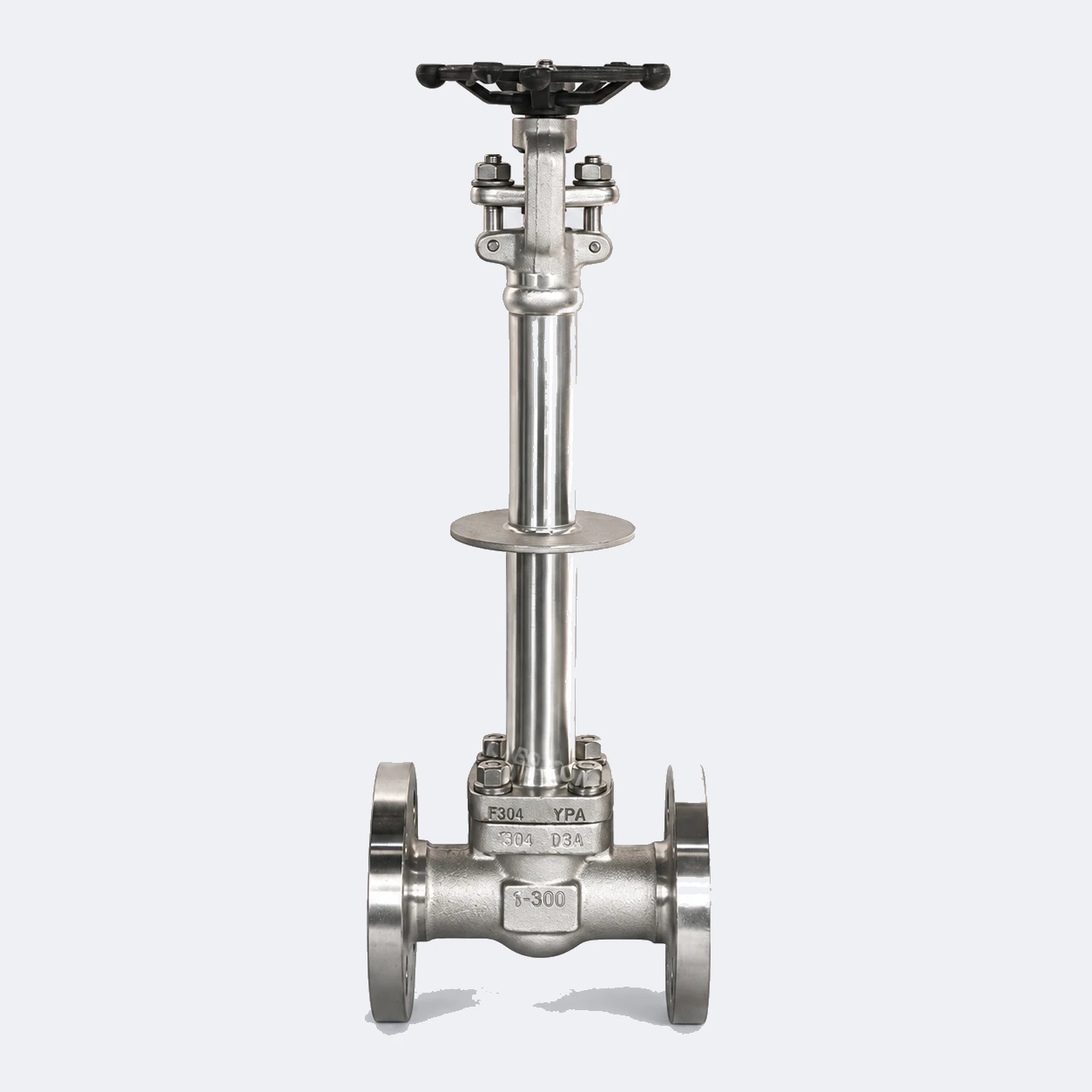
The extended bonnet moves the packing away from the cold fluid, so the stem seal stays warm enough to seal and the stem can still be operated. Velan's API 603 valves come in bolted-bonnet and welded extended (cryogenic) bonnet styles (Velan, n.d.). MSS lists MSS SP-134-2025, covering valves for cryogenic service and the requirements for body and bonnet extensions (MSS, n.d.). Three lines belong on the datasheet for a cryogenic gate valve: the minimum design temperature, the bonnet extension length, and the cryogenic test standard specified.
Atlas Steels' 304 and 316 datasheets state that the austenitic structure gives excellent toughness, even down to cryogenic temperatures (Atlas Steels, 2013). BS 6364 covers cryogenic valves and requires Charpy V-notch impact testing at or below the minimum design temperature (BSI, 1998). Emerson's ASME B16.34 bulletin notes that a valve used under the ASME pressure vessel or piping codes is subject to that code's rules on using a material at low temperature (Emerson, 2017).
Note: Duplex 2205 is not a cryogenic material: it is not generally suitable below -50 °C (-58 °F), because of its ductile-to-brittle transition (Atlas Steels, 2013).
Austenitic stainless plus an extended bonnet is the usual cryogenic combination for a stainless steel gate valve. The austenitic structure keeps excellent toughness down to cryogenic temperatures (Atlas Steels, 2013), and the extended bonnet keeps the packing away from the cold fluid so the stem seal stays warm enough to work.
The documents prove the alloy, the heat and the test, so name each on the purchase order: an API 598 pressure test record, an EN 10204 3.1 certificate against every heat, a positive material identification report, and an ASTM A262 report where the service demands one.
API 598 sets the minimum inspection and pressure tests referenced by API 603 (Powell, n.d.). Name the shell and seat tests on the purchase order, and state which the buyer will witness. MSS SP-55-2025 is the quality standard for iron and steel castings for valves, flanges, fittings and other piping components that sets a visual method for evaluating surface irregularities (MSS, n.d.).
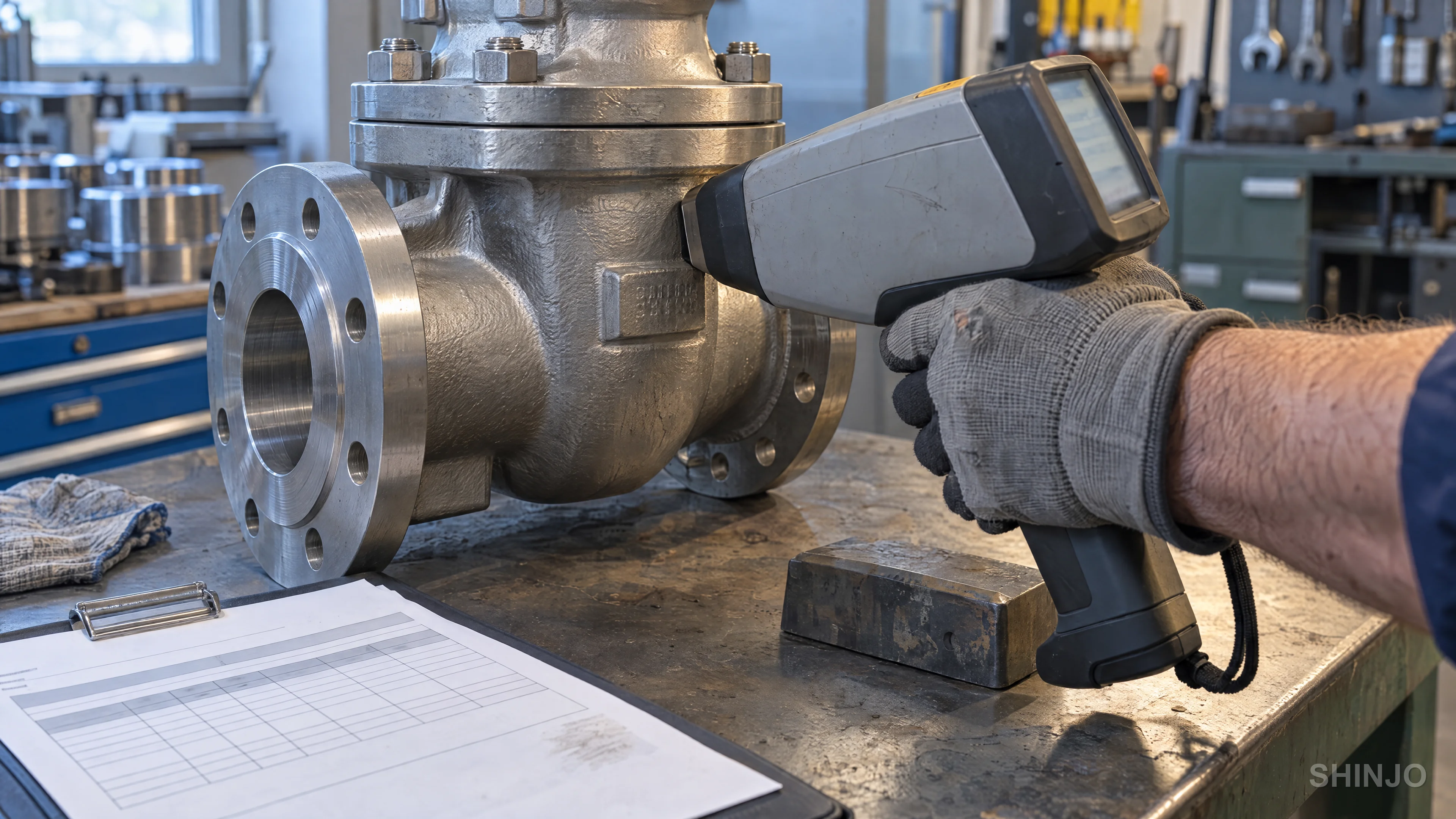
Positive material identification (PMI) checks the alloy chemistry of the delivered parts against the grade ordered, usually with a portable analyzer (ASTM International, 2021). The owner's PMI procedure sets how many parts are checked, not one universal number. Ask for a type 3.1 inspection certificate under EN 10204, and confirm the heat is stamped on the casting (CEN, 2004). Specify a type 3.2 certificate where regulations require a second party (CEN, 2004).
An EN 10204 type 3.1 inspection certificate is issued by the manufacturer, reports the actual test results for the products supplied, and is validated by the manufacturer's authorized inspection representative, independent of the manufacturing department (CEN, 2004). The heat number must match a marking on the casting.
Sensitization means chromium-depleted zones along grain boundaries, and ASTM A262 sets the practices that detect susceptibility to it (ASTM International, 2021). ASTM A262-15(2021) lists five practices: Practice A, an oxalic acid etch; Practice B, ferric sulfate-sulfuric acid; Practice C, nitric acid; Practice E, copper-copper sulfate-sulfuric acid; and Practice F, copper-copper sulfate-50% sulfuric acid (ASTM International, 2021). Practice A "allows rapid acceptance of specific lots of material without the need to perform time-consuming and costly hot acid immersion tests" (ASTM International, 2021). Practice F detects susceptibility to intergranular attack in molybdenum-bearing cast austenitic stainless steels (ASTM International, 2021). The purchase order names the practice and its acceptance criterion. For duplex, ask for a ferrite measurement and its acceptance range on the purchase order. Welding 2205 without filler metal may result in excessive ferrite (Atlas Steels, 2013).
Documents to demand with the valve:
- API 598 records for the shell and seat tests, with witness points.
- EN 10204 3.1 certificates for body, bonnet, wedge and stem, each with a heat number.
- PMI report on the delivered valve, keyed to the certificate.
- ASTM A262 report where the purchase order names a practice.
- Ferrite report for duplex, against the range set in the purchase order.
A stainless steel gate valve quotation is only as exact as the datasheet lines sent with it.
- Service parameters: fluid, chloride content, minimum and maximum temperature, design pressure.
- Valve size: NPS with DN.
- Pressure class: the required class.
- Design standard: API 603, API 600 or MSS SP-42-2026, plus ASME B16.34.
- Body and bonnet: the ASTM A351 or A995 grade, and the A182 grade of every forged part.
- Wedge type: solid, flexible or split wedge.
- Trim and faces: trim number, face materials, and which faces carry CoCr hardfacing.
- Stem type: OS&Y rising stem or non-rising.
- Bonnet type: bolted, pressure-seal, bellows-seal or extended.
- Packing and emissions: API 624, or ISO 15848-1 with its full class.
- Low-temperature requirements: minimum design temperature, impact testing per the governing code.
- End connections: end-to-end dimensions to ASME B16.10, flanges to ASME B16.5 and butt-weld ends to ASME B16.25 (Powell, n.d.).
- Tests and witnesses: API 598 with witness points.
- Required documents: EN 10204 3.1 with heat numbers, PMI, the ASTM A262 practice where ordered, ferrite for duplex.
A stainless steel gate valve datasheet lists the service and its limits, the cast grade and every forged A182 counterpart, the design standard and edition with the ASME B16.34 rating, the trim number with hardfaced faces, the bonnet and emission test, low-temperature requirements, and the tests and documents to be delivered.
Grade choice, trim and hardfacing, size and class, bonnet type, emission and cryogenic testing, and documentation and witness level all move both price and delivery. Duplex and higher alloys, hardfaced trims, larger sizes, higher classes, pressure-seal and bellows-seal bonnets, ISO 15848-1 endurance classes, cryogenic qualification, and third-party witnessed documents each add material, machining or scheduling to the order.
A request that carries these lines can be matched against the gate valves Shinjo supplies, listed on Shinjo's gate valve category page.
Many valve makers build stainless steel gate valves to API 603, API 600 or MSS SP-42, and no ranking replaces a datasheet check. Compare suppliers by the standard cited, the trim, API 598 test records, EN 10204 3.1 certificates and PMI. Shinjo Valve is one supplier; its pressure-seal gate valve page lists CF8, CF8M and F316L among its materials.
API 603 covers corrosion-resistant, bolted-bonnet gate valves, while API 600 is the heavier-wall steel gate valve standard. API 603 contains wall thicknesses equal to ASME B16.34 for bolted-bonnet valves and refers to ASME B16.34 for pressure-temperature ratings. A stainless valve can be ordered to either; name the one on the purchase order.
CF8 and CF8M are cast grades, while 304 and 316 are their wrought counterparts. The letter M means molybdenum is added, so CF8M pairs with 316 and CF8 with 304. The low-carbon versions are CF3, CF3M, 304L and 316L, and they resist sensitization after welding when the body cannot be annealed afterwards.
304 and 316 are subject to chloride stress corrosion cracking above about 60 °C (140 °F) in warm chloride service, but there is no single threshold. Under concentrated high-pH chloride droplets near a salt's deliquescence humidity, US Federal Highway Administration tests cracked 304L and 316LN at 50 °C (122 °F). Duplex resisted the same test.
PREN is the Pitting Resistance Equivalent Number, a formula that ranks stainless grades for pitting resistance from their chemistry. The British Stainless Steel Association gives PREN = Cr + 3.3Mo + 16N, and its calculated ranges are 17.5-20.8 for 304, 23.1-28.5 for 316/316L and 30.8-38.1 for 2205. It ranks; it does not approve a grade for a service.
Stainless sliding on stainless can gall, so hardfacing the seat prevents the wedge and seat from bonding and tearing under seating load. A cobalt-chromium overlay such as Stellite 6 on one or both seating faces gives the API trim chart's 350 HB minimum. For 316-bodied valves, API Trims 12 and 16 specify a CoCr-hardfaced seat.
Both are type tests of stem sealing, not tests of each valve shipped. API 624 tests rising-stem valves with graphite packing in methane; the packing is first qualified to API 622, with a 100 ppmv limit. ISO 15848-1 allows helium or methane, and grades results by tightness, endurance and temperature class.
Both. The body needs a grade that stays tough when cold, such as austenitic 304 or 316, with impact testing where the code requires it, and an extended bonnet keeps the packing away from the cold fluid so the stem seal stays warm. Duplex 2205 is not suitable below -50 °C (-58 °F).
An EN 10204 3.1 certificate reports test results for the material supplied, so ask for heat numbers traceable on the castings and one certificate per heat. How many parts get PMI is set by the owner's PMI procedure or project specification, not by any one standard.
Yes. MSS lists SP-42-2026 as active for corrosion-resistant gate, globe, angle and check valves with flanged and butt-weld ends in Classes 150, 300 and 600. Cite the current edition on the purchase order rather than an older one.
A stainless steel gate valve is the right choice when the datasheet closes each decision. The service and its limits come first, from warm chlorides to welding that cannot be followed by annealing. The cast grade sits beside its forged counterpart, in matched pairs such as CF8M with F316. The design standard and its edition carry the ASME B16.34 rating for the class and material group. The trim number names the face materials, with a hardfaced face on at least the seat. The bonnet style and the emission test, whether API 624 or ISO 15848-1, name their class. Cold service asks for an extended bonnet and impact testing.
The documents then prove it: an EN 10204 3.1 material certificate, positive material identification, and the ASTM A262 practice ordered. Where the service is not corrosive, carbon steel remains the usual choice.
- International Stainless Steel Forum. (2013). Stainless steel grade datasheets [Atlas Steels grade datasheets, August 2013 revision]. worldstainless.org. https://worldstainless.org/wp-content/uploads/2025/02/stainless-steel-grade-sheets.pdf
- British Stainless Steel Association. (n.d.). Calculation of pitting resistance equivalent numbers (PREN). Retrieved September 28, 2026, from https://bssa.org.uk/bssa_articles/calculation-of-pitting-resistance-equivalent-numbers-pren/
- Liu, R., Runion, A., & Jalinoos, F. (2024). Exploratory testing of stress corrosion cracking in stainless steels at low temperature (Publication No. FHWA-HRT-24-132). Federal Highway Administration. https://highways.dot.gov/sites/fhwa.dot.gov/files/FHWA-HRT-24-132.pdf
- Specialty Steel Industry of North America. (n.d.). Chloride stress corrosion cracking. Retrieved September 28, 2026, from https://www.ssina.com/education/corrosion/chloride-stress-corrosion-cracking/
- Emerson Automation Solutions. (2017). Pressure/temperature ratings ASME B16.34 valves (Bulletin VCBUL-04493-EN). Emerson. https://www.emerson.com/is/content/emerson/en/final-control/isolation-valves/bu-content/documents/ISV-BLT-Pressure-Temperature-Ratings-ASME-16.34-VCBUL-04493-EN.pdf
- American Petroleum Institute. (2021). API 600/603/623/594/602 trim number chart [Standard trim configurations, reproduced by Global Supply Line]. https://cdn.globalsupplyline.com.au/wpblob7acedbbe85/wp-content/uploads/2014/10/API600_VALVE_TRIM_CHART.pdf
- William Powell Company. (n.d.). API 603 gate, globe and check stainless steel valves [Product catalog]. Retrieved September 28, 2026, from https://processandsteam.com/wp-content/uploads/2020/06/Powell-API-603-Gate-Globe-Check-Stainless-Steel-Catalog.pdf
- Velan. (n.d.). API 603 corrosion-resistant cast steel gate valves. Retrieved September 28, 2026, from https://velan.com/products/api-603-corrosion-resistant-cast-steel-gate-valves/
- Manufacturers Standardization Society of the Valve and Fittings Industry. (n.d.). Active MSS standard practices (SPs). Retrieved September 28, 2026, from https://msshq.org/page/ActiveStandards/
- Valve World Americas. (2021). Fugitive emission testing for valves: ISO 15848-1 vs. API 624 - what is the difference? https://valve-world-americas.com/fugitive-emission-testing-for-valves-iso-15848-1-vs-api-624-what-is-the-difference/
- Allen, S., & Mertes, V. (2018). Emission control - fugitive emission testing methods. Bray Controls / Valve World. https://www.bray.com/docs/default-source/published-papers/emission-control-article.pdf
- European Committee for Standardization. (2004). EN 10204:2004 Metallic products - Types of inspection documents. CEN. https://standards.iteh.ai/catalog/standards/cen/f1f47c14-1a89-49b5-9a34-5ef16fcac59c/en-10204-2004
- British Standards Institution. (1998). BS 6364:1998 Specification for valves for cryogenic service. BSI. https://knowledge.bsigroup.com/products/specification-for-valves-for-cryogenic-service/
- ASTM International. (2021). ASTM A262-15(2021) Standard practices for detecting susceptibility to intergranular attack in austenitic stainless steels. ASTM International. https://www.astm.org/a0262-15r21.html
Last reviewed and updated: September 2026. Author: Shinjo Valve engineering team. For valve selection support or a quotation against your service conditions, contact our team.
