Globe Control Valve: Types, Trim and How to Specify One
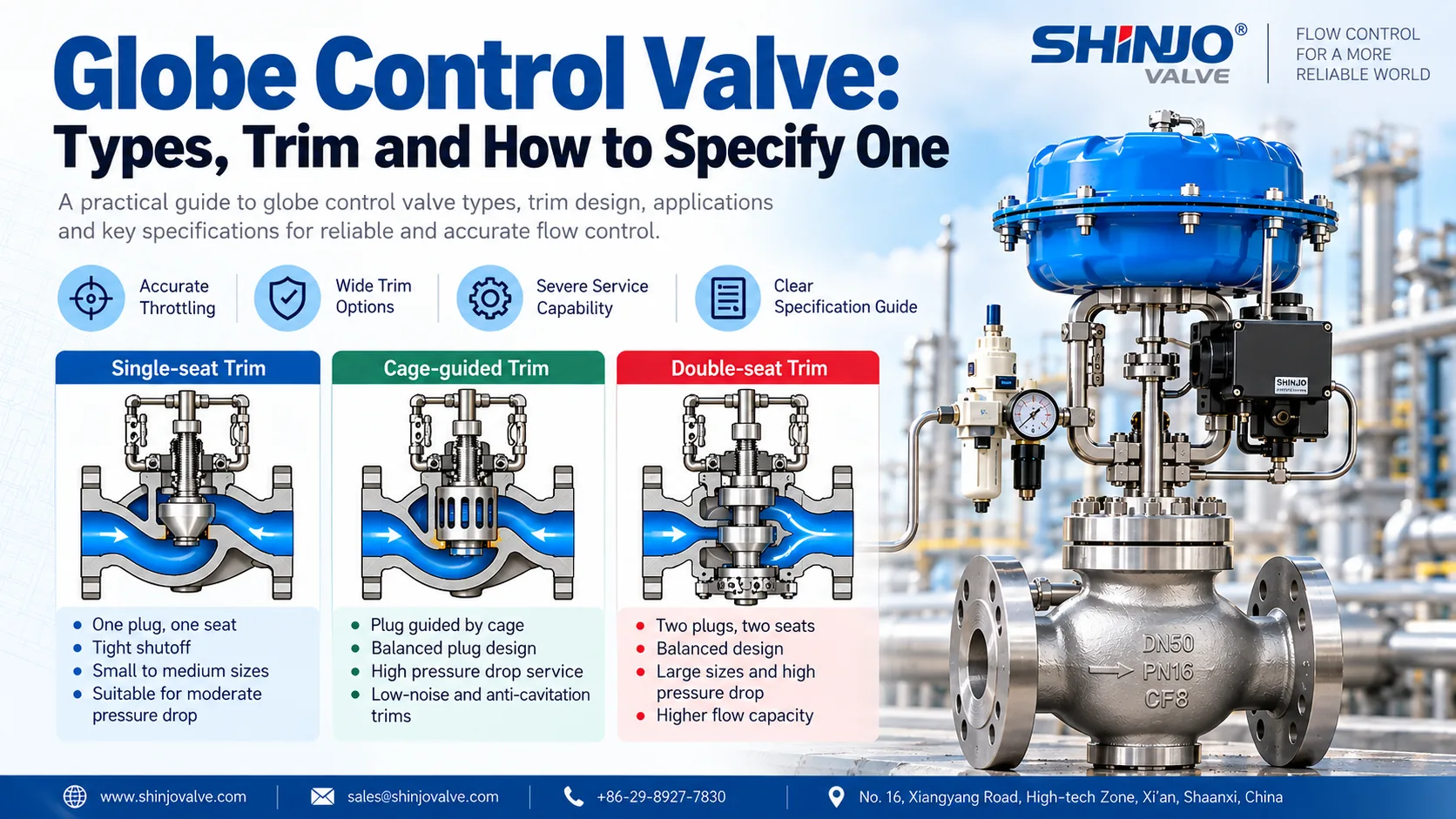
A globe control valve is the sliding-stem valve most process plants rely on when a loop has to throttle accurately. An actuator moves a contoured plug toward or away from a seat ring, and the changing gap sets the flow. The body and trim matter as much as the actuator on top of them: whether the trim is single-seat, cage-guided or double-seat decides how tightly the valve shuts off, how much pressure drop it can absorb and how large an actuator it needs.
This guide covers the valve body and trim: the main globe control valve types, where a globe body beats a rotary one, how each service changes the trim and materials, and what to write on the datasheet. Two neighboring subjects have their own pages. For actuator operation, symbols and diagrams, see our pneumatic control valve guide. For the sizing arithmetic, see Control Valve Selection: The 7 Numbers That Decide It.
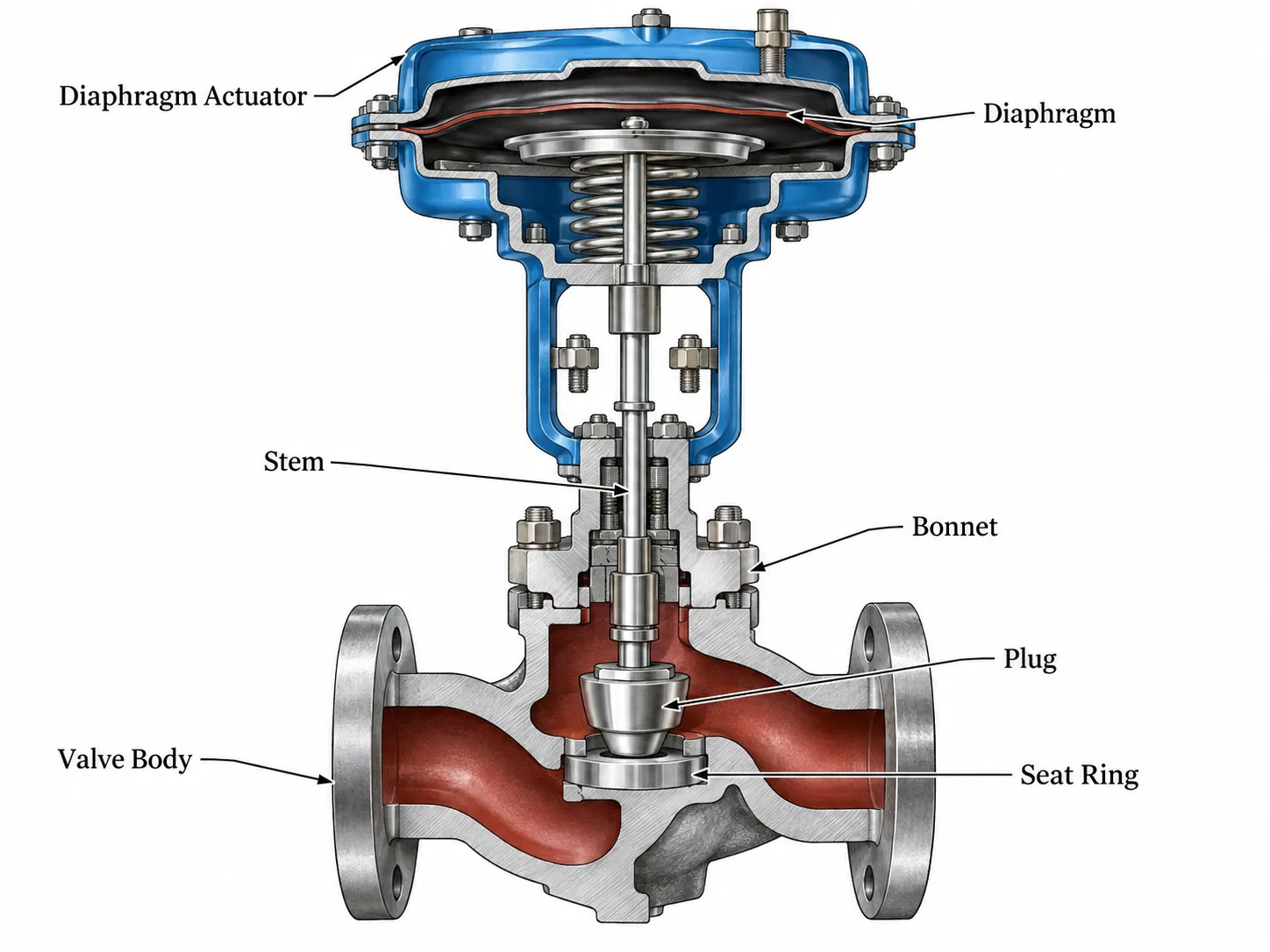
A globe control valve is a linear-motion valve. The stem travels in a straight line, and the plug it carries opens or closes a circular port in the seat ring. Flow enters the body, turns through the port and turns again to leave, which gives the body its rounded shape. The parts that do the controlling are together called the trim: the plug, the seat ring and, in many designs, a cage that guides the plug.
It belongs to the same body family as the manual globe valve, but the two are built for different jobs. A manual globe valve isolates or roughly throttles under a handwheel. A globe control valve has a characterized plug or cage, guided trim, low-friction packing and an actuator with a positioner, so it can hold any position between closed and open and return to it repeatedly.
Three properties make the globe body the usual first choice for throttling:
- Predictable control. Plug travel maps to flow area through a machined profile, so the valve can be built with a linear or equal-percentage characteristic and keep it.
- Low pressure recovery. A globe trim recovers less pressure downstream of the port than a butterfly or ball valve does, which appears as a higher liquid pressure recovery factor (FL) in the IEC 60534-2-1 sizing equations. At the same pressure drop, a globe valve therefore keeps more margin before cavitation and choked flow. Use the manufacturer's tested FL for the actual trim.
- Trim options and top-entry service. Reduced-capacity, low-noise and anti-cavitation trims fit the same body, and the trim comes out through the bonnet while the body stays in the line.
The costs are a more complex flow path, more pressure loss at full opening, and more weight and price than a rotary valve of the same capacity. In large line sizes that difference often decides the choice.
| Type | How it works | Where it fits | Main limitation | Shinjo series |
|---|---|---|---|---|
| Single-seat, top-guided | One plug closes on one seat | Tight shutoff; small to medium sizes; moderate pressure drop | Unbalanced plug: the actuator works against the full differential across the port | ZJHP |
| Cage-guided, balanced plug | The plug slides inside a cage; holes through the plug equalize pressure above and below it | High pressure drop; larger sizes; low-noise and anti-cavitation trims | The plug-to-cage seal is an extra leak path; tight clearances do not tolerate solids | ZJHM |
| Double-seat | Two plugs on one stem close on two seats | Large flow with a small actuator | Looser shutoff; can be unstable at small openings | ZMAN |
| Angle body | Inlet and outlet at 90°; flow leaves straight down the outlet | High pressure drop, flashing, viscous or solids-bearing fluids | Piping must suit the angle layout | ZMAS |
| Three-way | One plug assembly mixes two inlets or splits one inlet | Temperature control around heat exchangers; bypass duty | Mixing and diverting trims are not interchangeable | ZMAQ(X) |
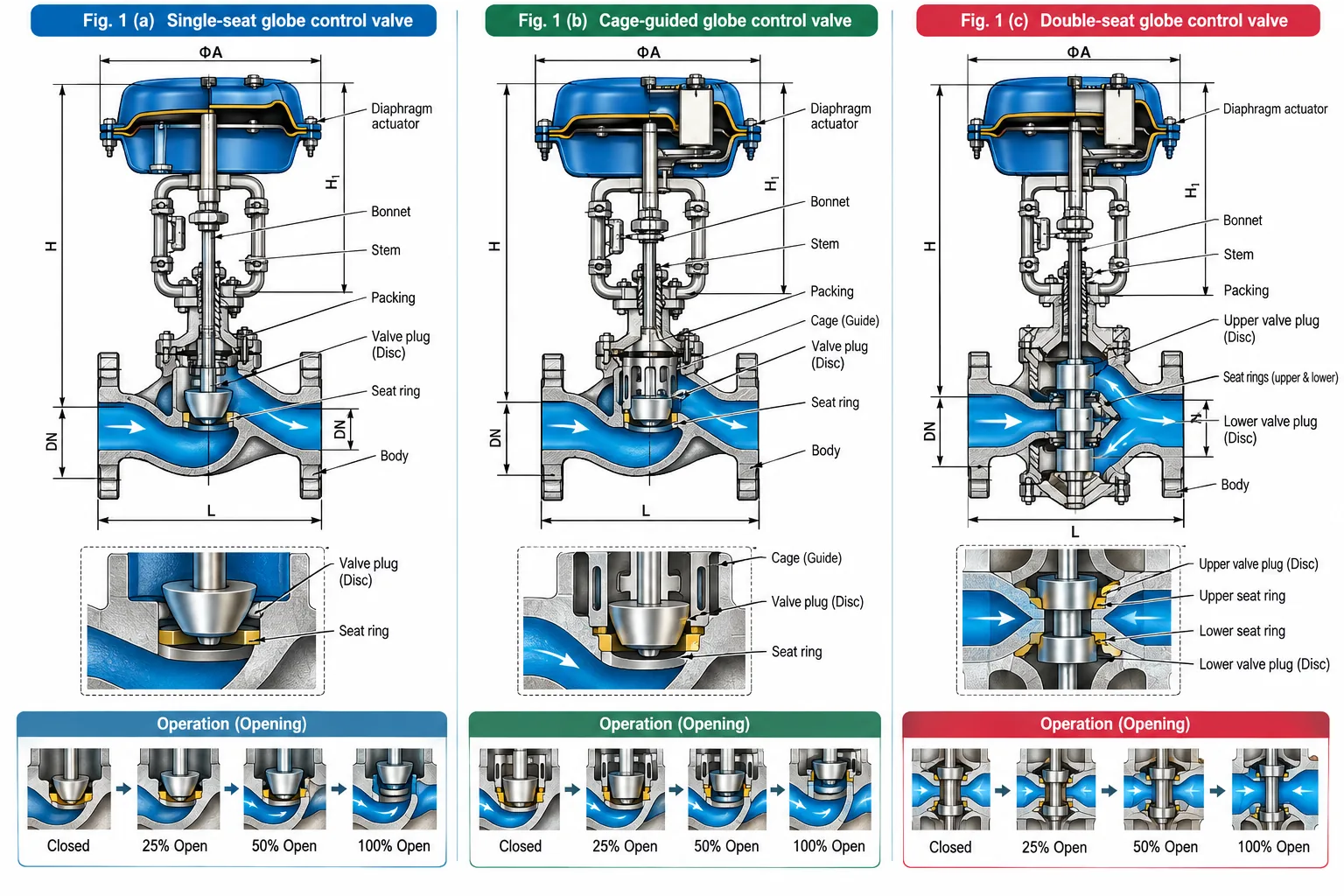
The single-seat design is the simplest and the tightest. One plug seats on one ring, so a metal-seated valve typically meets Class IV under ANSI/FCI 70-2 and IEC 60534-4, and a soft seat can reach Class VI. The price is force. The pressure differential acts across the whole port, so the actuator must overcome that load plus seat load and packing friction, which limits the allowable shutoff pressure as the valve gets larger.
Shinjo's ZJHP single-seat globe control valve is published in DN20 to DN350, PN16 to PN64 and Class 150 to 900, with linear or equal-percentage trim and an inherent rangeability of 50:1. It is intended for duties with a small allowable leakage and a limited differential pressure.
In a cage-guided control valve, a cylindrical cage guides the plug over its full travel, and the cage windows rather than the plug contour set the flow characteristic. Most cage valves use a balanced plug: holes through the plug let pressure act on both faces, so the unbalanced force is much smaller and so is the actuator. The cage also makes severe-service trims possible, because a drilled-hole or multi-stage cage breaks one large pressure drop into several small ones.
Balancing has a cost. The seal between plug and cage is a second leak path, so shutoff is normally looser than an unbalanced single-seat valve unless special seals are fitted. Shinjo states that its metal-seated cage trim can meet Class IV to GB/T 4213. Close plug-to-cage clearances also make this design a poor choice for fluids that carry solids or crystallize.
A double-seat valve puts two plugs on one stem. Pressure pushes one plug open and the other closed, so the forces largely cancel and a small actuator can move a large, high-capacity valve. The two plugs cannot both seat perfectly at once, especially after temperature changes the stem length, so leakage is higher: Shinjo publishes its ZMAN double-seat control valve at Class II, at most Class III. The net force on the plugs can also reverse as the differential changes, which may cause vibration at small openings. On the other hand, the design tolerates slightly dirty fluids better than a cage valve.
For a fuller comparison, see the difference between single-seated and double-seated control valves.
An angle body turns the flow through 90° and discharges it straight down the outlet pipe, away from the body wall. That suits high pressure drops, flashing liquids and viscous or solids-bearing fluids, and the body drains itself. Shinjo's ZMAS angle type control valve covers DN40 to DN200 in Class 150 to 1500.
A three-way valve replaces two two-way valves on mixing or diverting duty, most often temperature control around a heat exchanger. A mixing trim (two inlets, one outlet) and a diverting trim (one inlet, two outlets) use different parts, so state the duty and attach a flow sketch with the inquiry.
Three variants cover the edges of the range. A fluorine-lined single-seat valve puts an FEP lining between a strongly corrosive fluid and the body. A cryogenic control valve, published for -196 to 45 °C, uses an extended bonnet to keep the packing away from the cold. A bellows-seal bonnet removes the packing as a leak path for toxic or regulated fluids.
The same bodies are available with electric linear actuators; see Shinjo's electric control valves.
| If the duty involves | Lean toward | Why |
|---|---|---|
| A large share of the system pressure drop across the valve | Globe | Low pressure recovery and staged trims |
| Accurate, repeatable control at low flow | Globe | Guided plug and fine travel resolution |
| Noise or cavitation that must be treated inside the valve | Globe, cage-guided | Multi-stage and drilled-hole cages |
| Tight metal-seated shutoff on a throttling valve | Globe, single-seat | Plug loads squarely on the seat |
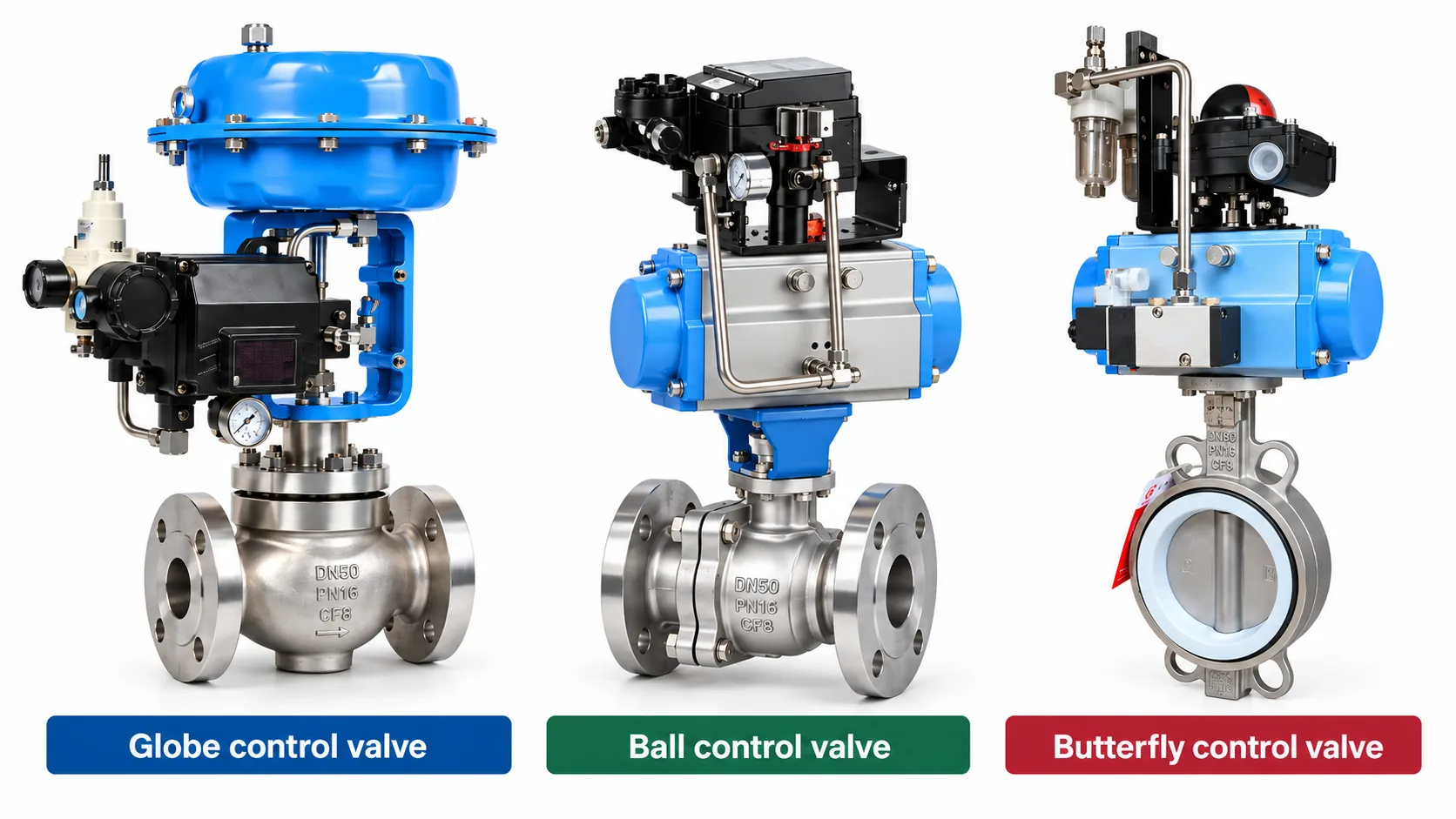
| Large lines, high capacity, low pressure drop | Rotary (butterfly) | Much more capacity for the size, weight and cost |
| Slurries, fibers or sticky fluids | Rotary (segmented ball, eccentric plug) | The closure member sweeps past the seat instead of trapping solids |
A globe valve is rarely wrong for a throttling duty, but it is often more valve than the duty needs. If the pressure drop is small, the fluid is clean and the line is large, a rotary valve usually does the job for less. A detailed side-by-side is in V-port ball control valves vs globe control valves.
The characteristic of a globe control valve is machined into the plug contour or the cage windows. Equal-percentage trim gives small flow changes at low travel and progressively larger ones as the valve opens, which suits systems where the pressure drop across the valve falls as flow rises. Linear trim gives equal flow change for equal travel and suits loops where the valve takes most of the system pressure drop. Quick-opening trim is for on-off duty. Installed behavior differs from the inherent curve because pumps, piping and other equipment change the pressure available across the valve.
Size the valve from flow and pressure drop, not from the pipe. A line-size globe valve is often oversized. The plug then works close to the seat, where a small movement produces a large flow change, the loop hunts and the seat sees high local velocity. A correctly sized globe control valve is commonly one size smaller than the line and installed between reducers. Ask the supplier for the calculated Cv and the predicted travel at minimum, normal and maximum flow, and check that the minimum case sits clear of the seat.
The equations, the characteristic decision and a worked rangeability example are in Control Valve Selection: The 7 Numbers That Decide It. The Cv formulas for water and steam are in Control Valve Cv Calculation.
| Service | Main risks | What to check | Typical globe solution |
|---|---|---|---|
| Steam | Choked flow, aerodynamic noise, high temperature, erosion | Steam condition, pressure-temperature rating, packing temperature | Cage-guided trim; multi-stage or low-noise cage for large pressure reductions; finned or extended bonnet |
| Water | Cavitation, flashing, water hammer, unstable low-flow control | Vapor pressure, pressure drop, travel at minimum flow, closing speed | Anti-cavitation cage; angle body with hardened trim where the liquid flashes |
| Gas | Choked flow, high velocity, noise, fugitive emissions | Compressible-flow sizing, pressure ratio, seat and stem leakage | Low-noise cage and larger outlet; low-emission packing or bellows seal |
| Chemicals | Corrosion, incompatible materials, leakage | Every wetted part at the actual concentration and temperature | Stainless or alloy trim; fluorine-lined single-seat body; bellows seal |
Steam combines high temperature, compressible flow, erosion and rapid pressure changes. Confirm whether the fluid is saturated steam, superheated steam or a steam-water mixture, because temperature and density differ. A large pressure reduction generates aerodynamic noise and high outlet velocity, which a staged or noise-attenuating cage reduces by taking the drop in steps. Body and trim ratings must cover design as well as operating conditions, and the packing must suit the stem temperature. If the duty is fixed pressure reduction rather than modulating control, a steam pressure reducing valve may be the simpler answer.
Water systems need attention to cavitation, flashing and water hammer. Cavitation starts when the pressure inside the trim falls below vapor pressure and the bubbles collapse as pressure recovers, damaging the plug, seat and body. An anti-cavitation cage splits the pressure drop into stages or moves the collapse away from metal surfaces. If the downstream pressure stays below vapor pressure, the liquid flashes instead. No trim prevents flashing, so the answer is hardened trim, an angle body and erosion-resistant outlet piping. Closing speed and piping design limit hydraulic shock.
Gas duties are governed by noise, choked flow, fugitive emissions and any fire-safe requirement the project defines. High differential pressure produces high velocity and aerodynamic noise, so compressible-flow sizing and a noise prediction belong in the quotation. The seat leakage class, packing and actuator accessories should reflect the actual gas.
Chemical service is a compatibility problem. The body, plug, seat, packing, gaskets, bellows and any lining must tolerate the actual concentration and temperature. A material described as corrosion resistant is not universally suitable. Give the supplier the chemical name, concentration, contaminants, moisture content and cleaning agents so compatibility can be checked against corrosion data and service experience.
Body. The body material follows corrosion resistance, strength, pressure-temperature limits and the piping specification. Carbon steel (WCB, WCC) is common in utility and hydrocarbon service, chrome-moly steel (WC6) is used at higher temperatures, and austenitic stainless steels (CF8, CF8M, CF3, CF3M) are used where corrosion resistance or cleanliness matters. These are the body materials Shinjo publishes for its ZJHP and ZJHM series. Chlorides, acids or sour constituents may call for a higher alloy or a lined body. Base the choice on the whole fluid, including contaminants, not on the main component alone.
Trim. The trim sees the highest velocity and all the mechanical contact, so it often needs different properties from the body. A stainless plug and seat are standard. Hardfaced or hardened surfaces last longer where erosion, cavitation, particles or frequent cycling are expected. Soft seats give low leakage within their temperature and chemical limits, while metal seats are preferred for high temperature, abrasive fluids and severe pressure drop. Specify the shutoff class the process needs, because an unnecessarily tight class adds actuator size and cost.
Bonnet. A standard bonnet serves moderate temperatures. A finned or extended bonnet keeps the packing and actuator away from very hot or very cold stem temperatures, and a bellows seal is used where stem leakage must be eliminated. For the ZJHP series, Shinjo publishes standard construction for about -20 to 200 °C, a finned bonnet for up to 450 °C and high-temperature materials for up to 560 °C. Confirm the limit for the quoted material.
Packing. Packing affects emissions, friction and actuator sizing. PTFE-based packing gives low friction and broad chemical resistance within its temperature range. Graphite packing is used for higher temperatures and fire-related requirements but adds friction. State any requirement for fugitive-emission qualification (for example ISO 15848-1), sour-service materials (NACE MR0175 / ISO 15156), oxygen cleaning or low-temperature preparation.
A globe valve needs linear thrust. The actuator must move the plug against the differential pressure, packing friction and seat load, with margin, at the minimum air or power supply available on site.
Spring-diaphragm actuators are the usual match, because they are sensitive and the spring gives a defined fail position. Shinjo fits multi-spring diaphragm actuators with published spring ranges of 20 to 100, 40 to 200 and 80 to 240 kPa. Piston actuators deliver more thrust in a compact package for large or high-pressure valves, and electric linear actuators are used where there is no instrument air. Size for the worst credible differential and the required shutoff load, not only for the normal control condition. For how the actuator itself works, see How Does the Pneumatic Actuator of a Control Valve Work?
Fail action is a process safety decision. An air-to-open valve with a spring-return actuator closes on air failure, and an air-to-close valve opens. A steam heating valve may need to fail closed to prevent overheating, while a cooling-water valve may need to fail open to protect equipment. Some duties need fail-in-place behavior, using lock-up devices, accumulators or double-acting actuators. The process hazard review should define the action, not a convention.
A positioner compares the control signal with the actual stem travel and adjusts the actuator pressure until they agree, which overcomes packing friction and plug forces. Digital and electro-pneumatic positioners can add diagnostics and feedback where the control system supports them; see What Is a Valve Positioner, and How Does It Work. Specify the input signal, communication protocol, hazardous-area classification, enclosure protection, ambient temperature and feedback requirements. Air filter regulators, solenoid valves, limit switches and manual overrides should be selected as part of the complete assembly. Shinjo also supplies actuators, positioners and air filter regulators as valve accessories.
| Symptom | Likely cause | What to check or change |
|---|---|---|
| Hunting or cycling near the seat | Oversized valve, sticking packing, positioner or controller tuning | Predicted travel, friction and loop tuning, before replacing parts |
| High noise on steam or gas | Choked or near-choked flow, high outlet velocity | Low-noise or multi-stage cage, larger outlet, noise prediction to IEC 60534-8-3 |
| Rattling noise and pitted trim on liquid | Cavitation | Anti-cavitation trim, pressure staging, moving part of the pressure drop elsewhere |
| Leakage through a closed valve | Worn or eroded seat, low seat load, wrong class specified | Trim condition, actuator thrust, the specified shutoff class |
| Leakage at the stem | Worn or overheated packing | Packing type, bonnet extension, live-loaded packing or a bellows seal |
| Valve does not reach full travel | Low air supply, undersized actuator, solids in the cage | Supply pressure at the valve, actuator sizing, trim cleanliness |
Severe-service symptoms usually mean energy is being dissipated too abruptly. Remedies include multi-stage trim, a diffuser, larger outlet piping or moving part of the pressure drop elsewhere. Each should be confirmed by calculation rather than chosen from a product description.
Installation matters as much as selection. Install the valve in the direction of the arrow on the body, because flow direction is part of the trim design. Most unbalanced single-seat valves are flow-to-open, with the flow under the plug; flow in the closing direction can pull the plug onto the seat at small openings and destabilize the loop. Provide the straight pipe the manufacturer recommends, support the line so the body does not carry piping loads, and leave clearance above the actuator to lift the bonnet and trim. Instrument air should meet the positioner manufacturer's cleanliness and dryness requirements.
Plan maintenance around the consequences of failure. Critical valves may justify online diagnostics, a bypass, or stocked trim and packing kits. Record travel, response, air consumption and leakage at commissioning so later changes can be identified. Persistent hunting is not automatically a valve defect, and diagnosing the complete loop avoids replacing components that are working as designed.
Two quotations are comparable only if they answer the same datasheet.
| Group | What to state |
|---|---|
| Process | Fluid and phase; minimum, normal and maximum flow; inlet and outlet pressure for each case; temperature; density or molecular weight, viscosity and vapor pressure |
| Body | Straight, angle or three-way (mixing or diverting); size and pressure class; end connection; face-to-face standard (IEC 60534-3-1 or ISA-75.08.01 for flanged globe bodies); body material |
| Trim | Single-seat, cage-guided or double-seat; balanced or unbalanced; flow characteristic; required Cv; flow direction; seat leakage class and test standard; trim materials; any low-noise or anti-cavitation requirement |
| Bonnet and packing | Standard, finned, extended or bellows-seal bonnet; packing type; emission requirement |
| Actuation | Actuator type; fail position; minimum and maximum air supply, or the electrical supply; positioner signal and protocol; solenoid valve, limit switches and air set; hazardous-area and enclosure ratings |
| Standards and documents | Design, rating and test standards (API, ASME, EN, DIN, JIS, GB or the project specification); inspection and test plan; material certificates; sizing and noise calculations; drawings; painting and preservation |
Compare technical compliance before price: sizing results, materials, pressure-temperature limits, trim construction, actuator margin, accessory specifications, test scope, documents, delivery and spare parts. Resolve deviations in writing and ask for a final datasheet and drawing for approval. To have a duty checked, send your process data to Shinjo.
It throttles flow to hold a process variable such as flow, pressure, temperature or level at its setpoint. It is chosen where control must be accurate and repeatable, or where the valve has to absorb a significant pressure drop, for example on steam, feedwater, process gas and chemical lines.
A manual globe valve is operated by a handwheel and is used for isolation and coarse throttling. A globe control valve has a characterized plug or cage, guided trim and an actuator with a positioner, so it can modulate continuously in response to a control signal.
Choose single-seat for tight shutoff at moderate differential pressure, in smaller sizes, and for fluids that are not perfectly clean. Choose a cage-guided balanced valve when the differential pressure or the size would make a single-seat actuator too large, or when a low-noise or anti-cavitation trim is needed and the fluid is clean.
Not necessarily. Size it from the required flow capacity and the available pressure drop. A correctly sized valve is often smaller than the line and installed between reducers, with checks on velocity, noise and piping effects.
Evaluate it when the pressure inside the trim falls near or below the liquid's vapor pressure and then recovers downstream. The decision depends on inlet and outlet pressure, vapor pressure, temperature, the trim's pressure recovery factor and how long the valve operates in that condition.
Follow the arrow on the body. Unbalanced single-seat valves are usually flow-to-open, while cage-guided valves may be flow-up or flow-down depending on the trim. Reversing the direction changes plug forces, capacity and noise behavior, so confirm with the manufacturer first.
Yes. The body and trim are the same, and an electric linear actuator replaces the diaphragm actuator where instrument air is not available. An electric actuator stays in its last position on power loss unless a fail-safe option is specified.
Start from the duty, then choose the trim: single-seat for tight shutoff, cage-guided for high pressure drop and severe-service trims, double-seat for capacity, and an angle or three-way body where the piping or the process calls for it. Match the materials, bonnet and packing to the fluid, size the actuator for the worst case, and put all of it on one datasheet so every supplier quotes the same valve.
