Mechanical Properties of Ductile Iron Pipe Joints: A Review
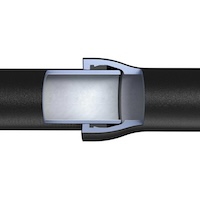
Abstract: To address deformation and fracture at pipe joints caused by insufficient resistance to axial tension and transverse bending in engineering applications, this paper reviews recent studies worldwide on the axial tensile, transverse bending, and other mechanical properties of ductile iron pipe joints. It identifies gaps in the existing literature and discusses potential directions for future research.
Steel water supply pipes used for river crossings in coastal areas are exposed to sea air and moisture, making them susceptible to rapid and severe corrosion. Ductile iron pipes, by contrast, generally have better corrosion resistance, higher strength, and greater durability, making them widely used in water supply projects. Ductile iron pipes are typically manufactured in 6 m lengths and joined on site. Because the joints are relatively vulnerable sections of the pipeline, joint pull-out is a common failure mode. Buried water supply pipelines, particularly those installed in poor soil conditions, are subject to axial tensile and compressive forces at the joints, which may result in joint pull-out, compressive failure, and axial cracking. Consequently, the mechanical and service performance of ductile iron pipe joints has been extensively investigated worldwide.
Axial pull-out tests have been conducted on rubber-gasketed flexible joints, which are widely used in China, with nominal diameters of 150, 200, and 300 mm to investigate the axial mechanical properties of ductile iron pipe joints. Quasi-static tests have also been performed on bell-and-spigot flexible joints to characterize and compare their axial mechanical responses under different loading conditions. The tests determined the ultimate leakage displacement and maximum tensile force and revealed a nonlinear force–displacement relationship for rubber-gasketed flexible joints.
Based on the experimental results and theoretical analysis, a model was developed to describe the axial force–deformation behavior of pipeline joints under cyclic loading, and its predictions agreed well with the experimental data. An equation for the axial stiffness of flexible bell-and-spigot joints was also proposed. Under cyclic loading, the hysteresis loops were relatively full and remained consistent at different loading displacements, indicating good seismic performance and energy-dissipation capacity of the flexible rubber-gasketed joints.
These findings provide a theoretical basis for manufacturers to optimize rubber gasket design and manufacturing and offer useful guidance for engineers in the seismic design of pipeline systems.
Jinghai Zhou et al. conducted static tensile tests on flexible joints in buried ductile iron pipelines, focusing on the following aspects:
- The mechanical properties of pipe joints.
- The pull-out resistance of joints under seismic loading.
- The force–displacement relationship of joints under axial tension.
- The tensile and seismic behavior of the joints.
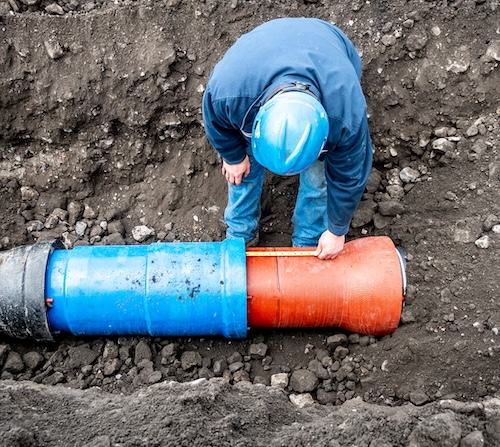
The results showed that the seismic performance of ductile iron pipelines with flexible joints depends strongly on pipe diameter, with larger-diameter pipes exhibiting greater seismic resistance. Water-filled pipes also demonstrated better seismic performance than empty pipes.
Based on these findings, the authors further investigated the mechanical behavior of pipe joints and the soil–pipe friction developed in sandy soil. The pull-out resistance of the joints under seismic loading was then evaluated and used as an indicator of pipeline seismic performance.
The maximum displacement capacities of the pipe joints were:
- DN150: 5.7 cm.
- DN200: 5.8 cm.
The internal water pressure remained stable within these displacement ranges. A sharp pressure drop occurred only after joint failure, indicating that no leakage occurred within the tested displacement range. These results provide a direct basis for evaluating damage to existing ductile iron pipelines.
Zilan Zhong et al. conducted static tensile tests on bell-and-spigot joints in ductile iron pipes, focusing on their axial pull-out behavior and failure characteristics. Their results showed that the finite element model developed for the pipe joints could effectively capture key mechanical responses, including stiffness degradation and energy dissipation, under axial cyclic loading. These findings provide valuable experimental data and numerical support for analyzing buried pipelines and evaluating their performance under complex axial loading.
The study also reached several conclusions with practical engineering implications:
(1) Numerical simulations showed that the axial force–displacement curves of the pipe joints were nearly identical with and without internal pressure. This indicates that internal pressure has little effect on the axial tensile behavior of the joints, suggesting that additional axial reinforcement of pressurized pipelines may not be necessary in practice.
(2) The loading mode, whether monotonic or cyclic, had little effect on the mechanical performance of the bell-and-spigot joints. In contrast, the spigot insertion depth was the primary factor governing the maximum tensile displacement of the joints.
Qingren Liu et al. investigated the variation in internal forces in tensile-resistant clamps used with T-type push-on flexible joints in ductile iron pipelines. They analyzed the restraining effect of the surrounding soil on pipe slippage and proposed a composite soil–pipe friction coefficient. The results showed that the axial bolt tension decreased markedly with increasing distance from the pipe bend compared with the tension at the bend.
Chunguang Chen et al. developed a full-scale test setup and conducted pull-out tests to investigate the mechanical behavior of rubber-gasketed push-on joints. Key parameters, including tensile force and joint deformation, were measured during the tests.
The test results showed that the rubber-gasketed push-on joint exhibited good axial tensile performance. When the joint deformation reached 40 mm, the pull-out force began to decrease, indicating that the joint had reached its peak axial tensile capacity. These results were consistent with findings reported in previous studies, with the agreement among different research groups providing further support for the reliability of the experimental results.
Provided that the rubber gasket remains intact, joint deformation should be maintained below the displacement at which the spigot disengages from the gasket. Based on this criterion and the measured force–displacement curves, the allowable joint deformation was estimated to be 3–4 cm, which is slightly higher than the values specified in current standards. These findings provide a practical basis for the rapid identification of pull-out failure in ductile iron pipelines in the field.
Liping Wang et al. conducted destructive tests on push-on joints in ductile iron water supply pipelines to investigate their mechanical behavior under vertical loading and developed a finite element model for numerical analysis. The results indicated that conventional joint designs are susceptible to failure under various loading conditions, including:
- Contact slip.
- Rotation.
- Pull-out.
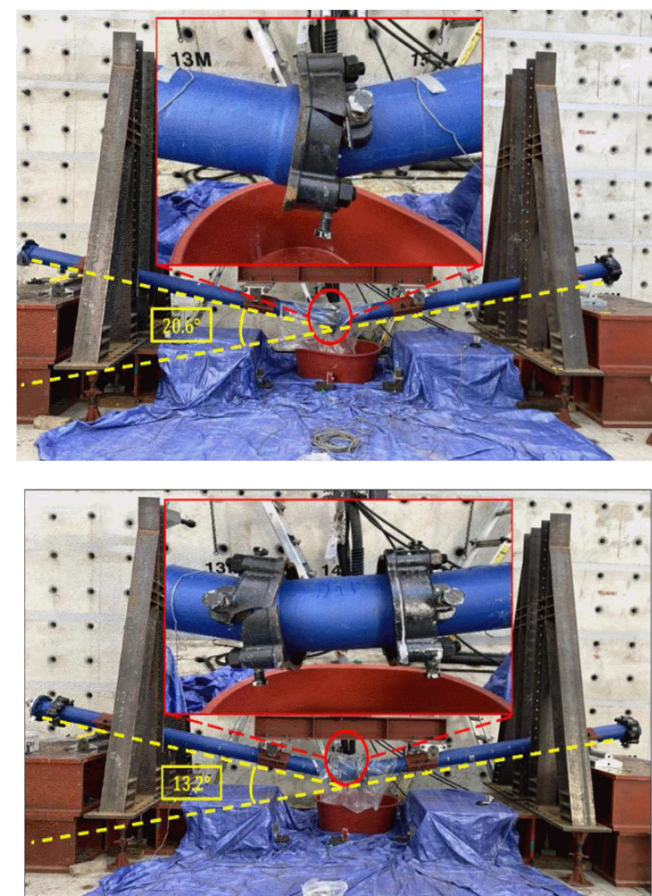
Based on these findings, the authors suggested that the design of rubber sealing rings used in ductile iron pipe joints should be further optimized.
Liwei Xu et al. investigated the mechanical behavior of ductile iron pipelines under different environmental conditions by developing simplified models based on the loading characteristics of the pipelines. In their analysis, the buried section of the ductile iron pipeline was modeled as a Vlasov beam on an elastic foundation, while the suspended section was simplified as a simply supported beam. Based on deformation compatibility, formulas were derived to calculate pipeline deflection and internal forces. These formulas can be used in engineering practice to rapidly determine key parameters such as pipeline span and burial depth.
Building on this work, the effects of the following key factors on the mechanical behavior and safety of suspended ductile iron pipelines under sinkhole conditions were systematically analyzed:
- Pipe material.
- Sinkhole size.
- Burial depth.
- Pipe specifications.
A normalization analysis was also performed to quantify the relative influence of these factors. The results showed that sinkhole size had the greatest influence on pipeline safety. This finding highlights the importance of strict quality control of the sand bedding beneath ductile iron pipelines during design and construction, as well as targeted ground improvement in areas with adverse geological conditions. The findings also have implications for emergency pipeline repair by providing a basis for rapidly assessing the effects of ground collapse on pipeline safety and developing appropriate repair strategies.
Xiaoxiao Li et al. conducted quasi-static loading tests on push-on joints of 400 mm diameter ductile iron pipes to investigate the mechanical behavior and failure mechanisms of water-filled pipe joints under axial tension and transverse bending. Monotonic and cyclic loading tests were combined with nonlinear numerical analysis. The numerical results agreed well with the experimental data, demonstrating that the model could effectively reproduce the mechanical response of the joints under cyclic loading, including stiffness degradation and energy dissipation.
To investigate the bending resistance of rubber-gasketed flexible joints in ductile iron pipelines under constant internal water pressure, Duan Junfeng et al. conducted full-scale bending tests on ductile iron pipes with different diameters and established the relationship between joint bending performance and load-bearing capacity. The experimental data were subsequently fitted using the MATLAB mathematical toolbox to develop a mechanical model for joint bending behavior. The model provided further insight into the bending response and load-bearing capacity of rubber-gasketed flexible joints in ductile iron pipelines.
Zilan Zhong et al. conducted four-point bending tests on push-on joints of 150 and 200 mm diameter ductile iron pipes to investigate their mechanical behavior and failure modes under transverse loading. The tests were performed without external soil cover and with an internal water pressure of 0.2 MPa. Both monotonic and cyclic loading were applied under various combined tension–bending conditions. The results showed that, depending on the initial joint opening, the bending moment–rotation response of the joint could be divided into three stages:
- Initial linear stage.
- Plastic deformation stage.
- Final stage leading to ultimate bearing failure.
These findings provide a useful basis for investigating seismic damage, conducting seismic assessments, developing design methods, and formulating seismic mitigation measures for buried ductile iron pipelines.
The lining method is a trenchless rehabilitation technique used for pipeline repair. To evaluate its effectiveness in improving the load-bearing and deformation capacities of pipe joints, the technique was applied to rehabilitate the bell-and-spigot joints of an existing 400 mm ductile iron water supply pipeline. Quasi-static pull-out and bending tests were then conducted on the rehabilitated joints. The results showed that the lining method significantly increased the tensile and flexural load-carrying capacities of the joints.
The experimental results provide essential data for evaluating the applicability of the lining rehabilitation technique and optimizing its construction procedures. As pipeline repair is a common engineering requirement, these findings also provide a useful reference for the development of rapid pipeline rehabilitation technologies.
To overcome the limitations of conventional bell-and-spigot joints, researchers have conducted studies on improved and novel joint designs. Based on the principles of mechanical self-anchoring and self-compensating deformation, Zhong Zilan et al. proposed a novel self-anchoring seismic joint for ductile iron pipelines. They conducted quasi-static axial tensile tests on both conventional bell-and-spigot joints and the proposed seismic joint, together with refined three-dimensional finite element simulations of the new joint. The study examined key mechanical characteristics of the proposed joint, including its tensile load-carrying capacity, initial tensile stiffness, deformation capacity, and ultimate failure state.
The authors also conducted axial mechanical performance tests on the novel seismic joint and developed a numerical model of a pipeline crossing a fault. The numerical results were validated against corresponding full-scale test data. By considering soil compaction conditions and the orientation of the pipeline
Under fault displacement, damage to water supply pipelines tends to occur at vulnerable locations such as pipe joints. To improve the performance of these vulnerable sections, the authors modified conventional bell-and-spigot joints by incorporating rubber gaskets and metal restraining rings, thereby developing a novel bell-and-spigot joint with enhanced pull-out resistance.
Before reaching the serviceability limit state, the novel joint can accommodate a certain degree of axial tension, axial compression, and rotational deformation. When the axial deformation reaches a critical level, a self-locking mechanism is activated to prevent further pull-out or joint separation and maintain the overall stability of the pipeline. After self-locking is engaged, relative displacement develops between adjacent pipe segments and the surrounding soil, producing an interlocking effect that helps absorb and mitigate excessive deformation induced by fault displacement. This mechanism enhances the seismic resistance and deformation adaptability of the pipeline.
To further evaluate the resistance of water supply pipelines with the novel push-on joints to fault displacement, the authors developed a three-dimensional nonlinear finite element model of pipe–soil interaction and investigated the effects of key parameters, including burial depth and the pipeline–fault intersection angle.
Singhal et al. derived analytical expressions for the tensile, flexural, and torsional capacities of pipeline joints based on experimental results. Meis et al. investigated the mechanical behavior of pipeline joints under static and dynamic loading and established their tensile deformation patterns and force–displacement relationships.
Yannian Zhang et al. investigated the effects of wet–dry cycles in acidic chloride solutions on the flexural performance of ductile iron pipe joints, obtaining moment–displacement curves and establishing the relationship between ultimate load-carrying capacity and the number of wet–dry cycles. The results showed that the flexural stiffness gradually decreased as the number of cycles increased, whereas the strains in the pipe body and flange increased continuously. The researchers also compared the effects of acidic, neutral, and alkaline salt solutions on the ultimate flexural capacity of ductile iron pipe joints and found that acidic salt solutions had the greatest effect. After 25–100 wet–dry cycles, the ultimate flexural capacity decreased by up to 35.13%.
Tong Jiang et al. investigated the seismic response of buried pipelines with flexible joints under seismic wave excitation. They homogenized the pipe bodies and joints into an equivalent uniform medium and developed a simplified elastoplastic pipe element model based on the response displacement method. On this basis, they derived a formula for calculating the displacement of straight pipe segments subjected to seismic displacement waves. The formula enables rapid estimation of joint deformation under seismic loading and can be applied in the seismic design of buried pipelines.
After determining the displacements of the equivalent pipe model, the researchers further analyzed the pipe segments and joints to obtain their actual internal forces and deformations. The proposed formulas were then used to evaluate the seismic responses of two types of buried pipelines, PVC and cast iron. The results were validated against finite element simulations, demonstrating that the proposed method provides sufficient computational accuracy for seismic design applications involving buried pipelines.
Chunguang Liu et al. investigated the seismic performance of composite bell-and-spigot buried pipelines by developing a finite element model of the pipe body consisting of four glass fiber/thermoset plies arranged in a 0°/90°/0°/90° sequence. Based on equivalent spring parameters representing the joints in three directions, they analyzed the mechanical behavior of the bell-and-spigot joints, focusing on the overall displacement distribution of buried pipelines under earthquakes of different intensities and the stress distribution in each ply, as well as the seismic performance of the bell-and-spigot joints.
The study identified the key constitutive parameters of the equivalent springs, including those for the axial, bending, and transverse directions of the flexible bell-and-spigot joints. The research methods and findings provide a useful reference for engineering applications and further research.
In summary, researchers worldwide have conducted extensive studies on the axial mechanical behavior of push-on joints in ductile iron pipes, including tensile capacity, axial deformation, seismic response, and energy dissipation under cyclic loading. The analytical and numerical models developed to characterize the axial behavior of these joints are generally relatively simple, while practical measures such as self-anchoring joints and concrete thrust blocks can be adopted to mitigate joint pull-out and other failure modes. Research has also addressed the transverse bending behavior of ductile iron pipe joints, including their bending resistance, deformation characteristics, and failure mechanisms. These findings provide a theoretical basis and practical guidance for the design, construction, and long-term management of municipal pipeline systems.