Shanghai Jonloo Machine MFG Co., Ltd.
What is Angle Type Globe Valve
On this page
In piping systems, angle-type globe valves are frequently employed to control the flow of gases or liquids. An extensive review of angle-type globe valves, covering their construction, uses, and functioning, is given in this comprehensive guide. The various kinds of angle-type globe valves, their benefits and characteristics, and how to choose the best valve for your requirements will all be covered.
Numerous industries, such as petrochemicals, shipbuilding, and pharmaceuticals, use angle-type globe valves. Additionally, they are frequently used to control medium flow in fuel oil or cooling water systems.
These valves are built for high-pressure environments and can handle a range of temperatures and pressures. Made of materials like cast iron or stainless steel, they’re designed for optimal performance in high-pressure settings. Let’s take a detailed look and determine which one is the best for you.
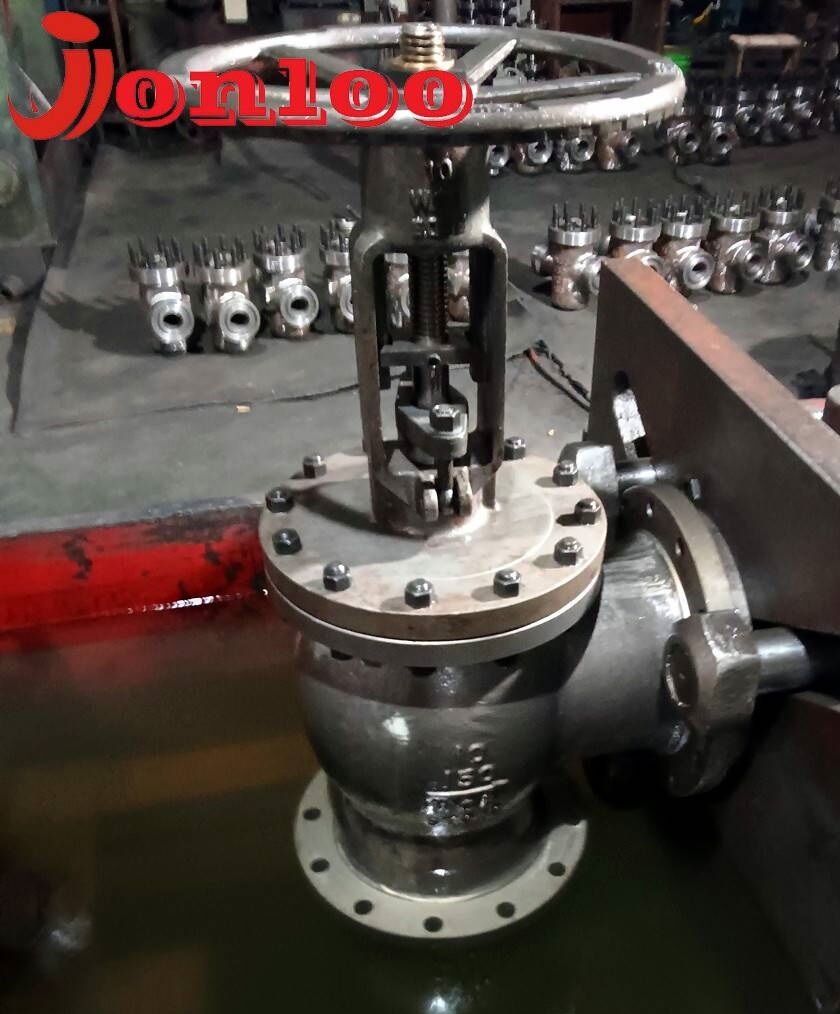
Installed at pipe changes, an angle-type globe valve is a variation of a conventional globe valve with right-angled intake and exit ports to allow for less pressure drop.
An angle-type globe valve is a variation of a Z-body globe valve that requires only one elbow rather than two since its diaphragm, or the basic glove, may move at right angles to its pipe axis. This allows for more efficient use.
The globe-shaped body of the valve has a moveable disk or plugs that can be raised or lowered to regulate the fluid flow. The fluid flow's direction changes due to the angle formed by the input and output ports, which can lessen turbulence and pressure loss.
Mechanical control valves called globe valves are used to adjust pressure and flow. Globe valves come in a wide range of designs and shapes, and they can be used to regulate both.
Compared to regular pattern globe valves, angle globe valves have a unique shape that allows for smaller pressure dips and requires fewer fittings during installation.
Depending on its use and temperature range, a Y-pattern globe valve seat can be made of either soft or metallic material. Soft-seated seats are usually used for low-temperature systems up to 60 degrees Celsius, while metallic seats are used for higher temperatures.
Generally speaking, angle valves should be positioned with their outlet pipe pointing downward to lessen the possibility of corrosion or fluid clogging over time.
When this kind of valve is opened, fluids can freely flow between its two ports because of its spherical body and tunnel connecting them.
These linear motion globe valves provide high degrees of shutdown capability and are a great option for steam and condensate service, pipeline temperature or pressure adjustment, and nuclear plant process control.
Angle-type globe valves are extensively utilized in many different sectors where accurate liquid or gas flow control is required. Angle-type globe valves are used in the following applications:
There are several disk designs available for this valve, including plug, composition, and ball disks. Low-pressure, low-temperature applications are where ball designs are most commonly used.
uses for this kind of valve include lubricant, air, and chemical uses, as well as cooling water and fuel oil systems. It is frequently selected because of its resistance to a wide range of temperatures and pressures.
A spherical body with an internal baffle and a threaded hole in the middle that acts as a seat for a plug that can be screwed on to seal or shut off the valve make up a valve.
By eliminating pipe elbows and reducing flow resistance, angle pattern designs allow media flow to perform a single 90-degree turn without the need for an elbow or extra welds.
The ability of angle valves to efficiently control varying flow conditions that result in slugging is a clear benefit. Because of this feature, angle valves are a great way to avoid pipe problems that other valves can cause.
Numerous industries, such as petrochemicals, shipbuilding, and pharmaceuticals, use angle-type globe valves. Additionally, they are frequently used to control medium flow in fuel oil or cooling water systems.
These valves are built for high-pressure environments and can handle a range of temperatures and pressures. Made of materials like cast iron or stainless steel, they’re designed for optimal performance in high-pressure settings. Let’s take a detailed look and determine which one is the best for you.
Installed at pipe changes, an angle-type globe valve is a variation of a conventional globe valve with right-angled intake and exit ports to allow for less pressure drop.
An angle-type globe valve is a variation of a Z-body globe valve that requires only one elbow rather than two since its diaphragm, or the basic glove, may move at right angles to its pipe axis. This allows for more efficient use.
The globe-shaped body of the valve has a moveable disk or plugs that can be raised or lowered to regulate the fluid flow. The fluid flow's direction changes due to the angle formed by the input and output ports, which can lessen turbulence and pressure loss.
Mechanical control valves called globe valves are used to adjust pressure and flow. Globe valves come in a wide range of designs and shapes, and they can be used to regulate both.
Compared to regular pattern globe valves, angle globe valves have a unique shape that allows for smaller pressure dips and requires fewer fittings during installation.
- Y-Pattern
Depending on its use and temperature range, a Y-pattern globe valve seat can be made of either soft or metallic material. Soft-seated seats are usually used for low-temperature systems up to 60 degrees Celsius, while metallic seats are used for higher temperatures.
- Straight-Through
Generally speaking, angle valves should be positioned with their outlet pipe pointing downward to lessen the possibility of corrosion or fluid clogging over time.
- Right-Angle
When this kind of valve is opened, fluids can freely flow between its two ports because of its spherical body and tunnel connecting them.
- Direct-Flow
These linear motion globe valves provide high degrees of shutdown capability and are a great option for steam and condensate service, pipeline temperature or pressure adjustment, and nuclear plant process control.
Angle-type globe valves are extensively utilized in many different sectors where accurate liquid or gas flow control is required. Angle-type globe valves are used in the following applications:
- Chemical Processing
- Food and Beverage
- HVAC
- Oil and Gas
- Pharmaceutical
- Power Generation
- Water Treatment
- Angle-type globe valves use a moveable disk or plug to control the opening of a port, hence regulating the flow of gases or fluids via a pipe.
- These valves can be fitted in spaces with limited space because of their tilted body shape.
- The disc, which is attached to the valve stem, can be turned by the actuator or handwheel to open or close the valve.
- The disc is pulled away from the seat when the valve is opened, allowing the fluid or gas to pass through the inlet port.
- The disc travels in the direction of the seat when the valve is closed, stopping the flow.
There are several disk designs available for this valve, including plug, composition, and ball disks. Low-pressure, low-temperature applications are where ball designs are most commonly used.
- Simpler construction
uses for this kind of valve include lubricant, air, and chemical uses, as well as cooling water and fuel oil systems. It is frequently selected because of its resistance to a wide range of temperatures and pressures.
- Effective sealing
A spherical body with an internal baffle and a threaded hole in the middle that acts as a seat for a plug that can be screwed on to seal or shut off the valve make up a valve.
- High performance
By eliminating pipe elbows and reducing flow resistance, angle pattern designs allow media flow to perform a single 90-degree turn without the need for an elbow or extra welds.
- Good appearance
The ability of angle valves to efficiently control varying flow conditions that result in slugging is a clear benefit. Because of this feature, angle valves are a great way to avoid pipe problems that other valves can cause.