Type IV Hydrogen Tanks: A Breakthrough in Storage
Hydrogen has considerable potential as an energy carrier for fuel cell vehicles, commercial transportation, industrial power generation, and other low-carbon applications. However, its low volumetric energy density under ambient conditions makes storage and transportation particularly challenging. Even when hydrogen is compressed to high pressures, the storage vessel can account for a substantial proportion of the total system weight and volume. Improving the amount of hydrogen that can be stored relative to the weight of the vessel is therefore essential to making hydrogen-powered vehicles more efficient and commercially competitive.
For fuel cell electric vehicles (FCEVs), onboard hydrogen storage directly affects vehicle range, payload capacity, packaging flexibility, refueling frequency, and operating costs. A heavier storage system reduces the amount of useful payload a commercial vehicle can carry, while a larger system can occupy valuable space that could otherwise be used for passengers, cargo, or vehicle components. Consequently, manufacturers are under pressure to develop storage cylinders that combine high pressure resistance, low weight, long service life, and reliable hydrogen containment.
Type IV composite hydrogen storage cylinders have emerged as an important solution. Their polymer liners and carbon-fiber composite structures offer significant weight-saving potential compared with conventional metallic cylinders. Recent advances in domestic manufacturing have further improved the prospects for large-scale adoption.
A notable example is Weishi Energy's reported second-generation 70 MPa, 57 L Type IV hydrogen storage cylinder, which has achieved a gravimetric hydrogen storage density of 6.1 wt%. The company also reports that some commercial-vehicle Type IV products in its planned portfolio can reach 6.8 wt%. These figures highlight the potential of lightweight materials, optimized structural design, and improved manufacturing processes to increase hydrogen storage performance.
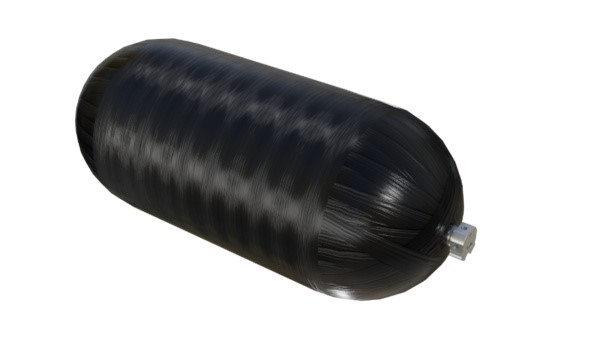
High-pressure hydrogen storage cylinders are commonly classified into four types according to their liner and reinforcement structures. The classification reflects how the pressure-bearing structure is constructed and how different materials contribute to mechanical strength and hydrogen containment.
| Cylinder type | Liner structure | Reinforcement | Main characteristics |
|---|---|---|---|
| Type I | All-metal | None | Robust construction but relatively heavy |
| Type II | Metal liner | Partial composite wrapping | Lower weight than Type I, with composite reinforcement around the cylindrical section |
| Type III | Metal liner | Full composite wrapping | High strength and improved gravimetric storage performance |
| Type IV | Polymer liner | Full composite wrapping | Lightweight design and high hydrogen storage potential |
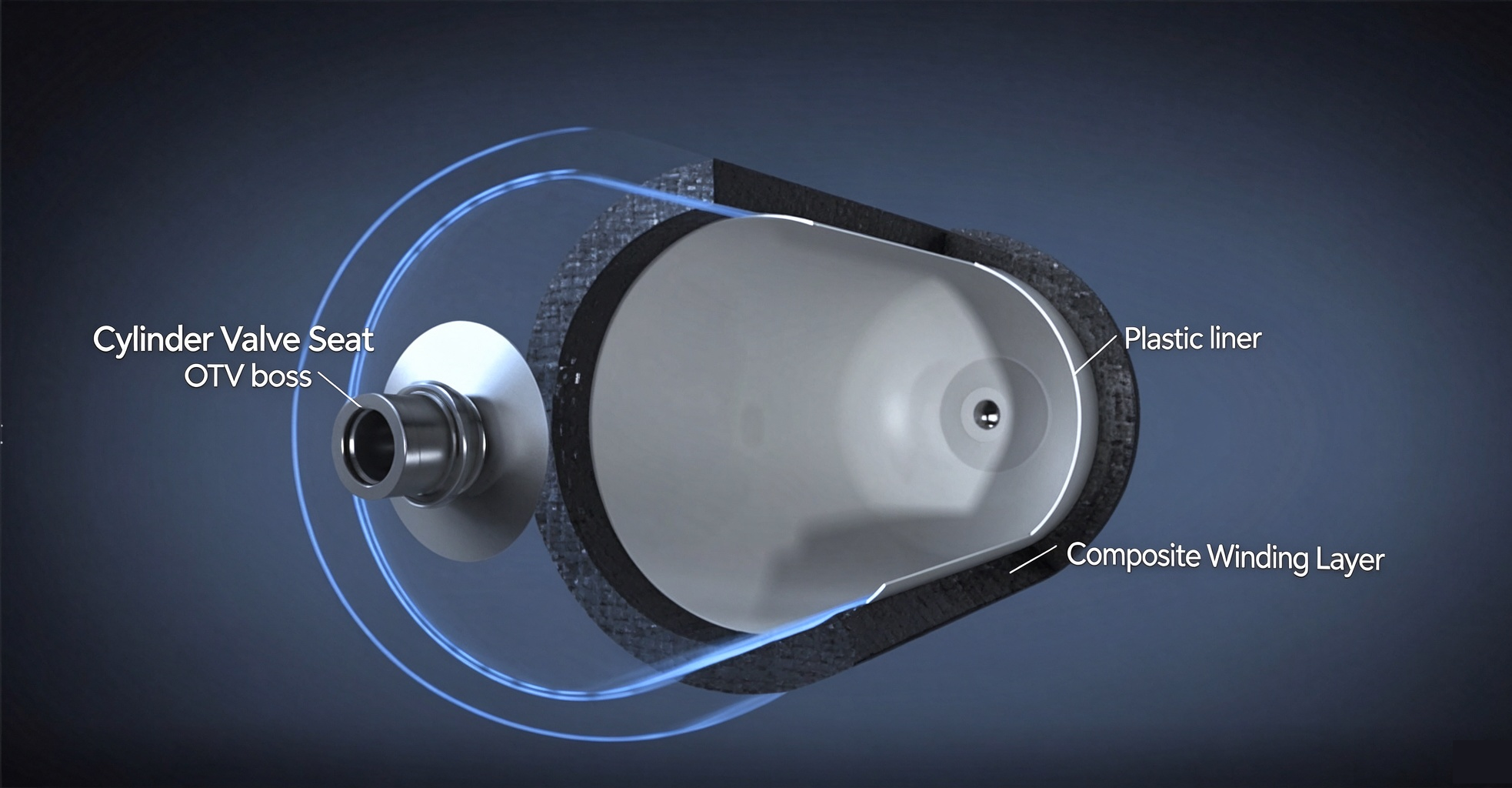
A Type IV cylinder generally consists of three main structural elements:
- Polymer liner: Provides the internal hydrogen containment barrier and helps prevent excessive hydrogen permeation.
- Carbon-fiber composite overwrap: Carries most of the pressure-induced structural load and provides the required strength.
- Metallic boss or valve seat: Provides the connection interface for the cylinder valve and associated high-pressure components.
Unlike Type III cylinders, which use a metallic liner, Type IV cylinders employ a non-metallic liner, commonly manufactured from engineering thermoplastics. This reduces the amount of metal used and can significantly lower the overall cylinder weight.
The carbon-fiber composite structure is particularly important because carbon fibers offer a high strength-to-weight ratio. By carefully controlling fiber orientation, winding tension, resin properties, and laminate thickness, manufacturers can design a cylinder capable of withstanding repeated high-pressure hydrogen filling and discharge cycles.
The main advantage of Type IV technology is its potential to improve gravimetric hydrogen storage capacity without compromising the pressure resistance required for vehicle applications.
Traditional metallic cylinders are limited by the weight of their pressure-bearing walls. Although Type III cylinders reduce this limitation through composite reinforcement, their metal liners still contribute considerable mass. Type IV designs further reduce structural weight by replacing the metallic liner with a polymer-based component.
Other advantages include:
- Reduced cylinder mass and improved vehicle payload potential.
- Greater flexibility in structural and material design.
- Potential improvements in hydrogen storage capacity per unit of cylinder weight.
- Compatibility with high-pressure onboard storage systems.
- Opportunities for automated composite manufacturing and production optimization.
Nevertheless, Type IV technology also introduces specific engineering challenges. Polymer liners have different hydrogen permeability, thermal expansion, mechanical deformation, and rapid-decompression characteristics from metallic liners. Manufacturers must therefore optimize the complete cylinder structure rather than simply replace a metal liner with plastic.
Weishi Energy reports that its independently developed second-generation Type IV hydrogen storage cylinder has achieved a gravimetric hydrogen storage density of 6.1 wt%.
The reported product is designed for onboard hydrogen storage systems in passenger fuel cell vehicles and has the following specifications:
| Parameter | Reported specification |
|---|---|
| Cylinder generation | Second generation |
| Cylinder type | Type IV |
| Nominal working pressure | 70 MPa |
| Water volume | 57 L |
| Gravimetric hydrogen storage density | 6.1 wt% |
| Main reinforcement material | Carbon-fiber composite |
| Primary liner material | Polymer |
| Target application | Fuel cell passenger vehicles |
The 70 MPa working pressure is consistent with the high-pressure storage approach widely used in modern fuel cell passenger vehicles. Compared with 35 MPa systems, 70 MPa storage allows more hydrogen to be stored within a given geometric volume, although it also places greater demands on the cylinder, valve, seals, fittings, and refueling infrastructure.
The reported 6.1 wt% result is particularly noteworthy because it exceeds the U.S. Department of Energy's commonly referenced 2025 target of 5.5 wt% for onboard hydrogen storage systems. However, the measurement boundaries must be clearly understood. DOE's target refers to system-level gravimetric capacity, which includes the complete storage system rather than only the pressure vessel. A cylinder-level result and a system-level target are therefore not directly interchangeable.
For manufacturers and vehicle integrators, the more meaningful comparison should include the complete onboard system, its usable hydrogen capacity, and the mass of all components necessary for safe operation.
Gravimetric storage density describes the proportion of hydrogen mass relative to the total mass of the defined storage unit.
A simplified expression is:
Gravimetric hydrogen storage density = Hydrogen mass ÷ Total storage-unit mass × 100%
For example, if a storage unit contains 6.1 kg of hydrogen and the total mass of the unit is 100 kg, its gravimetric storage density is 6.1 wt%.
However, manufacturers must specify exactly what is included in the calculation. The cylinder alone, the cylinder with its valve, and the complete vehicle storage system can produce different values.
The distinction is important for several reasons:
- Vehicle range: More hydrogen stored within a given system mass can potentially increase driving range.
- Payload capacity: A lighter storage system can reduce the weight penalty associated with hydrogen-powered commercial vehicles.
- Packaging: Improved storage performance can help vehicle manufacturers optimize available installation space.
- Energy efficiency: Lower vehicle mass can reduce energy consumption under comparable operating conditions.
- Operating economics: Better payload and range characteristics can improve the commercial attractiveness of fuel cell transportation.
Gravimetric density should not be considered in isolation, however. Volumetric storage density, usable hydrogen quantity, filling time, operating temperature, safety performance, and lifecycle cost are equally important when selecting a hydrogen storage solution.
The reported performance of Weishi Energy's second-generation cylinder is associated with developments in materials, structural design, and manufacturing processes. These three areas are closely interconnected: advanced materials create new design possibilities, optimized structures make better use of material properties, and improved manufacturing processes help translate theoretical performance into consistent production quality.
The polymer liner is one of the most important components of a Type IV hydrogen cylinder. Although it does not carry the majority of the pressure load, it plays a critical role in hydrogen containment, dimensional stability, and the durability of the cylinder.
Hydrogen molecules are extremely small and can diffuse through polymer materials. Consequently, the liner must provide sufficiently low hydrogen permeability while maintaining mechanical integrity under repeated pressure and temperature changes.
Important liner material properties include:
- Low hydrogen permeability.
- High resistance to hydrogen-induced degradation.
- Adequate tensile strength and ductility.
- Good dimensional stability.
- Resistance to rapid decompression damage.
- Compatibility with the manufacturing process.
- Reliable bonding or mechanical interaction with the composite overwrap.
Engineering thermoplastics such as high-density polyethylene and polyamide-based materials are frequently considered in Type IV cylinder development. The final material selection depends on the required pressure, operating temperature, permeation limits, manufacturing method, and service-life expectations.
A particularly difficult challenge is maintaining liner stability during rapid hydrogen discharge. Hydrogen can permeate into the polymer during high-pressure operation. If the pressure inside the cylinder decreases rapidly, the hydrogen trapped within the liner may not escape at the same rate. This can generate internal stresses and cause blistering, cracking, or deformation.
Research reviews identify hydrogen permeation and rapid decompression as important factors contributing to liner collapse in Type IV vessels. These problems demonstrate why liner design must account for both normal operating conditions and abnormal pressure-release scenarios.
A polymer liner must maintain its intended geometry throughout the cylinder's service life. Manufacturing defects, uneven wall thickness, residual stress, and insufficient structural support can increase the likelihood of deformation.
Weishi Energy reports that it has focused on the selection of polymer raw materials and the control of liner behavior during hydrogen discharge. The company also describes the development of injection-molded and welded liner manufacturing processes to improve dimensional consistency.
The engineering objectives include:
- Maintaining uniform liner thickness.
- Reducing residual stresses introduced during molding and joining.
- Preventing wrinkles and local buckling.
- Improving dimensional stability under repeated pressure changes.
- Maintaining a reliable interface between the liner and the composite structure.
A stable liner helps protect the overall cylinder structure and supports consistent performance across different production batches.
Carbon fiber is another critical material in Type IV hydrogen storage cylinders. The composite overwrap carries the majority of the mechanical load generated by internal hydrogen pressure.
Carbon-fiber reinforcement offers several advantages:
- High tensile strength.
- Low density.
- High specific stiffness.
- Good fatigue performance when properly designed.
- Flexibility in fiber orientation and laminate configuration.
However, carbon-fiber performance depends on more than the nominal fiber strength. The resin matrix, fiber volume fraction, impregnation quality, curing conditions, and interface between the fiber and resin all influence the final composite properties.
Weishi Energy reports that it has developed high-strength fiber prepreg and corresponding resin formulations through cooperation with domestic universities, research institutes, and supply-chain partners.
Prepreg is a reinforcement material that has been pre-impregnated with a controlled amount of resin. Compared with conventional wet winding, prepreg technology offers better control over resin distribution and can reduce manufacturing variability when the process is properly managed.
For pressure vessel manufacturers, this control is essential. Uneven resin content, fiber misalignment, voids, and inconsistent curing can create local weaknesses that affect burst strength and fatigue life.
The development of domestic material supply chains is also strategically important. Carbon fiber, resin systems, polymer liner materials, and high-pressure valves can represent significant portions of a Type IV cylinder's manufacturing cost.
Dependence on imported materials may expose manufacturers to:
- International price fluctuations.
- Longer procurement lead times.
- Supply-chain interruptions.
- Foreign technical restrictions.
- Difficulties in controlling product consistency.
- Higher production and inventory costs.
Weishi Energy reports that its Type IV product family has achieved full domestic control of key technologies and localization of critical materials and components, including carbon fiber, cylinder valves, and liners.
The company also reports a 20% reduction in overall cost. This figure should be understood as a company-reported result rather than an independently verified industry-wide cost reduction. Nevertheless, localization can create meaningful opportunities to improve supply-chain resilience and manufacturing economics.
The cylinder boss is a critical interface between the pressure vessel and its high-pressure valve. It must provide a secure mechanical connection while maintaining reliable hydrogen sealing under demanding service conditions.
This area is particularly challenging because the metallic boss and the composite structure have different mechanical and thermal properties. Pressure cycling, temperature changes, vibration, and external impacts can create complex stresses around the connection.
A poorly designed boss interface may lead to:
- Hydrogen leakage.
- Seal degradation.
- Local stress concentration.
- Relative movement between the boss and liner.
- Damage to the surrounding composite structure.
Weishi Energy reports that it has developed an integrated connection design involving the liner, metal boss, and sealing interface. The design reduces the number of conventional connecting components and uses a more direct structural arrangement.
The company also reports that its lightweight boss design reduces component weight by approximately 40% compared with competing products.
This type of weight reduction can contribute to overall gravimetric performance, but it must be achieved without compromising mechanical strength, sealing reliability, or resistance to external loads.
The cylinder boss must remain securely positioned throughout the product's service life. Internal pressure and vehicle vibration can generate forces that challenge the boss-to-liner interface.
An effective design must therefore address:
- Axial movement.
- Rotational displacement.
- Local deformation.
- Stress concentration around the boss.
- Load transfer between metallic and composite materials.
The boss profile, interface geometry, liner structure, and composite winding arrangement must be designed together.
Finite element analysis (FEA) is widely used to evaluate these complex interactions. By simulating pressure loads, temperature changes, and mechanical constraints, engineers can identify high-stress regions and optimize the structure before physical testing.
The use of FEA does not replace experimental validation. Instead, it helps reduce design iterations and provides a more systematic basis for determining safety margins.
The winding structure of a Type IV cylinder has a major influence on its pressure-bearing capability.
Carbon fibers are highly anisotropic: their mechanical properties are much stronger along the fiber direction than across it. Therefore, the winding angle and layer sequence must be carefully selected to match the stress distribution within the cylinder.
A typical composite cylinder includes:
- Hoop-oriented reinforcement around the cylindrical section.
- Helical reinforcement extending across the cylinder body and dome regions.
- Multiple layers with different winding angles.
- A resin matrix that transfers loads between fibers and protects the reinforcement.
The cylindrical section and dome sections experience different stress conditions. A winding pattern that is suitable for the straight cylindrical portion may not provide optimal reinforcement around the end domes.
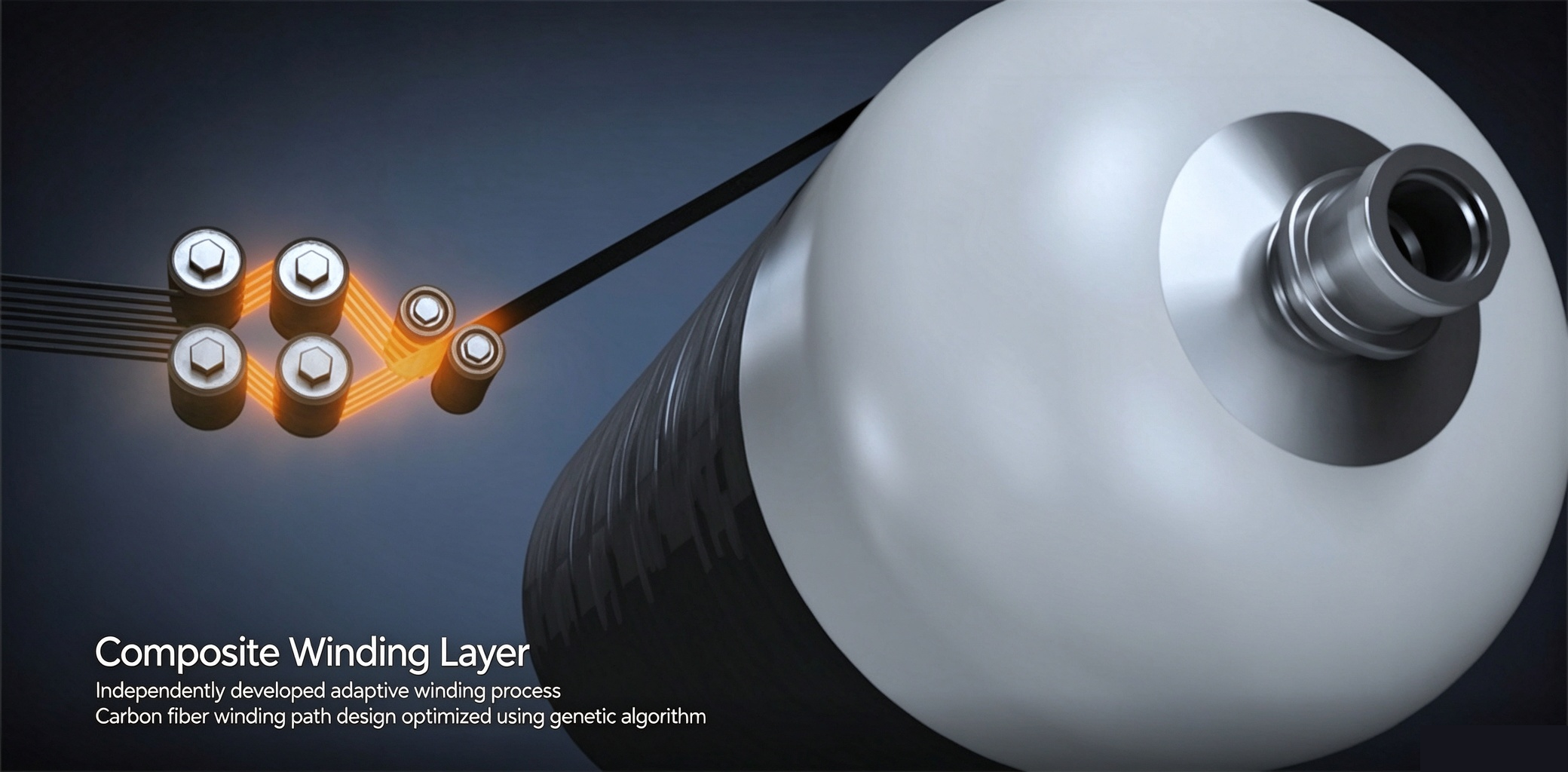
Weishi Energy reports using genetic algorithms and simulation software to optimize winding angles and laminate sequences.
Genetic algorithms are optimization methods inspired by natural selection. They can evaluate numerous design combinations and identify promising configurations based on defined objectives and constraints.
For Type IV cylinders, optimization may consider:
- Minimum composite mass.
- Required burst pressure.
- Pressure-cycle durability.
- Fiber utilization efficiency.
- Local stress distribution.
- Manufacturing feasibility.
- Structural reliability.
The objective is not simply to minimize the amount of carbon fiber. It is to achieve the required mechanical performance with an efficient and repeatable composite structure.
Composite pressure vessels are commonly manufactured through filament winding, in which continuous reinforcing fibers are placed around a liner according to a predetermined pattern.
In conventional wet winding, dry fibers pass through a resin bath before being wound onto the liner. The resin is applied during the winding operation.
In dry winding using prepreg, the fibers have already been impregnated with resin before entering the winding process. The prepreg is then applied directly to the liner according to the specified winding pattern.
This approach can improve resin-content control and reduce the handling of liquid resin during production.
Weishi Energy reports that it has adopted a dry-winding process using carbon-fiber prepreg for its second-generation Type IV cylinders.
According to the supplied company information, the dry-winding process has delivered several manufacturing improvements:
| Performance indicator | Reported result |
|---|---|
| Variation coefficient of product performance indicators | 2%–3% |
| Winding efficiency | More than 80% higher than wet winding |
| Curing time | Reduced by approximately 30% |
| Fatigue test cycles | More than 44,000 cycles |
| Resin handling | No dripping or leakage reported during winding |
These figures are company-reported results. Their interpretation depends on the exact testing methods, production conditions, comparison baseline, and definition of each performance indicator.
Even so, they illustrate the potential advantages of process innovation.
One of the main manufacturing challenges in composite pressure vessels is maintaining consistent fiber placement.
Variations in winding angle, tension, overlap, resin content, and layer thickness can produce uneven structural properties. Such defects may become particularly important in high-pressure applications because local weaknesses can affect the vessel's burst strength and fatigue performance.
A well-controlled dry-winding process can help manufacturers improve:
- Fiber placement accuracy.
- Resin-content consistency.
- Composite thickness control.
- Winding repeatability.
- Production efficiency.
- Surface cleanliness.
The reported 2%–3% variation coefficient is therefore an important indicator to investigate. However, manufacturers should clarify which performance indicators were included in the calculation and whether the result represents laboratory samples, pilot production, or serial manufacturing.
Curing is an essential stage in composite cylinder production. The resin must develop the required mechanical properties and establish a stable composite structure.
Long curing cycles can restrict production capacity and increase energy consumption. Reducing curing time without compromising resin performance can therefore improve manufacturing economics.
Weishi Energy reports that its dry-winding process reduces curing time by approximately 30%.
The actual benefit will depend on the resin formulation, curing temperature, oven configuration, cylinder dimensions, and production-line scheduling.
Manufacturers must also ensure that shorter curing cycles do not introduce incomplete curing, residual stress, void formation, or reduced interlaminar strength.
The manufacturing process for the polymer liner is equally important.
Weishi Energy reports using an injection-molding and welding process to produce its liners. The stated objectives include improving wall-thickness uniformity and dimensional stability.
Compared with processes that rely on less controlled liner forming, a carefully designed injection-molding process can offer advantages in dimensional repeatability and integration of complex geometries.
Welding introduces another engineering requirement: the joint must maintain sufficient mechanical integrity and hydrogen barrier performance under repeated pressure and temperature changes.
Important validation items include:
- Weld strength and joint integrity.
- Wall-thickness distribution.
- Dimensional tolerances.
- Residual stress.
- Hydrogen permeability.
- Resistance to pressure cycling.
- Long-term stability under service conditions.
A high-quality liner is essential because defects in this component can affect the performance of the entire composite vessel.
Hydrogen storage at 70 MPa places demanding requirements on pressure vessels and associated components.
Higher pressure can increase the amount of hydrogen stored within a given volume, but it also increases the mechanical load on the vessel and the demands placed on seals, valves, fittings, and connections.
For a 70 MPa system, engineers must consider:
- Burst resistance.
- Hydrogen leakage and permeation.
- Pressure-cycle fatigue.
- Temperature-related material changes.
- External impact resistance.
- Chemical exposure.
- Fire behavior.
- Valve and boss reliability.
- Long-term structural stability.
The pressure rating alone does not establish the safety of a cylinder. The complete storage system must be designed and validated for its intended operating conditions.
Hydrogen permeation is a particularly important issue for Type IV cylinders because their polymer liners are not completely impermeable to hydrogen.
Hydrogen can gradually diffuse through polymer materials. The permeation rate depends on the material structure, temperature, pressure, thickness, and other environmental factors.
Excessive permeation can create several problems:
- Reduced effective hydrogen retention.
- Potential hydrogen accumulation in enclosed spaces.
- Increased demands on vehicle ventilation and monitoring.
- Long-term changes in liner behavior.
- Greater risk of liner damage under certain pressure-release conditions.
The sealing interface around the cylinder boss is another potential leakage path. A reliable design must therefore consider both permeation through the polymer liner and leakage through joints or connections.
Research published in the International Journal of Hydrogen Energy identifies liner permeability, material properties, and surface characteristics as important factors affecting Type IV vessel durability. A 2026 review further examines how pressure, temperature, humidity, and cyclic loading interact with polymer-liner permeation and failure mechanisms.
Hydrogen cylinders used in vehicles are repeatedly filled and discharged. Every pressure cycle causes changes in the stress state of the liner, composite reinforcement, boss, and sealing interfaces.
Over time, repeated loading can contribute to:
- Matrix cracking.
- Fiber damage.
- Interlaminar separation.
- Liner deformation.
- Boss-interface deterioration.
- Progressive leakage.
The reported fatigue test result of more than 44,000 cycles for Weishi Energy's cylinder is therefore an important performance indicator.
However, a cycle count alone is insufficient to establish full service-life suitability. Engineers need to know the pressure range, cycle rate, temperature conditions, test medium, acceptance criteria, and whether the test was conducted on individual cylinders or complete storage systems.
A meaningful fatigue assessment should also examine the relationship between accelerated laboratory testing and actual vehicle operating conditions.
Fire safety is a fundamental requirement for onboard hydrogen storage systems.
When a high-pressure hydrogen cylinder is exposed to fire, the temperature and pressure inside the vessel can rise. If the pressure increases beyond the vessel's ability to withstand it, catastrophic failure may occur.
Vehicle hydrogen storage systems therefore commonly incorporate a thermally activated pressure relief device (TPRD). The TPRD is designed to release hydrogen under specified thermal conditions, reducing the risk of uncontrolled vessel rupture.
The discharge route must be carefully designed to prevent released hydrogen from accumulating in passenger compartments or other hazardous locations.
Weishi Energy reports that its second-generation Type IV cylinder has completed fire testing, durability testing, and operational performance testing. These are important development milestones, although the precise test standards, results, and certification status should be confirmed before the product is specified for a vehicle program.
International standards and vehicle regulations provide the framework for evaluating compressed hydrogen storage systems.
Relevant references include:
| Standard or regulation | Main focus |
|---|---|
| ISO 19881:2025 | Performance requirements for gaseous hydrogen fuel containers used in land vehicles |
| UN GTR No. 13 | Global technical requirements for hydrogen and fuel cell vehicles, including compressed hydrogen storage safety |
| SAE J2579 | Safety requirements for hydrogen vehicle fuel systems |
| SAE J2578 | General fuel cell vehicle safety considerations |
ISO 19881:2025 is particularly relevant because its second edition was published in June 2025. It establishes performance-based requirements covering the design, materials, manufacturing, testing, and marking of compressed hydrogen fuel containers for land vehicles.
UN GTR No. 13 addresses safety-related performance requirements for hydrogen fuel cell vehicles and their compressed hydrogen storage systems. Its testing framework includes pressure-cycle durability, environmental exposure, leakage-related performance, and fire testing.
Manufacturers should also consider the applicable national regulations and vehicle type-approval requirements in each target market. Compliance with a cylinder standard does not automatically establish approval of the complete vehicle fuel system.
Passenger vehicles generally require compact storage systems that balance driving range, weight, installation space, and cost.
A 70 MPa Type IV cylinder can provide high-pressure hydrogen storage while reducing the weight associated with conventional metallic structures.
For passenger vehicle manufacturers, important selection criteria include:
- Gravimetric and volumetric storage density.
- Available installation space.
- Cylinder dimensions and mounting requirements.
- Refueling performance.
- Operating temperature range.
- Crash protection.
- Service life and inspection requirements.
- Compatibility with vehicle fuel-system components.
Weishi Energy's reported 70 MPa, 57 L cylinder is intended for this application category.
Commercial vehicles have different requirements from passenger cars.
Heavy-duty trucks, buses, and logistics vehicles often need larger hydrogen storage capacity because of their longer operating hours, higher payload requirements, and extended travel distances.
The storage system must also withstand more demanding vibration, road impact, and operating conditions.
Weishi Energy reports plans for a broader Type IV product portfolio covering 35 MPa and 70 MPa working pressures. The planned specifications include 70 MPa–23 L and 35 MPa–210 L products, with some commercial-vehicle cylinders reportedly reaching 6.8 wt% gravimetric storage density.
The higher reported density could be attractive for commercial vehicle applications, where reducing storage-system weight can improve payload efficiency. However, comparisons should account for the cylinder size, pressure rating, hydrogen mass, and measurement boundary.
Fuel cell buses and cold-chain logistics vehicles are potential applications for high-pressure hydrogen storage.
Buses often operate on scheduled routes with predictable refueling requirements. Their storage systems must be designed around roof-mounted or other vehicle-specific installation arrangements, taking account of structural loading, vibration, passenger safety, and maintenance access.
Cold-chain logistics vehicles may operate for long periods while powering both the vehicle drivetrain and auxiliary refrigeration equipment. Their energy requirements can therefore be more demanding than those of conventional delivery vehicles.
For these applications, cylinder selection should consider:
- Required hydrogen consumption per operating shift.
- Vehicle range and refueling frequency.
- Available mounting space.
- Payload and axle-load limitations.
- Environmental temperature.
- Maintenance accessibility.
- Total storage-system cost.
Hydrogen storage technology may also support fuel cell vessels and other specialized transportation applications.
Marine environments introduce additional requirements, including saltwater corrosion protection, vibration resistance, humidity management, mechanical protection, and specialized installation and approval procedures.
A Type IV cylinder developed for road vehicles should not automatically be assumed suitable for marine use. The complete storage system must be evaluated against the applicable marine safety framework and operating environment.
The commercialization of Type IV hydrogen cylinders depends heavily on manufacturing cost.
Carbon fiber is one of the most important cost drivers because the composite overwrap requires a substantial quantity of high-performance reinforcement material. Resin systems, polymer liners, valves, precision manufacturing equipment, inspection procedures, and certification activities also contribute to total cost.
If manufacturers rely heavily on imported materials or components, they may face higher procurement costs and less control over delivery schedules.
Developing domestic alternatives can help reduce these pressures.
Weishi Energy reports that its Type IV cylinder product family has achieved full localization of key materials and components, including carbon fiber, polymer liners, and cylinder valves. The company also reports a 20% reduction in comprehensive cost.
For the broader industry, localization can create several benefits:
- More stable material supply.
- Reduced dependence on overseas suppliers.
- Better coordination between material and cylinder manufacturers.
- Shorter development cycles.
- Improved manufacturing flexibility.
- Greater opportunities for cost optimization.
However, localization must be accompanied by rigorous quality control. Domestic materials should be evaluated according to their actual mechanical properties, hydrogen compatibility, batch consistency, and long-term reliability rather than their origin alone.
A successful prototype does not automatically translate into economical mass production.
Industrial-scale manufacturing requires consistent raw materials, repeatable process parameters, reliable inspection methods, and effective production management.
For Type IV cylinders, key production-control areas include:
| Production stage | Important quality-control factors |
|---|---|
| Polymer material preparation | Material composition, moisture, and batch consistency |
| Liner molding | Wall thickness, dimensions, and residual stress |
| Liner welding | Joint integrity and leak resistance |
| Boss installation | Position accuracy and interface quality |
| Prepreg preparation | Fiber alignment and resin content |
| Composite winding | Winding angle, tension, overlap, and layer thickness |
| Curing | Temperature, time, and resin conversion |
| Final inspection | Leakage, dimensions, traceability, and structural performance |
Automated manufacturing can improve consistency, but it also requires precise process monitoring. For example, winding tension and fiber placement must remain within defined limits throughout production.
A comprehensive quality system should link raw material batches, process parameters, inspection records, and final cylinder identification. This makes it easier to investigate defects and maintain production traceability.
For vehicle manufacturers, hydrogen storage cylinder selection should begin with the actual vehicle operating requirements rather than a single performance figure.
The first decision is whether the application requires a 35 MPa or 70 MPa system.
A 70 MPa system can store more hydrogen within a given volume, which is particularly relevant to passenger vehicles with limited installation space. A 35 MPa system may be suitable for certain commercial vehicle configurations, depending on range, packaging, and refueling infrastructure.
The working pressure must be compatible with the vehicle's fuel system and the available hydrogen refueling infrastructure.
Manufacturers should compare both gravimetric and volumetric storage performance.
Gravimetric capacity indicates how much hydrogen is stored relative to system mass. Volumetric capacity describes how much hydrogen is stored relative to the available installation volume.
A high gravimetric value may not necessarily mean that the cylinder offers the best overall packaging solution. Vehicle designers must balance both parameters.
The polymer liner, carbon-fiber reinforcement, resin system, boss, valve, and seals must all be suitable for the intended hydrogen pressure and temperature conditions.
Particular attention should be paid to:
- Hydrogen permeation.
- Polymer aging.
- Rapid decompression behavior.
- Composite fatigue.
- Resin thermal performance.
- Metallic component compatibility.
- Seal performance.
Before integrating a cylinder into a vehicle, the buyer should request appropriate design-validation and type-approval documentation.
Important evidence includes:
- Burst-pressure test reports.
- Pressure-cycle fatigue results.
- Hydrogen leakage and permeation data.
- Fire test results.
- Environmental exposure testing.
- Impact and damage resistance testing.
- Production quality-control records.
- Applicable certification documents.
The test conditions and acceptance criteria should be reviewed rather than relying solely on headline performance figures.
The purchase price is only one part of the total cost of ownership.
A lighter cylinder may improve vehicle payload and energy efficiency, while a longer service life can reduce replacement costs. Conversely, a technically advanced product may require additional inspection, specialized installation, or more expensive associated components.
Buyers should therefore compare:
- Initial cylinder cost.
- Complete storage-system cost.
- Installation and integration expenses.
- Inspection and maintenance requirements.
- Expected service life.
- Replacement and disposal costs.
- Vehicle efficiency and payload benefits.
Increasing hydrogen storage density will remain an important development objective.
The DOE's 2025 onboard storage target specifies a system gravimetric capacity of 5.5 wt%, while its ultimate target is 6.5 wt%. These targets are intended to guide the development of practical onboard storage systems rather than individual pressure vessels.
Future improvements will likely depend on lighter structural components, higher-performance carbon fibers, optimized composite winding patterns, and improved integration of valves and mounting hardware.
At the same time, manufacturers must continue improving volumetric capacity and usable hydrogen delivery.
Polymer liner technology will remain a major research area.
Future development is likely to focus on materials with lower hydrogen permeability, better resistance to rapid decompression, improved thermal stability, and greater dimensional consistency.
Material modification, multilayer structures, polymer blends, and nanocomposite approaches may offer opportunities to improve hydrogen barrier performance.
However, any new material must be evaluated for long-term compatibility with high-pressure hydrogen and the manufacturing process used to produce the liner.
Dry winding and automated prepreg handling may become increasingly important as production volumes increase.
Potential development directions include:
- More precise automated fiber placement.
- Improved winding-tension control.
- Faster and more energy-efficient curing.
- Better resin formulations.
- Automated inspection of composite layers.
- Digital monitoring of manufacturing parameters.
- More effective defect detection.
These improvements can help manufacturers reduce production costs while maintaining the quality and consistency required for high-pressure applications.
The future competitiveness of hydrogen storage will depend on system-level optimization.
Cylinder manufacturers, valve suppliers, fuel-cell developers, and vehicle manufacturers will need to coordinate their designs more closely.
The objective is to reduce unnecessary weight and complexity while improving safety, installation efficiency, and maintainability.
Integrated design may also help optimize the relationship between the cylinder, valve, pressure regulator, mounting brackets, thermal protection, sensors, and vehicle fuel-delivery system.
The reported 6.1 wt% gravimetric hydrogen storage density of Weishi Energy's second-generation 70 MPa Type IV cylinder represents an important development in China's high-pressure hydrogen storage industry. Its reported improvements in polymer liner technology, carbon-fiber prepreg, boss structure, and dry-winding manufacturing demonstrate how coordinated innovation across materials, structural engineering, and production processes can improve cylinder performance.
The company's planned product portfolio, including 35 MPa and 70 MPa models and commercial-vehicle applications, also reflects the growing demand for different hydrogen storage solutions across transportation sectors. Reported domestic sourcing of key materials and components, together with a claimed 20% cost reduction, points to the potential benefits of a more localized supply chain.
Nevertheless, high gravimetric storage density is only one part of the commercialization equation. Hydrogen permeation, rapid decompression, pressure-cycle fatigue, fire safety, manufacturing consistency, certification, and complete system cost must all be addressed before a product can achieve widespread vehicle deployment.
As international standards continue to evolve and hydrogen transportation markets develop, Type IV cylinders are likely to play an increasingly important role in onboard hydrogen storage. The companies that can combine lightweight design, verified safety, reliable mass production, and competitive lifecycle costs will be best positioned to support the next stage of hydrogen mobility.