
Role of Deformation Degree in Optimizing Forging Quality
Forging is a critical metal forming process widely applied in industries such as automotive, aerospace, and energy equipment. During forging, the shape and dimensions of a metal workpiece undergo significant changes, and the extent of these changes is referred to as the forging deformation degree. The magnitude of deformation directly determines the internal microstructure and mechanical properties of the forging, including strength, hardness, toughness, and fatigue life. However, a higher deformation degree is not necessarily better: excessive deformation may lead to material embrittlement, whereas insufficient deformation fails to eliminate casting defects. Therefore, accurately understanding the mechanism of forging deformation and mastering its control methods are crucial for improving forging quality and reducing production costs. This article systematically analyzes the influence of deformation degree on forging performance and introduces practical control strategies used in production.
Definition and Measurement of Forging Deformation Degree
The forging deformation degree refers to the extent to which the shape and dimensions of a workpiece change during the forging process. In practice, technicians quantify deformation degree using parameters such as reduction ratio, strain, or percentage deformation. These parameters provide an objective reflection of the plastic changes occurring in the metal under applied pressure.
The required deformation degree varies with the forging method, equipment type, and specific part requirements. For instance, the deformation distribution in open-die forging differs significantly from that in closed-die forging, and large forgings have different deformation control requirements compared to small components. Regardless of the method, the deformation degree directly affects the final properties of the workpiece, making its accurate understanding and control a core aspect of forging technology.
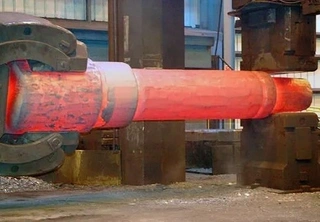
Forging Methods and Their Deformation Requirements
Different forging methods impose different requirements on the deformation degree. Open-die forging is suitable for large or simply shaped workpieces and typically requires a higher deformation degree, achieved through multiple upsetting and stretching operations to break up casting microstructures. Closed-die forging is more appropriate for batch production of medium to small parts, with deformation concentrated within the die cavity to ensure complete filling of all regions. Specialized forging processes, such as isothermal forging or powder forging, demand even more precise deformation control, often requiring specific amounts of deformation within controlled temperature ranges to achieve desired microstructural properties.
Effects of Forging Deformation Degree on Mechanical Properties
Changes in forging deformation degree are first reflected in the mechanical properties of the forged component. From strength and hardness to ductility, toughness, and fatigue life, the influence of deformation degree on these core properties varies, necessitating careful balance during process design. The following sections analyze these effects in detail.
1. Improvement in Strength and Hardness
As the forging deformation degree increases, the internal grain structure of the metal is refined, and dislocation density rises. These microstructural changes significantly enhance material strength and hardness. For steel forgings, higher deformation degrees create finer grain structures, improving yield strength, tensile strength, and hardness. This property is particularly important for applications requiring high strength and wear resistance, such as automotive components and aerospace structural parts.
Specifically, under high pressure and strain during forging, coarse initial grains are broken and rearranged into a denser and more uniform microstructure. The increased dislocation density strengthens the material’s resistance to external deformation, manifesting as increased macroscopic strength and hardness. Therefore, for components subjected to high loads, such as gears, shafts, and connecting rods, appropriately increasing the forging deformation degree is an effective means to ensure load-bearing capacity.
2. Effects on Ductility and Toughness
While a higher deformation degree enhances strength and hardness, it may simultaneously reduce ductility and toughness. High dislocation density and refined grains hinder dislocation motion, making the material less capable of plastic deformation under subsequent loads. When a component must absorb impact energy or endure large deformations without fracturing, excessive deformation can be detrimental.
In practice, forging deformation must be carefully controlled to achieve a balance between strength, ductility, and toughness. This balance is not fixed but depends on the specific application. For example, construction structural components may prioritize toughness to withstand seismic loads, whereas cutting tools focus on hardness to maintain sharpness. Engineers must establish appropriate deformation ranges based on material characteristics and component function.
3. Enhancement of Fatigue Performance
The deformation degree also significantly affects fatigue performance. Higher deformation refines grains, reduces defect size, and improves residual stress distribution, making the microstructure more uniform. These changes help inhibit crack initiation and propagation, thereby extending fatigue life.
Under cyclic loading, component failure often originates at stress concentration points. Forging deformation disperses inclusions, refines grain boundaries, and alleviates stress concentration. Proper deformation can also induce beneficial residual compressive stresses at the surface, counteracting external tensile stresses and slowing fatigue crack growth. Consequently, forged components with well-controlled deformation are ideal for gears, shafts, and connecting rods that endure repeated cyclic loading.
Effects of Forging Deformation Degree on Microstructure
The changes in mechanical properties stem from the evolution of microstructure. The forging deformation degree affects grain refinement, phase transformations, and residual stress distribution, determining the intrinsic quality of the forging.
1. Grain Refinement Mechanism
During forging, metals are subjected to high pressure and strain, causing grain deformation and dynamic recrystallization. With increasing deformation degree, grains are broken into smaller, more uniform sizes, forming a refined grain structure. This process occurs throughout the material, provided the deformation is sufficient and temperature is properly controlled.
Refined grains improve strength, hardness, ductility, fatigue resistance, and corrosion and creep resistance. This makes heavily deformed forgings suitable for high-temperature, high-pressure, or corrosive environments. For example, forgings used in petrochemical equipment often require sufficient deformation to achieve refined grains, ensuring long-term reliability.
2. Phase Transformation Control
The deformation degree can also induce phase transformations. In some steels, high deformation promotes the formation of hard phases like martensite, increasing hardness and strength. However, such transformations may reduce ductility and toughness, and uncontrolled deformation can cause brittle fracture in service.
Therefore, in materials prone to phase changes, controlling deformation degree must be coupled with precise temperature management. Understanding the critical transformation temperature ranges is essential to avoid excessive deformation within sensitive zones. By controlling deformation and cooling rate, desired phase transformations can be achieved, producing components that balance strength and toughness.
3. Residual Stress Distribution
Forging deformation also affects residual stress distribution. Excessive deformation can generate complex residual stresses, which have both positive and negative effects. Appropriate compressive residual stress enhances fatigue performance by hindering crack propagation, while excessive tensile residual stress reduces strength and ductility, increasing susceptibility to stress corrosion cracking.
Residual stress control depends not only on deformation degree but also on post-deformation cooling and heat treatment. For large forgings, slow cooling due to large cross-sections leads to complex residual stresses, often requiring stress-relief annealing or tempering to ensure dimensional stability and safety.
Distribution Patterns of Forging Deformation
Beyond the magnitude, the uniformity of deformation distribution within a forging is critical. Factors such as friction and material constraints lead to non-uniform deformation, impacting local microstructure and properties.
1. Causes of Non-uniform Deformation
Internal deformation is rarely uniform, primarily due to boundary friction and material constraints. Friction at the die-workpiece interface hinders free metal flow, causing surface deformation to be less than that at the core or creating distinct deformation zones.
This is pronounced in billets, cylinders, and shaft-type forgings, where severe shear zones form between high-deformation regions and rigid undeformed regions, directly affecting internal quality and final performance.
2. Formation and Movement of Shear Zones
As deformation progresses, stress distribution changes, and shear zones move as previously rigid areas enter plastic deformation. During pressing, the shear zone between the die-contacting rigid region and the central high-deformation region undergoes intense strain. Once deformation reaches a critical value, the originally rigid zone yields, rapidly increasing load. Improper process control at this stage can propagate defects.
Understanding shear zone formation and movement helps optimize process parameters such as deformation rate, amount, and pass distribution, reducing internal defects and improving overall forging quality.
3. Relationship Between Inclusions and Cracks
At the microscopic level, the morphology and distribution of inclusions directly influence local stress concentration. In non-uniform deformation areas, combined shear deformation and local stress can cause the matrix between inclusions to fracture. Micro-cracks around inclusions may coalesce into larger cracks, explaining why central layers of billets often show defects. In large forgings, inclusions and coarse grain boundaries are major damage sources.
Research indicates three primary crack types occur between 800°C and 1200°C: void formation and coalescence around inclusions, inclusion-matrix separation along interfaces, and intergranular cracks propagating along grain boundaries. Understanding these mechanisms aids in preventive process design to reduce defects and improve mechanical properties.
Common Defects Due to Improper Deformation
If deformation degree is not properly controlled, various internal and external defects may arise. These include microstructural defects (e.g., coarse grains, cold hardening), morphological defects (e.g., cracks, folds), and dimensional defects (e.g., disturbed flow lines, misalignment).
1. Coarse Grains and Cold Hardening
Coarse grains typically result from excessive initial forging temperature, insufficient deformation, or final forging at temperatures producing critical deformation. They reduce strength and toughness, increasing the risk of brittle fracture.
Cold hardening occurs when forging temperature is too low, deformation speed too high, or cooling too fast. Recrystallization cannot keep pace with strain hardening, producing regions with high hardness but low ductility, prone to cracking, and requiring post-forging annealing.
2. Cracks and Folds
Cracks are serious defects caused by high tensile or shear stress during forging, microcracks in the billet, improper temperature, or excessive deformation. Folds occur when oxidized surface metal layers are pressed together during flow, forming stress concentrators and potential fatigue crack origins.
3. Disturbed Flow Lines and Dimensional Errors
Non-uniform flow lines, misalignment along parting planes, or deviations in geometry result from poor die design, improper process, or incorrect handling. Such errors reduce anisotropic control of mechanical properties and may compromise assembly and function.
Methods to Reasonably Control Forging Deformation
After understanding the influence mechanisms and common defects, controlling the deformation degree is critical. Control spans material selection, process design, and quality inspection.
1. Importance of Material Selection
Different metals respond differently to forging deformation. Ductile metals like aluminum and copper can withstand large deformations to refine grains, while brittle materials like titanium alloys and high-strength steels require smaller incremental deformations to prevent cracking. Knowledge of chemical composition, phase transformation, and high-temperature mechanical behavior is essential to establish optimal deformation ranges.
2. Forging Process Design Considerations
Process design involves selecting the appropriate forging method, forging temperature, and die geometry. Temperature management is crucial: high temperatures reduce flow stress and enhance ductility but risk oxidation and grain growth. Die design should ensure uniform metal flow to minimize harmful shear zones. Deformation speed and pass distribution must be carefully planned to avoid cold hardening or cracking.
3. Quality Control and Inspection Methods
Quality control includes raw material inspection, process monitoring, and post-forging detection. Techniques such as ultrasonic testing, magnetic particle inspection, and radiographic testing identify internal defects, while mechanical testing (tensile, hardness, fatigue) ensures performance. For large forgings, introducing deformation rate concepts and multi-pass incremental forging achieves uniform structure and high property levels.
Conclusion
Forging deformation degree is a key factor affecting mechanical properties, microstructure, and service life. From grain refinement to phase transformation, strength enhancement, and fatigue improvement, proper deformation significantly improves material performance. However, higher deformation is not always better; an optimal balance must be struck among strength, toughness, fatigue resistance, and other properties. By understanding deformation distribution, preventing common defects, selecting materials wisely, and precisely controlling process parameters, manufacturers can produce high-quality forgings for demanding applications. As the manufacturing industry evolves, precise control of forging deformation remains central to enhancing quality and reducing production costs.
Send your message to this supplier
Related Articles from the Supplier
Role of Temperature Control in Metal Forging
- Mar 11, 2026
The Role of Tie Rod Ends in Vehicle Steering
- Jul 18, 2024
The Role of Forgings in Pressure Vessel Safety
- Dec 02, 2025

3D Printing Plays a Key Role in Large Forgings
- Apr 18, 2016
Forging Pickling Process and Its Key Role
- Feb 21, 2025
Related Articles from China Manufacturers

Role of Packing Seals in Chemical Control Valves
- Nov 17, 2025

The Role of the Flange in Pipeline Equipment
- Jun 27, 2016
Related Products Mentioned in the Article

Supplier Website
Source: http://www.creatorcomponents.com/news/role-of-deformation-degree-in-optimizing-forging-quality.html